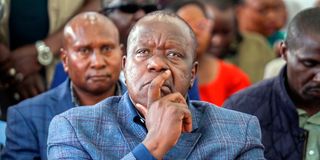
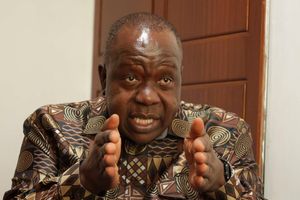
When former Interior Cabinet Secretary Fred Matiang'i sat down for NTV's Fixing the Nation last year, he appeared determined to put to rest one of the most controversial episodes of his decade in government.
The former Education Cabinet Secretary dismissed claims surrounding the Ruaraka land compensation saga as politics disguised as accountability.
"Let us not confuse people on account of politics. The court decided this matter six years ago," he said.
This week’s Court of Appeal judgment declaring that the land occupied by Ruaraka High School and Drive-In Primary School is public land has dramatically altered both the legal and political landscape, thrusting the former powerful Cabinet minister into what could become one of the defining battles of his presidential bid.
Although the court did not find Dr Matiang'i personally liable, its affirmation that the compulsory acquisition was unlawful has revived scrutiny of decisions taken during his tenure as Education Cabinet Secretary and handed his political rivals fresh ammunition just as he attempts to convince Kenyans that he represents competent, decisive leadership.
For a candidate whose campaign revolves around restoring efficiency in government, the Ruaraka judgment presents perhaps his biggest political test yet.
The Court of Appeal upheld an earlier Environment and Land Court decision that declared the compulsory acquisition of about 13.5 acres occupied by the two public schools unlawful and nullified the Sh1.5 billion compensation paid to firms claiming ownership of the land.
The judgment reinforced investigations by the Ethics and Anti-Corruption Commission (EACC), which concluded that the land had already been surrendered to the government during the subdivision of LR No. 7879/4 and had therefore become public land reserved for public utilities.
According to the court, there was no legal basis for the National Land Commission (NLC) to compulsorily acquire land that already belonged to the government. That ruling has now triggered a fresh chapter.
The EACC has announced plans to recover the Sh1.5 billion already paid to Afrison Export Import Limited and Huelands Limited through Whispering Palms Estate Limited, while also forwarding investigation files to the Director of Public Prosecutions for consideration of criminal charges against public officials and other individuals involved in processing the compensation.
The anti-graft agency has further advised the Ministry of Education and the National Land Commission to issue title deeds for the school land to permanently secure public ownership.
The legal consequences may primarily affect institutions and individuals directly involved in processing the compensation.
Politically, however, the ruling has reopened questions that Dr Matiang'i had hoped were settled years ago.
Jubilee Presidential hopeful Dr Fred Matiang'i in Borabu, Nyamira County on April 24, 2026.
Photo credit: Ruth Mbula | Nation Media Group
But Dr Matiang’i insists that critics are deliberately ignoring how compulsory acquisition works under Kenya's legal framework.
Appearing on NTV, he argued that the Ministry of Education neither initiated the acquisition nor determined ownership of the disputed land.
Instead, he maintained, the ministry's involvement was limited to confirming that the schools served a public purpose.
"The only thing the Ministry of Education did was to confirm the public interest," he said. "The only question that the National Land Commission asked us was whether there is public interest in the school."
He argued that questions relating to ownership and compensation were matters handled by constitutionally mandated institutions rather than the Education ministry.
His defence finds support in testimony given by former Basic Education Principal Secretary Belio Kipsang before the courts.
Dr Kipsang told the court that the Ministry of Education accepted the National Land Commission's advice because the commission held the constitutional mandate to verify land ownership before recommending compulsory acquisition.
He said the ministry believed due diligence had been undertaken and that the institutions claiming ownership possessed valid instruments of title.
The ministry therefore relied on the NLC's recommendation in supporting acquisition. That process eventually resulted in the payment of Sh1.5 billion in 2018, while an additional Sh1.7 billion remained pending.
Biggest governance controversies
Yet what began as an administrative exercise soon evolved into one of the country's biggest governance controversies.
Parliament questioned why taxpayers were compensating private entities for land many believed had already become public property.
Faced with conflicting positions from different public institutions, the National Land Commission itself sought the intervention of the Environment and Land Court to determine fundamental questions surrounding ownership, compulsory acquisition and entitlement to compensation.
Those questions have now been answered by the Court of Appeal. Even so, the political debate is unlikely to end in the courtroom.
Dr Matiang'i has repeatedly argued that if evidence exists against any individual, investigators should pursue the matter through established legal institutions instead of political rallies.
"If I know someone stole, I go to the DCI and say, here is the evidence—arrest him. I do not shout from a political platform. "If there was fraud, the law is clear. Recover the land. Recover the payment," he said during a recent interview with Nation.
Unlike many politicians focusing on constitutional reforms or new laws, Dr Matiang'i argues that Kenya's biggest challenge is ineffective leadership.
"Kenya's problem is not money. It is not climate change. It is not people," he has said. "Kenya's problem is leadership."
Supporters argue that his record in government demonstrates precisely the kind of decisive leadership the country requires.
They cite his role in ending examination cheating, implementing digital migration, reforming security coordination and enforcing public sector discipline.
His admirers portray him as a technocrat who consistently delivered difficult reforms despite political resistance.
Critics, however, see the same record differently. To them, Ruaraka raises broader questions about oversight, accountability and leadership at the highest levels of government.
Even if institutions such as the National Land Commission bore primary responsibility for acquisition, critics argue that senior Cabinet officials cannot entirely escape political responsibility for decisions made under their watch.
Having secured the Jubilee Party presidential ticket, Dr Matiang'i is positioning himself as one of the principal challengers to President William Ruto in 2027 while also navigating complex negotiations within the opposition alliance over the possibility of a single presidential candidate.
His campaign has increasingly centred on competence, managerial efficiency and institutional discipline. Ruaraka now threatens to complicate that narrative.
Dr Matiang'i, however, appears determined to keep returning to one central argument—that institutions acted within their constitutional mandates and that any allegations of wrongdoing should be tested in court rather than in political arenas.