Education Cabinet Secretary Julius Migos Ogamba has summoned Moi University management and the University Academic Staff Union (UASU) to emergency talks in Nairobi this Friday, as a deepening financial crisis threatens to shut down one of Kenya’s largest public universities.
The crisis talks seek to resolve a crippling lecturers’ strike and a standoff over the institution’s failure to honour a Return-to-Work Agreement signed in November 2024, as well as key financial clauses in the 2017–2021 Collective Bargaining Agreement (CBA).
At stake are billions of shillings in unpaid salaries, pensions, statutory deductions—and the future of more than 20,000 students.
With student numbers having halved since 2015, the management has appealed for a government bailout to meet its obligations, but UASU insists the university must immediately release funds already agreed upon.
“We are walking a tightrope. This impasse must be resolved immediately to avert institutional collapse,” a senior Ministry of Education official close to the talks said.
Uasu staff has refused to resume duties until the university meets its end of the bargain, including the release of Sh500 million and Sh1.25 billion in salary arrears as outlined in the CBA.
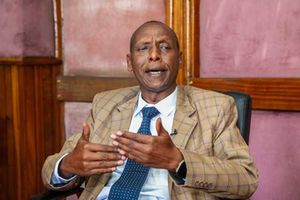
Moi University acting vice chancellor, Prof Kiplagat Kotut, during the interview in Nairobi on May 15, 2025.
Photo credit: Lucy Wanjiru | Nation Media Group
But Acting Vice Chancellor Prof Kiplagat Kotut maintains the institution is broke, citing falling enrollment, rising staff costs and debts accumulated over more than a decade.
“We have no money and are operating in the red. Without a government bailout, we cannot meet the monetary clauses of the agreement,” Prof Kotut said.
Uasu insists it is not demanding new benefits, only the implementation of a Sh2.6 billion compensation package already signed in the presence of CS Ogamba and Higher Education PS Beatrice Inyangala.
The package includes Sh500 million for pensions and welfare, Sh1.25 billion in salary arrears, Sh2.1 billion in university assets (land in Kitale, Nairobi, and Mombasa) transferred to the pension scheme, and additional tranches spread out up to the 2027/28 financial year to clear outstanding pensions, loans and staff benefits.
The union also demands Sh3.3 billion to be paid in 2026/2027 for outstanding pension contributions and bank loan settlements, and the final tranche of Sh1.75 billion in 2027/2028 to clear pending payments.
Other negotiated benefits include Sh100 million to offset bank loans, Sh40 million for staff welfare, Sh30 million for the benevolent fund and Sh30 million for group life insurance, Sh50 million union dues, and Sh100 million refund to employees who personally cleared institutional loans from their own pockets.
University Academic Staff Union's Secretary, Moi University Chapter, Dr Busolo Wegesa (centre), Organising Secretary Dr Ojuki Nyabuta (left), and the branch's Chairman Dr Richard Okero, during a press briefing in Eldoret, Uasin Gishu County on August 25, 2025.
Photo credit: Jared Nyataya | Nation
The union argues the payments are not tied to tuition income but were to come from external funding, as agreed.
“These funds were agreed upon and are not linked to student numbers or tuition fees. It must come from external funding, as agreed. We are not asking for new benefits or salary increases, just what was already owed and promised,” said UASU Moi University Branch Organising Secretary Ojuki Nyabuta.
Moi University’s financial woes stem from multiple factors: student numbers plunging from 50,000 in 2015 to 21,000 today, the closure of satellite campuses, reduced government funding under the Differentiated Unit Cost model, and the weight of unfunded CBAs.
CS Ogamba confirmed the institution is battling Sh8 billion in certified debts, with limited capacity to meet its obligations under the current funding model.
The university is currently battling Sh8 billion in certified debts, with a monthly wage bill of Sh450 million.
The outcome of Friday’s meeting could make or break the institution, with the risk of a prolonged shutdown if no deal is reached.