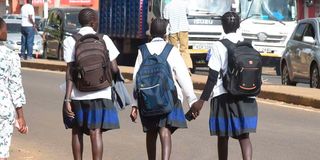
Public schools will close this week for the April holidays, mired in the perennial financial strain that has come to define public education, as heads of schools struggle to keep operations running.
While the official school calendar indicates that Term One runs to Thursday, April 2, a number of schools, especially boarding institutions, have already sent learners home earlier as debts mount and essential supplies run low.
Principals say the Sh44.2 billion sent by the Ministry of Education (MoE) for Term One barely covered 50 percent of the expected funds and did little to clear debts accumulated over the years.
“We were underfunded this term, and what was sent was not even 50 percent of the capitation. A number of my colleagues have requested that I loan them money, which I also do not have,” said a school principal from Makueni County.
The school head noted the disbursement for Term I was based on last year’s enrolment for Form Two, Form Three and Form Four, leaving schools that admitted large numbers of Grade 10 learners greatly exposed.
“That is why lots of boarding schools are closing earlier than the April 2 official closing day because they cannot sustain the learners in school with debts sitting on their shoulders,” he said.
Similar sentiments were echoed by a senior school principal in Murang’a County, whose school only received Sh7,200 per learner for term one as opposed to Sh11, 122 they expected.
According to government policy, each learner in secondary school is entitled to Sh22,244 per year, disbursed in three tranches at the ratio of 50:30:20. He noted that schools have, over time, come to expect partial disbursements, forcing them to carry forward unpaid bills from one term to the next.
Education CS Julius Ogamba, when he appeared before MPs during the 2026 Legislative Retreat for Members of the National Assembly, at Lake Naivasha Resort in Naivasha, Nakuru County, on January 28, 2026.
Photo credit: Boniface Mwangi | Nation Media Group
“We did not receive the 50 percent and we do not expect them (MoE) to send it, as has always been the case, meaning that debts just keep piling up term after term,” he said.
The latest complaints mirror a long-running funding crisis that has left public schools operating under mounting debts, and principals warning that institutions are increasingly being pushed into survival mode.
On January 2, the government released Sh44.2 billion meant to take schools through Term One 2026, the first time in recent years that schools had received funds on schedule ahead of reopening.
But even with the early release, principals say the money was inadequate and did little to ease the burden of pending bills accumulated over time.
“This is the money that we are supposed to use to buy exercise books, laboratory essentials, computer accessories, among other things, so you can imagine what a struggle it has been to survive this term,” said a school principal in Mombasa.
In January, President William Ruto directed senior school principals to admit all Grade 10 learners placed in their schools, regardless of their tuition fee status.
The directive was issued amid concerns that a significant number of the 1.13 million Grade 10 learners had failed to report to school, with Ministry of Education data indicating that lack of school uniform was the leading barrier. The President instructed them to go to school even if they did not have school uniform.
This introduced a new strain on the already overstretched resources amid the chronic underfunding of learners in public schools, despite the government maintaining official per-learner funding rates.
“Many of these Grade 10 learners are heading home for the April holidays still wearing their junior school uniforms, a stark sign that they have yet to settle school fees balances, leaving their institutions financially crippled,” said a parent in Nakuru.
In July last year, before learners closed for the August holidays, principals through the Kenya Secondary Schools Heads Association (Kessha) demanded the release of Sh18 billion in unpaid capitation, warning that public secondary schools, particularly day schools, were on the brink of collapse.
The financial constraints have also affected co-curricular activities, with teachers reporting reduced participation in events due to lack of funding.
Education PS Julius Bitok during the 2025 Kenya Primary School Heads Association Annual Delegates Conference in Mombasa on November 12, 2025.
Photo credit: Kevin Odit| Nation Media Group
“We have observed that most schools kept off for extra-curricular activities such as Scout events, drama festivals and athletics due to the financial strain,” said a teacher in Bungoma.
He added that many Cluster One schools, formerly national schools, were particularly overstretched due to high enrolment and rising operational demands.
As learners now head home for the three-week break, parents are also being urged to keep children constructively engaged to minimise idleness and exposure to risky behaviour.
A teacher from Bungoma County has advised parents to help their children strike a balance between rest, revision and practical activity.
“As the learners break for the April holiday, it is vital that they engage their psychomotor skills after doing some reading and revision and finishing up house chores,” he said.
He recommended that learners develop personal timetables to help them organise their time around study, household responsibilities, recreation and social activities.
Parents were also cautioned against unsupervised access to the internet and digital devices, as children are increasingly vulnerable to online abuse and harmful content.
Family sex educator Emily Akingi Ochieng’ said the holidays should also provide an opportunity for parents to build stronger emotional connections with their children beyond academics.
“Parents should take advantage of the April holidays and engage their children in basic conversations on life, such as what they are experiencing beyond just asking them about academics,” she said.
She urged parents to create home environments where children feel safe discussing even difficult issues.
“Create a home environment where the children feel it is easy to talk about anything, and this makes it easier to have those hard conversations, such as sex and the dangers of pornography,” she said.