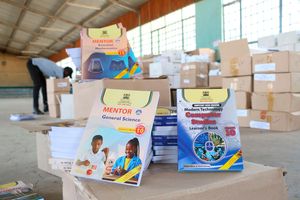
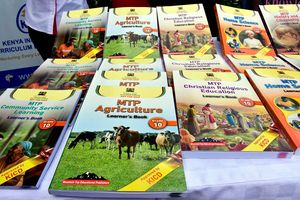
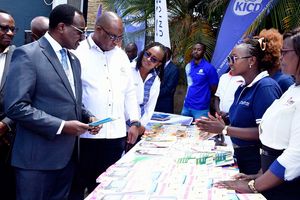
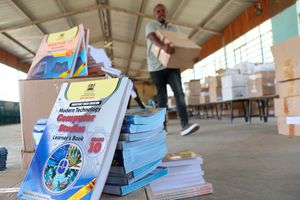
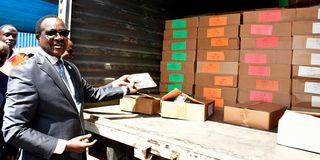
Education Cabinet Secretary Julius Ogamba before the flagging off the distribution of Grade 10 textbooks at English Press Ltd offices on January 22, 2026.
A growing debt burden owed to textbook publishers is threatening the smooth rollout of the competency-based education (CBE), even as schools grapple with inadequate learning materials.
The government’s pending bill owed to publishers has surged to Sh7.7 billion for printing, packaging and distribution of textbooks, up from Sh4.4 billion in January, raising concerns over the sustainability of supply in a system already under strain.
Basic Education Principal Secretary Julius Bitok told the National Assembly Committee on Education that additional books procured recently had pushed the bill upwards despite partial payments made earlier this year.
“Initially we had a Sh10 billion pending bill, then we paid about Sh5.6 billion and because of the procurement of new books there has been an additional bill and that is why we are coming to Sh7.7 billion currently,” he said.
By December 2025, the government owed publishers Sh10 billion, triggering a standoff that saw firms decline to print Grade 10 books just days before learners reported to senior school.
A teacher collects newly arrived Grade 10 textbooks from the collection centre in Nakuru Day Senior School on February 3, 2025.
Under pressure, the government entered into negotiations with publishers, paying Sh5.6 billion and promising to clear the balance later. This prompted the 23 contracted firms to resume production of 35 approved textbooks and literary works, but the outstanding amount remains unpaid to date.
The situation has been further complicated by the fresh procurement, which has pushed the debt back up even as earlier arrears remain unsettled. This comes at a critical time for CBC implementation, particularly for Grade 10 learners who require new sets of specialised learning materials.
The debt burden exposes deeper structural challenges in the government’s textbook supply model introduced in January 2019, where the State took over direct procurement from schools after failing to achieve the desired 1:1 learner to book ratio even after years of funding.
Under this system, the Ministry of Education retains part of tuition capitation funds per learner and centrally purchases books based on enrolment data from the National Education Management Information System (NEMIS).
However, the credibility of NEMIS data has come under scrutiny, with a special audit commissioned by Parliament’s Public Accounts Committee uncovering widespread irregularities, including ghost schools, inflated enrolment figures and institutions operating shared bank accounts.
These weaknesses have distorted procurement planning and contributed to inefficiencies in distribution of textbooks.
Some of the Grade 10 textbooks flagged off during the distribution of Grade 10 textbooks at English Press Ltd offices on January 22, 2026.
The audit, by Auditor-General Nancy Gathungu, revealed troubling gaps in the system, including oversupply of books to some schools and undersupply to others. In some cases, schools received textbooks for subjects they do not offer, while others reported not receiving books at all.
The review, which sampled over 1,100 schools across primary, junior and secondary levels, found excess textbooks worth Sh90.83 million lying idle in stores, resources that risk deterioration or obsolescence.
At the same time, many schools continue to face shortages, forcing learners to share books despite government claims of achieving a one-to-one textbook ratio.
This mismatch highlights inefficiencies in both procurement and distribution, raising questions about value for money in the multi-billion shilling programme.
Data tabled in Parliament shows pending bills for the State Department of Basic Education as at January 31 2026 stood at Sh13.7 billion. Aside from the moneys owed to publishers under the KICD, the bill includes Sh4.7 billion under the Kenya National examination Council (KNEC) and Sh713.6 million under the Kenya Literature Bureau (KLB).
Others include Sh404.4 million under the Jomo Kenyatta Foundation (JKF), Sh100 milllion under National Council for Nomadic Education (NACONEK) and Sh27 million under School Equipment Production Unit (SEPU).
Follow our WhatsApp channel for breaking news updates and more stories like this.