The release of Kenya’s first-ever Junior School Education Assessment (KJSEA) scores signals a significant shift in the country’s education assessment landscape.
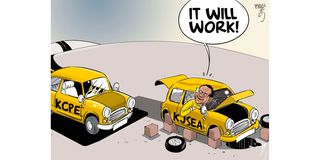
It marks the move from the high-stakes, exam-focused 8-4-4 system to a learner-centred, competency-based approach.
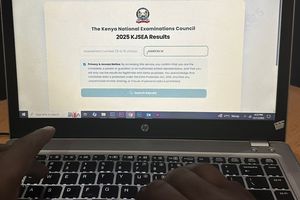
Kenya releases first-ever KJSEA results, ushering in new grading model
Under the new model, learner performance is measured continuously from Grade One, with KJSEA forming a key component of this holistic evaluation.
Unlike the Kenya Certificate of Primary Education (KCPE), which relied on a single exam out of 500 marks, KJSEA contributes 60 per cent of a learner’s final Grade Nine outcome.
Kakamega Hill school KCPE 2021 candidates sitting exams on day one at the school.
Photo credit: File| Nation Media Group
The remaining 40 per cent comes from Grade Six Kenya Primary School Education Assessment (KEPSEA) scores, which account for 20 per cent, and school-based assessments, including class tests, projects, and practical tasks, contributing the other 20 percent.
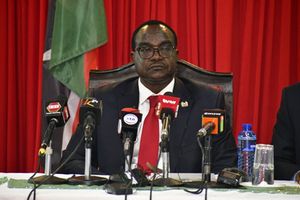
“This approach ensures that a child’s final score reflects years of consistent learning rather than performance on one exam day,” said Mr David Njengere, the chief executive of the Kenya National Examinations Council (KNEC), during the release of KJSEA results yesterday. “In competency-based education, learners progress to senior school to specialise in areas of strength, so an aggregated score is no longer necessary to determine their abilities.”
Junior school learners sit nine subjects, each with a maximum of eight points, giving a highest possible KJSEA score of 72 points. Rather than raw marks, performance is assessed through competency bands: Exceeding Expectations, Meeting Expectations, Approaching Expectations, and Below Expectations. Each band is subdivided into upper and lower tiers, allowing nuanced differentiation of learner achievement.
For example, a student scoring in the lower 80s may be classified as Exceeding Expectations and earn seven points, while another in the high 90s may fall in the upper tier and earn eight points.
A centre manager collects KCSE examination papers.
Photo credit: File | Nation Media Group
This system aims to promote a more equitable learning environment, where pupils are encouraged to develop according to their strengths and interests rather than compete solely on test performance.
The new scoring model replaces the traditional 500-mark KCPE system under 8-4-4, which emphasised rankings and competition. Previously, learners were assessed in five subjects—Mathematics, English, Kiswahili, Science, and Social Studies, with Religious Studies also contributing to the total. Scores were often aggregated out of 700 marks, driving intense competition for limited slots in national schools.
Notably, the KJSEA results were released without the fanfare that traditionally accompanied KCPE results, which often featured nationwide comparisons, school rankings, and celebratory events.
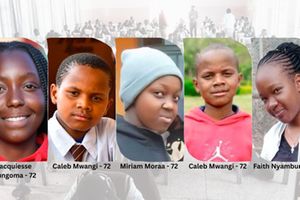
Some of the top performers in the first-ever Kenya Junior School Education Assessment (KJSEA) results.
Photo credit: Nation Media Group
This reflects the broader shift towards assessment for learning rather than ranking and competition, in line with Kenya’s commitment to holistic, learner-focused education.
The introduction of KJSEA represents a transformative step in the education system, focusing on continuous assessment, skills development, and personalised learning paths.