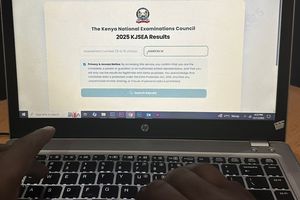
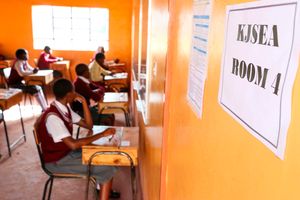
With the release of the first-ever Kenya Junior School Education Assessment (KJSEA) results on Thursday, the country ushered in a new era in its education system. The milestone marks a full transition from the traditional exam-driven model to a competency-based approach.
With the release of the KJSEA results, the 8-4-4 system has been effectively phased out, and competency-based education (CBE) fully implemented at the pre-secondary level.
To mark the transition, the Ministry of Education and the Kenya National Examinations Council (KNEC) made it clear that the approach to assessment—and even the optics—would be markedly different.
Education Ministry releases KJSEA results
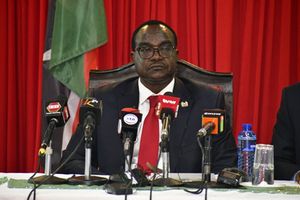
Unlike previous national examination releases, this year’s announcement was a low-key affair held in a boardroom at New Mitihani House, attended only by key education agencies. There was no place for the long line-up of stakeholders, teachers’ union leaders, association representatives, or parliamentary committee members who typically dominated KCPE-era briefings.
“We’re reducing the stakes as far as KJSEA is concerned,” said Knec CEO Dr David Njeng’ere.
Under KCPE, candidates were tested in five subjects—Mathematics, English, Kiswahili, Science, and Social Studies, including Religious Education—each marked out of 100, for a maximum total of 500 marks.
Placement into secondary schools was determined solely by performance in this single final examination. The competency-based approach (CBA), however, shifts the focus to skills, learning pathways, and learner potential, assessed continuously over time rather than through a single high-stakes test.
The transcripts downloaded by learners place them into four performance bands: Exceeding Expectations, Meeting Expectations, Approaching Expectations, and Below Expectations. Each band is further divided into two tiers, creating an eight-point scale, with top performers earning seven to eight points.
“The KJSEA summative assessment consisted of written papers and dry practicals or projects. Most subjects had a single paper, while languages, Integrated Science, and manipulative subjects had two papers due to the composition, practical, or project components,” said Education Cabinet Secretary Julius Ogamba during the release of the first KJSEA results.
Bravin Kololi (70), Jeremy Njagi (69), Anita Wairimu (70) and Rosemary Wakanyi (68) of Roots Academy in Nakuru celebrate with teachers at the institution on December 11, 2025 after the release of the Kenya Junior School Education Assessment results.
Photo credit: Boniface Mwangi | Nation Media Group
Under the new CBE reporting model, learners are assessed using performance bands such as Exceeding Expectations 1 (EE1) and Exceeding Expectations 2 (EE2), which measure competency rather than traditional marks.
EE1 represents the highest level of mastery, showing that a learner can apply skills and knowledge independently and consistently, while EE2 reflects strong competency, where the learner demonstrates a solid understanding but may still require guidance in some areas.
“This assessment goes beyond traditional examinations; it focuses on identifying learners’ strengths, aptitudes, and interests, ensuring that every child is placed in an environment where they can excel and realise their full potential,” said Mr Ogamba.
Progress to senior school
Under the former KCPE system, a learner could pass the national exam by scoring 250 marks out of 500, meeting the 50 per cent pass threshold. Under the CBE system, however, the focus has shifted from raw scores to demonstrated competencies.
Speaking during the release of the results, Mr Ogamba said seven of the 12 subjects assessed recorded strong performance, with more than half of learners meeting or exceeding expectations. These were Hindu Religious Education (84.62 per cent), Integrated Science (61.77 per cent), Social Studies (58.56 per cent), Creative Arts and Sports (58.04 per cent), Kiswahili (57.98 per cent), Christian Religious Education (53.96 per cent), and Agriculture (52.26 per cent).
“Seventy-five per cent of learners performed at Approaching Expectations and above across all subjects. Creative Arts and Sports registered the strongest performance at 96.84 per cent,” the CS said, adding that this level is adequate for progression into senior school pathways that require basic competencies in those areas.
“An Approaching Expectation grade is sufficient for learners to progress to senior school pathways that require basic competencies in the subject area,” he added.
Natasha Kinya (left) and Wamuyu Mwangi (right) both from Juja St Peter's School celebrate with family in Nakuru City on December 11, 2025 after they scored 69 and 68 points respectively in this year's Kenya Junior School Education Assessment results.
Photo credit: Boniface Mwangi | Nation Media Group
Under the CBE, learners will be guided into specific pathways in Senior School based on their strengths, interests and performance in the KJSEA. The three pathways are STEM (Science, Technology, Engineering and Mathematics), Social Sciences, and Arts and Sports.
Placement into these pathways enables learners to focus on subjects that match their aptitudes and career goals, moving away from the one-size-fits-all approach of 8-4-4. They will also not study the same subjects across pathways, allowing for deeper specialisation.
According to the Basic Education Curriculum Framework (BECF), on which it is anchored, the pathway system aims to nurture talent, reduce academic pressure, and provide a clear link between education and future opportunities.
“Of the 1,130,459 candidates who sat the 2025 KJSEA, 59.09 per cent demonstrated potential to pursue the STEM 16 pathway at Senior School, 46.52 per cent the Social Science pathway, and 48.73 per cent the Arts and Sports pathway,” said Mr Ogamba.
The performance falls within the recommended BECF ratios — 60 per cent in STEM, 25 per cent in Social Sciences, and 15 per cent in Arts and Sports pathways. Students did not receive their raw percentage marks; only the Ministry of Education and Knec have access to the detailed scores. The only indicator shared with learners is the computation used to determine their qualification for the various pathways.
Mr Ogamba added that the next crucial step is the placement and transition of learners to Senior School. Placement will be guided by their performance, chosen pathways, and the capacity of available schools.
In line with the recommendations of the Presidential Working Party on Education Reforms, the Grade Nine assessment draws 20 per cent from learners’ performance in the Kenya Primary School Education Assessment (KEPSEA) at Grade Six, 20 per cent from school-based assessments in Grades Seven and Eight, and 60 per cent from the Grade Nine summative evaluation.
“We clustered current secondary schools according to the pathways they will offer, and this guided the school selections undertaken by learners and parents earlier in the year. As of today, the total capacity of the 9,540 Senior Schools stands at 2.2 million learners. A total of 929,262 learners will be exiting secondary school after the KCSE this year, leaving extra classrooms since Senior Schools will now have only three classes. These additional 18 classrooms per school are expected to ease pressure and prevent overcrowding. We therefore have more than enough capacity to accommodate all the learners whose results we are releasing today,” Mr Ogamba said.