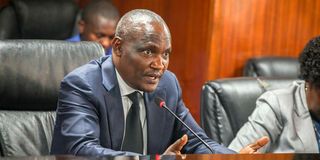
Treasury Cabinet Secretary John Mbadi has admitted that the government has not been releasing the full capitation amount under the government's free education programmes, blaming it on constrained fiscal space.
Mr Mbadi revealed that instead of funding each learner in secondary school at the recommended rate of Sh22,244 per year, the National Treasury has been releasing Sh16,900 per learner. Principals of schools blame the reduction of funds for the challenges schools face. The Ministry of Education is required to disburse the capitation money in three tranches at a ratio of 50:30:20 percent.
“If you take all the students who are in secondary school, and divide per learner the budget of Sh54 billion, it is less than Sh22,000,” he said.
Mr Mbadi added that it is about time that the country admits that it has been living a lie, noting as it is, the government is struggling to make sure that it does not unduly underfund education.
“The problem is we live a lie. President Mwai Kibaki started the free primary education, then Presi
dent Uhuru Kenyatta came with subsidised secondary education, which then somehow was escalated to free. The truth is we do not have the capacity as at now to finance free primary and free secondary education,” he stated.
Class Based Crisis: The state of education under the CBC
While insisting that the government had released 80 percent of the capitation by May 19, 2025, covering Term I and Term II, Mr Mbadi said there is inconsistency in the disbursement because the amount budgeted is less than the requirement. He was appearing before the Committee on Education of the National Assembly.
“So, if you calculate the total budget for the year and you divide by the number of students, instead of Sh22,244 per learner per year, we are funding up to Sh16,900,” he admitted, after the legislators insisted on knowing the actual amount released per learner.
His remarks come on the back of demands by principals in public secondary schools that the government release Sh18 billion they claim is owed to schools in capitation since the beginning of the calendar year. Through the Kenya Secondary Schools Heads Association (KESSHA), the principals warned that public secondary schools, particularly day schools, are on the brink of collapse due to delayed capitation funds.
Ideally, learners should be provided with tuition and operational costs at the rate of Sh1,420, Sh15,042 and Sh22,244 per learner in primary, junior school and senior secondary school, respectively.
“Where is this money going and why can’t the Ministry of Education (MoE) be bold and tell the schools that they should not budget for Sh22, 000 but for say Sh17,000,” posed Kibra MP Peter Orero during the session that was also attended by the Cabinet Secretary for the Education Julius Ogamba alongside the Principal Secretary for Higher Education PS Beatrice Inyangala and her counterpart for Technical and Vocational Education and Training (TVET), Esther Muoria.
Emuhaya MP Omboko Milemba noted the government has been underfunding learners over the years, with this year’s Term II emerging as the worst funded for students in secondary school.
“The second team is usually the longest at 14 weeks and so far, the schools have received Sh3,471 of the Sh6,673 per learner capitation and this has been the been the trend over the past three years,” he said.
The MP tabled data that showed that in 2022, Term II disbursement per learner was 4,200, in 2023, the amount released was Sh4,100 and then in 2024, it was Sh4,500. Disbursement for 2025 Term II was Sh3,471, making it the lowest ever disbursed.
In March last year, the then Basic Education PS, Belio Kipsang, told the National Assembly’s Public Accounts Committee that capitation for free secondary school education had declined from Sh22,224 to Sh17,000.
Dr Kipsang had decried that the amount set as capitation for the Free Day Secondary Education programme has never been increased despite a palpable population increase of learners in schools.
“There is something happening in between the National Treasury and the MoE such that moneys aren’t reaching the schools,” said Mr Milemba.
Mr Mbadi explained that financial pressures, including competing needs, including debt repayment, had pushed the government to underfund per capita allocation for education per child in Kenya.
The Woman Representative for Narok, Rebecca Tonkei, wondered why the Ministry of Education did not see the need to issue a circular to learning institutions on the reduced capitation, while knowing fully well they were not going to fund learners at the stated Sh22,000.
Following a barrage of questions from the MPs, Mr Mbadi challenged lawmakers to provide more funds in the budget in order to fund education adequately, since it is Parliament has the power of the purse.
Further, Mr Mbadi challenged the lawmakers to cede 40 percent of the budget of the Constituency Development Fund so that it can go towards funding the education sector.
The lawmakers, however, told Mr Mbadi to use the money that the government dishes out every weekend in “empowerment drives” in order to bridge the gap of the capitation sent to schools.
As regards review of capitation rates to reflect real institutional needs, he said, due to constrained fiscal space and other emerging priorities within the Education Sector, updating these rates might be untenable.
“The Government will however consider reviewing these rates should revenue performance improve,” he said.
His remarks come on the back of a plan by the government to merge some public secondary schools with low student enrolment in a bid to optimise resource utilisation in the education sector.
Last week, Basic Education Principal Secretary Julius Bitok explained that the move is informed by insights from the recently concluded placement exercise for over 1.2 million Grade 9 learners transitioning to senior secondary school under the Competency-Based Curriculum (CBC).
It had emerged that more than half of the 9,750 secondary schools across the country were not selected by learners joining Grade 10 under the new curriculum.
By failing to attract learners, it means the affected schools are set for a tough road ahead since no capitation will come their way.
A recently released report by Zizi Afrique Foundation and Usawa Agenda identifies capitation and teacher shortage for public schools as a major drawback to delivering effective education outcomes.
The report titled State of Education in Kenya identified a lack of adequate staffing, ICT, Science facilities and related Physical infrastructure, including ablution and sanitation blocks, as some of the major challenges hampering education development in Kenya.
Shock as KPSEA candidate discovers he wasn't registered for exam
Mr Mbadi also waded into the payment of exam fees for students, saying the country must have an honest discussion on whether the policy is sustainable going forward.
“We have a strong feeling as the National Treasury that it is not right to pay for exams for all children. This country can’t run a welfare state,” Mr Mbadi said.
“For now, we will continue to pay the exam fee for all students, but it’s an ongoing discussion that we must have. Why for instance should the government pay for my child yet I can afford to pay?,” Posed Mr Mbadi.
Mr Mbadi said the cost of exams in the country, just like the General Election, is exaggerated and not tenable.