The National Assembly Education Committee has recommended an increase of budgetary allocation to the education sector by Sh284 billion in order to adequately cater for funding deficits for learners in both primary and junior schools.
The amount will also cater for university students’ scholarships, loans, settle pending bills in public universities, cover the medical cover for teachers under the Social Health Authority (SHA) and settle the Collective Bargaining Agreement (CBA) for lecturers.
The committee, in its consideration of the Budget Policy Statement (BPS) for the education sector, has warned that the funding deficit contained in the proposals currently being considered by the House risks crippling key sectors in the education sector.
In its report to the Budget and Appropriation Committee, the education committee wants an enhanced allocation of Sh8.6 billion for primary education programmes in order to cater for the capitation deficit to ensure that all public primary school learners receive capitation as per the existing policy.
The Parliament Building in Nairobi.
Photo credit: Sila Kiplagat | Nation Media Group
The committee says that in order to cater for 6.4 million learners at Sh2, 330 per learner, Sh15 billion is required against a 7 billion provision, hence having a funding gap of Sh8.6 billion.
The implication of the funding gap is that 3.7 million learners will not receive capitation, or all learners are funded at 1,096
For the secondary education programme, the committee chaired by Julius Melly has proposed an enhanced allocation of Sh47.2 billion to cater for the capitation deficit in junior and senior schools to ensure that learners are funded as per the existing policy.
The committee noted in its report that in the senior school capitation, in order to cater for 3.5 million learners at Sh22,244 per learner, Sh78.4 billion is required against Sh 54.8 billion provision, hence having a funding gap of Sh23.5 billion.
The implication of the funding gap is that 1.1 million learners will not receive capitation, or all learners are funded at Sh15, 780
For the Junior school capitation, the committee noted that in order to cater for 3.6 million learners at Sh15, 042 per learner, Sh54.7 billion is required against a Sh30.9 billion provision in the BPS, hence having a funding gap of Sh23.8 billion.
The implication of this funding gap is that 1.6 million learners will not receive capitation, or all learners are funded at Sh8,536
For the school meals programme, there is a funding gap of Sh850 million in order to reach out to 2.8 million needy learners in targeted areas. However, in the BPS, Sh3 billion has been provided against a requirement of Sh3.8 billion.
For the school examination and invigilation, the committee noted in its report a funding gap of Sh 4.8 billion. In the BPS currently before the House, Sh9.9 billion has been provided against a requirement of Sh14.7 billion;
For the school infrastructure, the committee, in its scrutiny of the BPS, noted that only Sh1.3 billion has been provided against a requirement of Sh2.8 billion, leaving a funding gap of Sh1.5 billion.
In the University sector front, the committee wants an additional Sh29.4 billion to cater for scholarships for University students and Sh67 billion loans for both university and Technical and Vocational Education and Training (TVET) students based on the student-centred funding model.
“These critical resource gaps in the sector need to be addressed to ensure that what the BPS 2026 envisages in terms of scaling up investment in people through education, skills development, scientific training and innovation is realized,” reads the committee report.
The committee also wants another Sh1.1 billion to cater for Collective Bargaining Agreements (CBA) for Universities staff in order to end the perennial strikes that have affected students over the years.
The committee also wants their counterparts in the Budget and Appropriation to allocate another Sh85 billion in order to settle pending bills in public universities and another Sh46 billion for government-sponsored students who were previously admitted in private universities.
In the Technical Education Programme, the committee has pitched for Sh22 billion to cater for scholarships for TVET students.
It also wants the House to make provisions for Sh10 billion to cater for teachers' medical cover under the Social Health Authority (SHA).
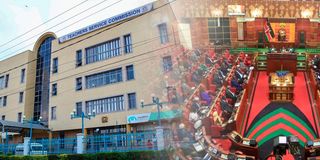
The TSC headquarters in Upper Hill, Nairobi (left) and a past session in the National Assembly.
Photo credit: Nation Media Group
The committee also wants the Teachers Service Commission (TSC) to allocate Sh5.3 billion to cater for group life, group personal accident and Work Benefits Injuries Act (WIBA) for teachers.
“The committee recommends that the expenditure ceilings for the State Departments and the Teachers Service Commission be increased to accommodate the above critical areas which are not adequately funded in 2026/27 BPS,” reads the committee report.
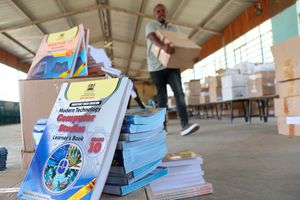
The committee says that in order to achieve the envisioned education reforms under Competency Education (CBE).
The Budget Policy Statement 2026 has proposed an overall resource ceiling of Sh767 billion for the education sector in the 2026/27 financial year.
The amount comprises Sh737 billion in recurrent expenditure and Sh30 Billion development expenditure.
The BPS shows that TSC will receive more than 55 percent of resources allocated to the sector, with the rest of the Departments within the ministry sharing the remaining 45 percent.
The budget committee will now review the proposals by the education committee and present its report to the House on Tuesday next week.