Taxpayers have been losing millions of shillings under the scheme through which government procures and supplies textbooks to primary, junior and secondary schools, an audit report shows.
The report indicates that the government has been paying for textbooks that are not needed while at the same time failing to supply some textbooks that schools need. The rampant over-supply, delivery of books for subjects not even offered, and in some cases, outright non-delivery to schools as the main ways through which the money is lost.
The special audit by Auditor General Nancy Gathungu reviewed textbook procurement and distribution between the 2020/2021 and 2023/2024 financial years established weaknesses relating to disbursements and utilisation of funds set aside for purchase of textbooks.
The audit was commissioned by the National Assembly Public Accounts Committee (PAC). It sampled 442 secondary schools, 339 junior schools and 336 primary schools. In the schools sampled, the value of excess textbooks supplied to schools in the review period stood at Sh90.83 million.
Auditor-General Nancy Gathungu.
Photo credit: File | Nation
The figure could be higher and running into billions of shillings since there are over 9,000 public secondary schools, 18,000 junior schools and over 23,000 primary schools.
“During the years under review, it was established that there were excess textbooks delivered to 394 secondary schools, 94 junior schools and 182 primary schools in comparison to the number of learners enrolled in the respective schools,” said Ms Gathungu in the report.
The over-supply represents idle public resources sitting in store rooms, some of which risk deterioration, loss or obsolescence as curriculum needs evolve. Equally concerning are instances of undersupply in other schools, where learners reportedly continue sharing books despite government claims of achieving a 1:1 textbook-to-learner ratio.
The audit established a shortfall in textbook deliveries to 415 secondary schools, 194 junior secondary schools and 245 primary schools compared to their actual enrolment figures. The total value of the undelivered textbooks amounted to Sh295.63 million.
The total value of the distributed textbooks for subjects not offered at the schools amounted to Sh30.34 million while the textbooks not delivered but paid for amounted to Sh41.41 million.
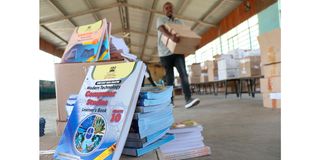
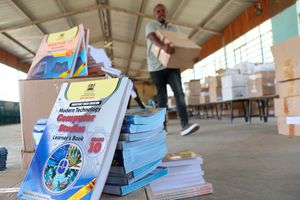
A teacher collects newly arrived Grade 10 textbooks from the collection centre in Nakuru Day Senior School on February 3, 2025.
Photo credit: Boniface Mwangi | Nation Media Group
The audit further flagged ambiguities in textbook budgetary allocations where unlike other vote heads where disbursement per learner is clearly indicated — such as activity fees at Sh1,500 per learner and medical insurance (EduAfya) at Sh2,000 — the allocation per learner for textbooks is not explicitly stated.
Instead, textbook funds are disbursed directly to the Kenya Institute of Curriculum Development (KICD) for centralised procurement and distribution, in a model that limits transparency at the school level, as principals do not receive a clearly itemised per-learner allocation for textbooks.
Starting January 2019, the government shifted to the procurement model where it procures textbooks directly from publishers who are also contracted to distribute them to schools. The strategy was put in place after the government stopped sending the money directly to schools after it was established that managements of schools would misappropriate the funds.
The current arrangement is that the Ministry of Education retains portions of tuition cash per enrolled learner in each school to cater for centralised procurement of textbooks, meaning that the supply of the textbooks is based on NEMIS enrolment data.
However, the enrolment data on the NEMIS has been called into question as the special audit lays bare a deeply compromised system, riddled with non-existent schools, inflated learner numbers, and even institutions operating through shared bank accounts.
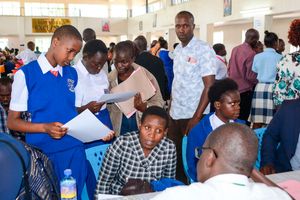
Delegates buy textbooks during the 2025 Kenya Primary School Heads Association conference in Mombasa on November 10, 2025.
Photo credit: Kevin Odit | Nation Media Group
The audit established that 71 schools which received capitation funds totalling Sh55.2 million were classified in the National Education Management Information System (NEMIS) as appearing in counties and sub-counties which differed with records maintained by either the Teachers Service Commission (TSC) or Kenya National Examination Council (KNEC).
“These discrepancies indicate weaknesses in data capture and validation controls, which may lead to misreporting, distorted resource allocation, and challenges in policy implementation and oversight and may lead to fraud,” Ms Githungu said in the audit report tabled in June 2025.
The special audit concluded that the current capitation model fails to guarantee equitable funding for public schools, as it relies largely on inaccurate NEMIS enrolment data and does not adequately factor in special needs, poverty levels or geographical disparities.
Funds for Free Primary Education, Junior School Education, Free Day Secondary Education and Special Needs Education are allocated strictly based on learner enrolment as captured in NEMIS, at the rates of Sh1,420, Sh15,043, Sh22,244 and Sh57,974 per learner, respectively.
The audit found a 20 per cent capitation shortfall over the four years under review, delayed exchequer releases, and undisbursed funds, in what crippled the smooth running of school operations.
A comparison of capitation requirements for secondary, junior secondary and primary schools over the four years shows a total need of Sh419.7 billion against an approved budget of Sh334.1 billion, leaving a funding gap of Sh85.6 billion, or 20.4 per cent of the required amount.