Heads of schools face a tough balancing act deciding the co-curricular activities to participate in as funding for the activities in public schools continually becomes inadequate.
The situation is compounded by the fact that sports, arts, science competitions and other talent-building activities have been mainstreamed into the curriculum under the competency-based education (CBE).
Funding for co-curricular activities is embedded in capitation grants that the Ministry of Education allocates to schools under the Free Primary Education (FPE) and Free Day Secondary Education (FDSE) programmes. For primary schools, the annual figure is Sh76 per learner while learners in secondary schools are funded at the rate of Sh1,500 per learner per year specifically for co-curricular activities like ball games, drama and music festivals.
According to a circular from All County Directors of Education dated November 28 2025, the Ministry of Education released Free Day Secondary Education (FDSE) funds for the first term of 2026. Each student was allocated Sh7,952.04, with Sh375 specifically earmarked for co-curricular activities such as sports, science clubs, and arts programmes.
The circular notes that the funds are distributed according to verified enrolment from NEMIS as of April 22 2025, and confirmed by Heads of Institutions and Sub-County Directors of Education in November 2025.
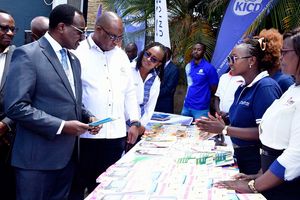
Oxford University Press Publishing Lead Rosemary Jepchirchir (right, in blue t-shirt) briefs Education Cabinet Secretary Julius Ogamba (left) on the school books on display during the launch of the distribution of Grade 10 textbooks at English Press Ltd offices on January 22, 2026.
Photo credit: Francis Nderitu | Nation Media Group
Under CBE, learners in senior school have the option to follow specific pathways. Most of the co-curricular activities are closely related to the Arts and Sports pathway. It allows learners to specialise in subjects and activities that align with their talents and career interests, combining core academics with focused training in sports, visual and performing arts, music, and creative disciplines.
Funding from FDSE will play a critical role in supporting this pathway, as schools need resources for sports equipment, art supplies, music instruments, and specialised coaching to ensure students can fully develop their skills.
Unlike the previous system where sports and drama were not closely entwined in the curriculum, the new structure positions them as potential career tracks.
However, experts now warn that these programmes may struggle to meet the objectives of the Arts and Sports pathway, potentially limiting opportunities for students to excel in these areas. School principals now say the current funding model for co-curricular activities places immense pressure on management of the institutions.
As a result, many schools are forced to seek additional contributions from parents, a move administrators describe as uncomfortable but unavoidable.
“The current model of funding co-curricular activities is a total disadvantage to schools. It is grossly inadequate and has become a burden not just to institutions, but to parents as well. Most of the money is retained at the Ministry of Education, leaving schools with very little to support learners. What we receive can only sustain one activity, sometimes only up to the zonal or sub-county level. Beyond that, it becomes a struggle. This model is actively disadvantaging our students,” said a principal in Nakuru County.
Grade Two pupils in class at St Xaviers Primary School in Nakuru City on January 5, 2026 on day one of Term One.
Photo credit: Boniface Mwangi | Nation Media Group
“The way co-curricular activities are currently funded is unsustainable. Schools are expected to deliver excellence in sports, arts and science competitions, yet the resources provided are nowhere near sufficient. What we receive cannot comfortably support learners beyond the lower competition levels. As a result, parents are forced to step in and bridge the gap. This not only strains families financially, but also denies many students the opportunity to fully participate and showcase their talents. The system, as it stands, is placing schools in a very difficult position,” said another principal in Nairobi.
KUPPET Deputy Secretary General Moses Nthurima noted that funding for co-curricular activities in schools remains inadequate, leaving sports, games, and other talent-building competitions poorly supported.
He said that under the current system, every student is expected to contribute Sh1,500 per year, but much of the funding intended for competitions is often redirected or left to county officials and parents to cover.
The union official highlighted that government support rarely reaches the full cost of county or national competitions, leaving teachers uncompensated and demoralised. Participation levels are also affected, with the number of teams allowed to compete at county and national levels often reduced.
“More often than not, county officials ask parents to cover costs, which shows the ministry has not been keen on funding sports and games. Teachers traveling for competitions, especially at the county level, are not properly compensated, which is very demoralising. Participation is further affected as the number of teams allowed to compete at county and national levels is often reduced,” said Mr Nthurima.
“The government has been working against sports and games for too long. Now that we are operating under the Competency-Based Education (CBE) system, the government will need to provide more funds for games and sports. Otherwise, the money allocated for students will remain unspent, despite repeated complaints from teachers over the years,” he added.
He called on the government to increase allocations for co-curricular activities and ensure that funds are released on time, warning that without proper intervention, schools will continue to struggle to nurture talent in sports, arts, and other competitions.
“We have even sought intervention, but it has not been determined. Teachers continue to negotiate with the government over what they should be paid, yet even with oversight from the Salaries and Remuneration Commission (SRC), there is still uncertainty about allowances for participating in competitions,” he noted.