The Kenya Universities and Colleges Central Placement Service (KUCCPS) will introduce new university placement criteria to align admissions with the competency-based education (CBE) system ahead of the transition of the first cohort to institutions of higher learning in 2029.
The first group of learners under the new curriculum, currently in Grade 10, are expected to complete senior school in 2028 before joining universities and colleges the following year.
Unlike the outgoing 8-4-4 system, where placement is largely based on the Kenya Certificate of Secondary Education (KCSE) grades, students under CBE will be admitted according to specialised career pathways selected in senior school.
Candidates sitting for an exam.
Photo credit: File | Nation Media Group
Kenya has adopted three major pathways under CBE: STEM (Science, Technology, Engineering and Mathematics), Social Sciences, and Arts and Sports.
More than 1.1 million learners joined senior school earlier this year under the pathway-based system. They will study for three years before joining institutions of higher learning in 2029.
KUCCPS Chief Executive Officer Agnes Wahome said the placement agency is already working with universities, professional bodies and education stakeholders to develop an admission formula that fits the new curriculum.
“We are going to have a new criteria. We will wait to know whether we are going to have grades A to E or Exceeding Expectation being the best grade and the last being Below Expectation,” she said during an interview with Government Spokesperson Isaac Mwaura.
Under the 8-4-4 system, the Kenya National Examinations Council (KNEC) uses grades A to E, with A being the highest grade. However, in the CBE system, learners are assessed using descriptors such as Exceeding Expectation (EE), Meeting Expectation (ME), Approaching Expectation (AE) and Below Expectation (BE).
A teacher engages Grade 10 learners in Langalanga Senior School in Nakuru County during a Chemistry lesson on February 5, 2026.
Photo credit: File | Nation Media Group
Dr Wahome said the biggest challenge will be determining placement cut-off points if the country fully adopts competency-based grading.
“Those who will have EE, we will have to know the range. Is it those with 100 per cent up to a certain point? We are working with universities and professional bodies because one of our mandates is to come up with criteria for placement,” she explained.
She noted that professional bodies will play a critical role in helping KUCCPS determine minimum subject requirements for specialised courses.
“For example, engineering requires Physics. We must determine what minimum grade a learner should attain in Physics to qualify for engineering courses,” she said.
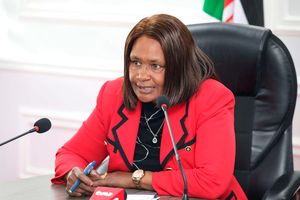
Ms Agnes Mercy Wahome, the CEO of the Kenya Universities and Colleges Central Placement Service (KUCCPS).
Photo credit: File | Nation Media Group
Dr Wahome dismissed fears that universities may the lack capacity to absorb learners under the new system.
She said the current university intake projections already exceed the number of students qualifying for degree programmes.
“For the 2025 class expected to join universities in September 2026, we already have 322,000 university capacities against about 270,000 students who scored C+ and above in KCSE, including both Kenyan and non-Kenyan students,” she said.
According to Dr Wahome, the pathway system is likely to ease competition for university placement because learners will pursue specialised fields rather than competing broadly across all subjects as is the case under KCSE.
She cited the STEM pathway, noting that not all students will study pure sciences such as Physics, Chemistry, Mathematics and Biology, reducing pressure on science-based degree programmes.
“Those taking sports, for example, are not many because only a few schools can offer the pathway effectively. This means that university placement under CBE will become more targeted and easier,” she said.