Public school principals are unable to say no to an association they belong to, transferring Sh6 billion in taxpayer funds to the Kenya Secondary School Heads Association (Kessha) despite the absence of a legal instrument authorising the payments.
Presentations in Parliament and interviews with school heads reveal that the Ministry of Education’s failure to adequately fund co-curricular activities has seen Kessha partner with schools to ensure sports, music and other activities are held each term.
Part of the Sh6 billion has also been used to settle Kessha membership fees and pay for an annual conference attended by school heads.
Auditor-General Nancy Gathungu and MPs have questioned why a private entity received billions of shillings in taxpayer funds without a clear legal basis or the accountability safeguards that apply to public money.
The principals insist the money was not simply membership subscriptions to Kessha but was used to finance co-curricular activities for learners and capacity-building programmes for school managers.
The contributions are calculated according to enrolment, meaning schools with larger populations pay more.
Nairobi School principal Maina Momanyi told a Parliamentary committee that schools contribute Sh500 per student at sub-county level and Sh200 at regional level for co-curricular activities.
Mr Momanyi said principals sometimes find themselves caught between complying with demands linked to the activities and questioning the legality of the payments.
“So you multiply this by the number of students you have. So it is Kessha that whips us and mobilises us to support these activities so we comply. Because if we stay away, my boys will not understand why they are not allowed to participate and will think that I have messed up with their money. So sometimes we find ourselves in a difficult situation,” Mr Momanyi told MPs.
“I personally raised this matter on transfer of money to Kessha with the Ministry of Education, and I was told an agreement is an agreement and that all school heads were contributing to the kitty,” he added.
Auditor-General Nancy Gathungu.
Photo credit: Wilfred Nyangaresi | Nation Media Group
Ms Gathungu noted in her reports that Kessha is a welfare organisation whose membership is drawn from school principals and which is not defined in the government funding system.
“There is no assurance that it has implemented effective, efficient and transparent financial management and internal control systems to manage the funds transferred by schools,” she said in the audit reports.
She noted that, in the circumstances, value for money for funds transferred to Kessha could not be confirmed.
A month-long analysis of the Auditor-General’s reports tabled in the National Assembly revealed that, among institutions already audited, Kaaga Boys Secondary School in Meru County transferred the highest amount to Kessha at Sh3.32 million over the review period.
It was followed by Langa Langa Secondary School in Nakuru at Sh3.3 million, Mang’u High School in Kiambu at Sh2.77 million and Maryhill Girls High School, also in Kiambu, at Sh2.66 million.
Coming fifth was Njabini Boys High School in Nyandarua, which transferred Sh2.359 million, followed by Karangari Boys High School in Kiambu at Sh2.351 million. Kahuhia Girls High School transferred Sh2.3 million, St John’s Girls Secondary School Sh2.24 million and Kaaga Girls High School Sh2.15 million, while Alliance High School transferred Sh2.12 million.
Following the release of the Auditor-General’s reports, the National Assembly Public Investments Committee on Governance and Education (PIC-G&E) this month began inviting senior school principals to respond to audit queries covering four financial years.
“As we speak, the Auditor-General is saying Kessha received close to Sh6 billion in public money, and we want to know who follows up on spending on these funds to know if there is value for money,” committee chairman Dick Maungu said.
So far, principals who have appeared before the committee have given remarkably similar explanations, saying Kessha had become the mechanism through which secondary schools supported co-curricular activities that begin at sub-county level and progress to national competitions.
Mang’u High School Principal Dr Benard Kingah said the money paid to Kessha should not be treated as membership subscriptions, but as contributions towards co-curricular activities such as music, drama, sports and science fairs.
“The money is paid at sub-county and county level and is calculated per student; therefore, the higher the student population, the higher the amount paid,” he told the PIC-G&E.
Mr Kingah noted that Mang’u, which has 2,800 students, 137 teachers and 79 non-teaching staff, also pays the money to support workshops for principals, deputy principals and bursars.
He added that the expansion of activities, including newer disciplines such as scrabble and chess, had increased the financial demands on schools.
Limuru Girls principal Susan Kariuki acknowledged that the school transferred money to Kessha but said it was intended for co-curricular activities and engagements involving principals, deputies and student leaders.
Kenya High School principal Reverend Edith Koech gave a similar explanation, saying Kessha, in collaboration with the Ministry of Education, facilitates extracurricular activities from sub-county to national level.
“The association also facilitates in-service training for school administrators in collaboration with the Teachers Service Commission and the Ministry,” she said.
Senior school principals who did not wish to be named said Kessha organises co-curricular activities and the Ministry of Education is fully aware that principals are making payments to the association.
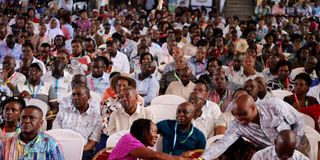
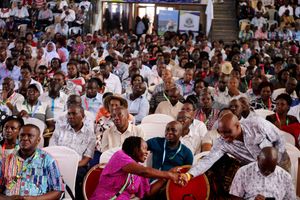
Students air their grievances during a special session at the 46th Kenya Secondary School Heads Association annual conference in Mombasa on June 29, 2023. Kessha is under scrutiny over Sh6 billion transferred by public schools for co-curricular activities and other programmes.
Photo credit: File | Nation Media Group
“The money which is pegged in the school’s enrolment numbers goes to Kessha, which is then forwarded to the county director or sub-county director of education for the management of the co-curricular activities and there is even a schedule for this,” said a principal.
Principals are usually told by county directors of education that funds released by the Ministry of Education to cater for co-curricular activities are insufficient, and they are therefore levied to cover the deficit.
They explain that the amount is calculated per student enrolled as opposed to the number of students taking part in an event, so the larger the enrolment, the more a school will pay.
“Even if your students do not proceed to the higher levels of the competitions, you are still supposed to pay. Whether they are winning or not winning. Whether they are taking part in the activities or not,” lamented another principal.
Once a teacher is promoted to become a principal, the Teachers Service Commission (TSC) automatically begins deductions to cater for their subscription to Kessha.
Kessha usually holds a national conference annually, which all members are expected to attend and for which they pay a participation fee of Sh6,000.
To facilitate the release of funds, the principals say Kessha engages the Ministry over the conference. A letter is issued, and principals get copies, which they present to the Boards of Management that then give the go-ahead.
“Every national conference we attend, the Ministry gives us letters so that we present them to the BOM so that we are given the money,” he said.
The money is usually derived from the school’s operations account or boarding account, and the amount is inclusive of the Sh6,000 participation fee at the conference.
If it is a county conference, the letter comes from the County Director of Education.
The Basic Education Act and subsequent regulations provide a framework for the management of co-curricular activities in public schools, with county education structures assigned responsibility for sports, games and other activities.
Kenya Secondary Schools Heads Association National Chairman Willie Kuria (centre) with other delegates during the Murang’a County Head Teachers Conference in Mombasa on April 15, 2026.
Photo credit: Kevin Odit | Nation Media Group
The regulations also provide a mechanism for schools facing inadequate funding for such activities to notify the County Director of Education, who, together with the County Education Board, can consult the Cabinet Secretary on how to meet the deficit.
“Our duty is to see that the law is adhered to. Because the law says that the County Education Board shall take charge of sports and in case there is a delay in funding, there is a procedure given,” said Mr Maungu, who is also Luanda MP.
Pangani Girls principal Dr Millicent Odhiambo was more direct about the absence of written authority.
“While we give to Kessha money to support the co-curricular activities, we don’t have a letter of authority that gives us authority as a principal to transfer money,” she said.
Starehe Girls similarly told the committee that the arrangement was “borne out of practice” and required policy guidelines from the Ministry of Education.
The committee has raised the possibility of principals being surcharged if the payments are ultimately found to have lacked proper authority.
The PIC-G&E has warned that it could recommend surcharging school principals and recovering the money if the expenditure is found to have been unauthorised.
Central Imenti MP Moses Kirima argued that where a public officer uses public funds for an unauthorised purpose, the accounting officer could be personally liable for refunding the money. Lunga Lunga MP Mangale Munga echoed his sentiments and was categorical in describing the transfers to Kessha as illegal.