The Kenya National Examinations Council (Knec) has announced that it will allow candidates seeking to sit the 2027 Kenya Certificate of Secondary Education (KCSE) examination but do not have Kenya Certificate of Primary Education (KCPE) certificates.
However, the candidates will be required to first undergo validation of their primary school qualifications by sitting a qualifying test. The KCSE will be offered for the last time next when the last 8-4-4 class exits secondary school.
The directive will affect all prospective 2027 candidates who do not hold KCPE certificates or equivalent qualifications, including learners who missed the 2023 KCPE examination but were still allowed to join secondary school with the approval of the Ministry of Education.
An invigilator distributes KCSE English Paper One question sheets to Nakuru Girls High School candidates on November 3, 2025.
Photo credit: Boniface Mwangi | Nation Media Group
Knec said such candidates must present their primary school qualifications for validation before they can be cleared to register for the KCSE Qualifying Test (QT), which will be administered in September 2026.
“All persons without KCPE examination certificates or their equivalent who intend to register for the 2027 KCSE examination will present their primary school qualifications for validation by KNEC and thereafter sit the KCSE Qualifying Test,” the council said in a notice.
Knec chief executive officer, Dr David Njengere said anyone who dropped out before sitting the KCPE or registered but did not sit KCPE must sit the Qualifying Test this year to be eligible for registration for KCSE in 2027.
"As the country prepares to implement CBE fully in the entire basic education cycle in 2028, it is very important that anyone with unfinished business with 8.4 4 takes advantage of the last KCSE to be administered in 2027. In case anyone needs clarification on this, they should contact Knec. I appeal to Kenyans not to wait for the last minute next year," said Dr Njengere.
The move places fresh attention on a special category of learners who transitioned to secondary school without sitting KCPE, at a time when the country is preparing for the final phase-out of the 8-4-4 education system.
The 2027 KCSE examination will be the last under the current system before the country fully transitions to the Competency-Based Education (CBE) framework, making the qualifying test a crucial step for affected candidates hoping to sit the final secondary school examination.
Knec has directed heads of institutions to ensure that all their Form Three learners in 2026 who do not have KCPE qualifications comply with the new requirements within the set timelines.
As part of the validation process, affected candidates will be required to submit an application letter, report cards or any other proof of having attended primary school, as well as evidence of payment of a Sh3,480 validation fee.
Once the validation exercise is complete, successful applicants will be issued with a clearance letter allowing them to register for the KCSE Qualifying Test.
Knec said the registration portal for the qualifying test is already open and will close on July 30, 2026.
The qualifying test will be administered online in September at venues to be identified by County Directors of Education, with the examination expected to take place at county headquarters, as has been the practice in previous years.
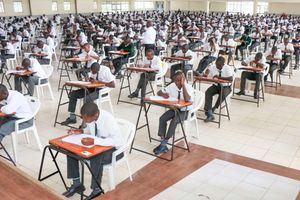
An invigilator supervises KCSE English paper one examination at Nakuru High School on November 3, 2025.
Photo credit: Boniface Mwangi | Nation Media Group
For registration, candidates will be required to present a letter from their school in the case of regular candidates, or from the Sub-County Director of Education in the case of adult candidates. They will also be required to provide an equation letter from Knec, a soft copy of their passport photograph, and either a birth certificate or national identity card.
Candidates will further pay Sh3,000 as registration fees for the qualifying test through the e-Citizen platform.
Knec said the test will also be offered to candidates with foreign qualifications who are currently in Form Three, provided their certificates have first been equated by the council.
The results of the qualifying test will then be used to determine eligibility for registration for the 2027 KCSE examination.
The notice is expected to affect a number of learners who joined secondary school without KCPE certificates, especially those who missed the 2023 national examination but were admitted to Form One under special arrangements by the Ministry of Education.
It also comes at a time when the country recorded historic examination candidature numbers as the final cohorts under 8-4-4 move through the system.
This year, Kenya registered the highest national examination candidature in its history, with more than 3.5 million learners set to sit the country’s three main national assessments and examinations.
Data from Knec shows that 3.54 million candidates have registered for the Kenya Certificate of Secondary Education (KCSE), Kenya Primary School Education Assessment (KPSEA) and the Kenya Junior School Education Assessment (KJSEA) in 2026.
The figures include 1,300,864 learners registered for KPSEA, 1,193,200 for KJSEA and 1,049,276 for KCSE, pushing the secondary school examination past the one-million mark for the first time since its introduction in 1989.
The record candidature has largely been linked to the final transition out of the 8-4-4 system, with the 2027 KCSE expected to mark the end of an examination cycle that has defined Kenya’s education system for nearly four decades.
Against that backdrop, Knec’s latest directive is likely to trigger a rush by affected schools, parents and candidates to regularise records and complete the validation process in time, especially for learners who do not have KCPE certificates but still hope to sit the final KCSE examination.