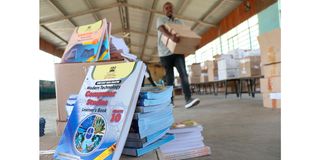
One month since Grade 10 learners reported to senior school, those in public schools are yet to receive textbooks for all subjects from publishers contracted by the government.
As a result, teachers have been forced to teach using the curriculum designs developed by the Kenya Institute of Curriculum Development (KICD) and the textbooks they were using previously for the 8-4-4 system. The delay was caused by a standoff between publishers and the government over non-payment of outstanding debt running into billions of shillings.
“These books were print-ready by June [2025] and have been waiting for a signal to start distribution. The signal is mainly the payment of the publishers’ dues which also translates into the printers’ and transporters’ dues,” said Prof Charles Ong’ondo, the CEO of the KICD in an interview in December 2025.
On Friday, Prof Ong’ondo absolved the institute from blame saying it has been on schedule with evaluating manuscripts submitted by publishers and awarding the tenders for supply. Printing of the books started in the second week of January after the government paid publishers Sh5.6 billion, part of the more than Sh11 billion owed for books for other grades that were supplied but not paid for.
“We’ve already evaluated and approved books for Grade 11. We’re awarding the tenders on Tuesday next week. With adequate funding, distribution of books for Grade 11 can even begin in May. We’ll start evaluating books for Grade 12 in August this year,” the CEO said.
Prof Ong’ondo said that he expected to get a status update on the distribution yesterday [Friday] in the evening but that publishers have experienced some challenges in the field.
A parent buys textbooks for her daughter at a bookshop in Kisumu on January 4, 2025 ahead of the reopening of schools.
Photo credit: Alex Odhiambo | Nation Media Group
“Some are ahead of others. The distribution is also not uniform across the country but they are all in the field,” he said.
He added that publishers have encountered challenges where the numbers of learners for particular schools provided by the Ministry of Education do not tally with those in schools. Also, there are variances in the subjects various schools are offering, based on senior school pathways.
While Grade 10 learners and teachers in public schools remain without textbooks, those in private schools have the materials. After the KICD evaluated and approved textbooks for use in Grade 10, publishers printed books for the ‘open’ market but left out millions of copies meant for the government tender. Parents with learners in private schools have therefore bought books for their children.
Winning a tender to supply textbooks for public schools is lucrative business as the winning publisher is assured of a ready market for millions of copies for at least two years. As a result, competition for the coveted tender has become a cut-throat affair where publishers undercut each other to gain an edge over rivals amid accusations of impropriety in the process.
With about over million learners in Grade 10, winning a tender to supply textbooks in a particular core subject implies selling a million copies at one go as the government strives to actualise the 1:1 learner to textbook ratio.
“Unfortunately, it appears some of the publishers who were awarded the tenders lack the capacity to print the books they promised to supply. Some publishers took loans to print and supply Grade 9 textbooks and when the government delayed their payment, they have struggled to remain operational,” a publisher told Nation.
According to KICD, 11,867,325 copies of books have been ordered for 35 learning areas. Under the competency-based education (CBE) all learners in senior school study four core subjects (English, Kiswahili, or Kenyan Sign Language, Core or Essential Mathematics, and Community Service Learning (CSL).
The other subjects are determined by the pathway choices and also the particular areas of study a learner is interested in. The pathways are Arts and Sports Science, Social Sciences, and Science, Technology, Engineering, and Mathematics (STEM).
Ideally, publishers print books by August and begin supply to schools in third term (from September) to ensure learners have learning materials by the time they report for their new class in January. A check by the Nation indicates that many schools have received textbooks for some subjects and not others. Contracted publishers are still queuing at the printers and there is real danger some schools might not receive textbooks by the time schools close on April 2 2026.
Parents and guardians purchase textbooks and stationery at Topgate Bookshop in Nairobi on January 5, 2026 ahead of the reopening of schools.
Photo credit: Bonface Bogita | Nation Media Group
“We only have 38 English textbooks but we’re teaching. We are using the 8-4-4 textbooks alongside the curriculum designs but there’s a problem. Some of these children were never taught well in junior school because they did not have teachers for all the subjects. There is a lot of ground to cover,” a teacher at a public school in Mwea, Kirinyaga County told Nation.
The direct government textbook tendering model was introduced in 2018 after realisation that a 1:1 learner to book ratio had remained elusive despite the government disbursing billions of shillings to schools to purchase books in the open market.
Once KICD approves textbooks for use in schools, it selects the top two for purchase by the government. These are scored based on how they package the content as well as pricing. The successful publishers are then awarded a contract to print, package and distribute the books.
The publisher with the highest score is awarded a contract to supply 60 percent of the total number of textbooks required for a particular subject while the second best publisher supplies 40 percent of the books. At inception of the model only one publisher supplied all the books for the subject they were adjudged best in.
The process is highly competitive and publishers. Pricing has been a major factor and books sold through the government tenders are usually highly priced lower than those in the open market.