Learners joining Grade 10 will know the senior schools they will be placed in before Christmas Day, according to a detailed plan by the government on how the top candidates will secure their preferred schools.
This is intended to give parents time to prepare their children for senior schools that they are expected to report to on January 12, 2026.
The process of placement will start this week after the Ministry of Education announced that the Kenya Junior School Education Assessment (KJSEA) will be released by Thursday. The placement will be done electronically by the Ministry of Education, and the admission letters will be issued through the National Education Management Information System (Nemis).
Education Cabinet Secretary Julius Ogamba.
Photo credit: Lucy Wanjiru | Nation Media Group
Last week, Education Cabinet Secretary Julius Ogamba assured Kenyans that his ministry will work round-the-clock to ensure that the KJSEA results are released in good time to give parents and guardians adequate time to prepare for their children’s transition to senior school.
The Nation can now reveal some details of how learners will be placed as well as how they will receive their individual results.
The results of the KJSEA, which had a candidature of 1.1 million, will be accessible on the Kenya National Examinations Council (Knec) portal using the learner’s specific assessment number.
According to a document from the ministry, the top six learners per gender in each science, technology, engineering, and mathematics (Stem) track per sub-county will be placed in their boarding schools of choice. The top three learners per gender in each social science track per sub-county will also be placed in boarding schools of their choice, so will the top two learners per gender in each arts and sports science track per sub-county.
The KJSEA results will be based on a new reporting structure with an eight-level quantitative score for each of the learning areas. This is an expansion of the four-level scoring system used under the competency-based education (CBE)—exceeding expectation, meeting expectation, approaching expectation and below expectation. Each of these four levels will be broken down into two to form the eight-point scoring levels.
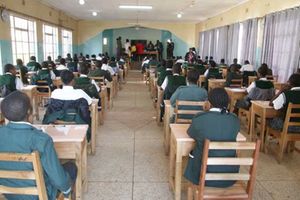
Grade Nine candidates start KJSEA English language at Moi Nyeri Complex Primary School in Nyeri county on October 27, 2025.
Photo credit: Joseph Kanyi | Nation Media Group
For example, a candidate whose qualitative score is exceeding expectation in mathematics will have a score of either seven or eight as the quantitative score, whereas a candidate whose qualitative score is below expectation will have a quantitative score of either one or two. Candidates with achievement level of seven and eight per track will be placed to boarding schools of their choice.
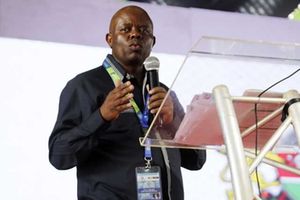
Knec CEO David Njeng'ere at a past event.
Photo credit: Bonface Bogita | Nation Media Group
In an exclusive interview with the Nation, Knec Chief Executive Officer David Njeng’ere said that the change in how the council will report the assessment results is to manage the stakes and also adhere to global best practices.
“We’ll not report a percentage score. Candidates will have points on a range of one to eight for each learning area. It is this that the Ministry of Education will use to place them to senior school. The purpose of junior school is to expose the learner to a broad curriculum, then assess them and use their performance to place them in career pathways and tracks in senior school,” Dr Njeng’ere said.
“If your child has gotten four or five, six or three, you can tell if he or she is very strong or weak in mathematics, English, creative arts or the rest of the subjects. You will get the results showing your child’s performance,” he explained.
The final score will be generated from the score in the Kenya Primary School Education Assessment (KPSEA), formative assessments in Grade Seven and Eight and the KJSEA they undertook a month ago.
“From KPSEA we have 20 per cent then we have another 20 per cent from the school-based assessments; that is 40 per cent. Then we have the summative KJSEA which they sat for recently which gives us 60 per cent. We do not want to subject a child to one assessment to tell their abilities. We wanted it to be something we see it grow over a period of time,” Dr Njeng’ere said.
On placement, Cluster 1 schools (national schools under 8-4-4) will offer all the three pathways while day schools will offer only two pathways. The pathways are Stem, social sciences and arts and sports.
The learners have already selected their preferred 12 senior schools. In the selection, nine of the schools are boarding schools (three from the learners’ home county and six from outside their home county or county of residence). The other three are day schools in their home sub-county or sub-county of residence.
Some schools will be allowed pre-selection because they do not conduct open placement. Starehe Boys Centre is an example of such schools.
According to the ministry’s document, all schools, both public and private, will admit Grade 10 learners through Nemis, and principals will not be allowed to enter a learner into the system before they report to the school physically. The ministry will monitor the reporting of the learners daily.
Further, learners who wish to change schools will make requests through the heads of the junior schools they attended at least two weeks before the official Grade 10 reporting date.
“Priority shall be given to those who had earlier selected the schools they are requesting. Approvals by MoE shall be based on senior schools’ documented capacity. Upon a request’s approval, the joining instructions shall be accessed online; at no time shall a school issue printed letters for replacement cases,” the document reads.
Replacement will be done once and shall not be reversible, the document adds.
Kenya Institute of Curriculum Development Director Charles Ong’ondo urged teachers, parents and guardians to engage the learners in meaningful discussions on their career path choices once the KJSEA results are released.
Kenya Institute of Curriculum Development CEO Charles Ong’ondo.
Photo credit: File | Nation
“Because they will now have their results, let’s talk to them together with their parents to help them make well-thought-out decisions. We are in discussions at the stakeholder level to allow children some time to revise what they had earlier chosen,” Prof Ong’ondo said.