When 20-year-old Rose Isichi enrolled at Moi University last September, she never imagined she would spend her days hawking products in Eldoret offices rather than in the lecture halls studying nursing.
The persistent lecturers’ strike has shattered learning at the university and forced many students like Rose into desperate measures to support themselves amid mounting uncertainty.
Once alive with vibrant debates and groundbreaking academic exchanges, the lecture halls at Moi University, now silent, resonate with whispers of frustration and despair.
A first year Moi University School of Medical student, with coffee sachets which she sells to keep herself busy, following the lecturers strike that entered day 37, on October 23, 2025.
Photo credit: Jared Nyataya | Nation
Ongoing challenges to restore the institution’s once-sterling reputation have left many questioning whether the iconic university can ever regain its former academic glory, with students caught in the crossfire of industrial disputes and governmental delays.
The greatest victims of the turmoil are students, particularly first-year entrants who arrived in September full of hope and ambition.
Rose, a nursing student and class representative, recalls a university life she has barely experienced. Since joining, physical classes have been a rare luxury after teaching ceased at the onset of the lecturers’ strike.
“Since I joined this school, I have hardly entered a classroom. We had a few online classes before they were also stopped,” she explains.
To survive financially, Rose has resorted to selling natural coffee products from office to office in Eldoret city.
“I have decided to sell coffee to earn a living, but life for many of my colleagues is far worse,” she admits.
For many students at Moi University, the strikes are more than an academic disruption, as they represent a crushing blow to their hopes and dreams. The institution, once a shining beacon of academic excellence and innovation in the region, now struggles with protracted industrial disputes that have left students trapped in limbo.
The ongoing national strike of lecturers does not help matters, and as it drags on, many students face harsh realities, with some considering dropping out or seeking opportunities elsewhere.
Nation caught up with student Ezra Sikuku, who has been at Moi University for over eight years studying medicine. He is even more pessimistic.
Ezra anticipates graduating after a decade due to the cumulative effects of strikes and disruptions caused by the COVID-19 pandemic.
“It is heartbreaking to watch as political leaders focus on their agendas while the education sector suffers. This strike is a reflection of that neglect,” he says bitterly.
Second-year Information Science student Aziz Hillary shares a similar story of dashed hopes. He joined the university in August last year, eager to pursue his dream, only to be met immediately with strikes.
The first industrial action was eventually called off, rekindling hope among students, but just as he prepared to settle into his studies, a nationwide strike came.
“Since starting my second year, I have not attended a single lecture. The only academic activity I remember was an online assignment set three weeks ago,” says Aziz.
The absence of classes, combined with a dwindling financial support, has left him worried about how long he can sustain himself at university.
“It is hard not knowing when things will improve. It feels like my time is being wasted, and I wonder how I will afford basic needs while the strike continues,” he adds.
Kelvin Mwema, a first-year medical student, echoes this sense of despair.
The former Kangundo High School pupil who scored a B+ had his sights set firmly on becoming a doctor. However, the strike has halted all teaching, and the campus atmosphere is one of anxiety and uncertainty.
“Every day, students pace back and forth, hoping for news about when classes will resume,” Kelvin says.
With no classes and his upkeep funds depleted, he spends much of his time scrolling through social media, seeking distraction from the growing uncertainty.
“This strike is like a nightmare. It disrupts my entire academic calendar and threatens my future as a medic,” he says.
The impact of the strike extends far beyond academic delays. Many students are battling anxiety, depression, and a growing sense of helplessness.
Carlos Ihiro, a fourth-year medical student and Secretary General of the School of Medicine Student Union, describes the collective mood as one of despair.
“Parents have exhausted their savings on tuition fees, and yet the strike drags on. Many of us have had to defer graduation multiple times. Hope is fading fast,” he laments.
Carlos speaks for many students whose academic and personal lives have been disrupted by the ongoing impasse.
With classes halted and days unstructured, student leaders warn that many students, now idle, face increased vulnerability to drug abuse and unprotected sex for money.
Moi University’s administration faces growing pressure to resolve the crisis, but has so far been unable to broker a solution.
The lack of structured activity at the institution has left many vulnerable to negative influences, adding a worrying dimension to the crisis. President of the Moi University Student Organisation (MUSO) Edwin Lagat paints a grim picture of student life amid the strike.
“More than 80 percent of students have been forced to return home as they await the court’s ruling due on October 29,” says Lagat.
“Many students have become involved in drug abuse and risky behaviours, including unprotected sex for money. If the strike continues, these problems will only worsen,” the student leader warns.
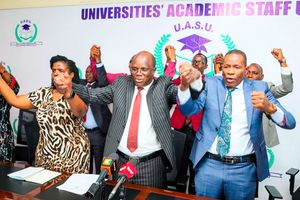
Dr. Busolo Wegesa (left), University Academic Staff Union's Secretary for Moi University Chapter, in Uasin Gishu County, accompanied by the Chapter’s Chairman Dr Richard Okero second (left), Mary Chepkwemoi, Secretary of Kenya University Staff Union at the institution, and other officials during a press conference in Eldoret City in the county, about the on-going nationwide strike by lecturers and other workers over pay which entered day 37, on October 23, 2025.
Photo credit: Jared Nyataya | Nation
Meanwhile, lecturers remain unwavering in their demands for payment of Sh 7.9 billion in wage arrears owed from previous collective bargaining agreements.
Led by University Academic Staff Union (UASU) Secretary General at Moi University, Busolo Wegesa, they have refused to resume teaching until these payments are honoured and fresh negotiations for the 2025–2029 period are concluded.
“Students are the ones suffering, but the Ministry of Education is taking their plight lightly,” says Mr Busolo, who declared their strike will continue until all their grievances are addressed.
On Thursday, Dr Richard Okero, the Moi University UASU branch chairman, emphasised the union’s resolve.
“We want to settle all pending issues before returning to class. We cannot allow another strike in the future,” he said, accusing the university management of misleading students to return to campus when the strike is still ongoing.