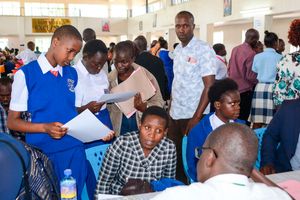
Grade 10 learners pursuing the Science, Technology Engineering and Mathematics (STEM) pathway still do not have textbooks, which is causing uncertainty with schools due to break for the midterm on February 25.
Secondary school principals have now raised the alarm, warning that the delay is disrupting learning at a critical transition point under the Competency-Based Education (CBE).
According to the school heads, while learners have already begun settling into their chosen pathways, the absence of approved STEM textbooks means that both teachers and students are having to rely on improvised notes and reference materials.
“Grade 10 text books for subjects Kiswahili, business studies, literature, Fasihi, History & citizenship and community service learning from Oxford University Press Publishers have been supplied today evening. No single book for STEM pathway for grade 10 have been supplied two weeks before schools breaks for mid-term on February 25, 2026,” said a Principal of a school in Samburu County, who requested to speak on condition of anonymity for fear of victimisation.
A parent buys textbooks for her daughter at a bookshop in Kisumu on January 4, 2025 ahead of the reopening of schools.
Photo credit: Alex Odhiambo | Nation Media Group
The concern comes at a time when schools are already grappling with low enrolment in some language subjects.
“We are in the second month of learning, and our STEM classes are operating without approved course books. Teachers are forced to use the 8-4-4 textbooks which may not fully align with the curriculum designs. What was the point of changing the curriculum if there are no textbooks? This is not sustainable,” said a Principal in Bungoma County, who also spoke in confidence.
Another school head based in Turkana added: “The delay is widening inequality. Schools in urban areas may have alternative digital resources, but in rural schools like ours, textbooks are the primary teaching tools. Our learners should not be punished for choosing STEM.”
Kenya Institute of Curriculum Development (KICD) Chief Executive Officer Charles Ong’ondo attributed the situation to shifting learner numbers and subject selections. He explained that the numbers of learners taking various subjects in particular schools across the country, before placement, are quite different now.
“The challenge that has arisen is that the numbers of learners taking various subjects in particular schools across the country, before placement, are quite different now. Some schools have admitted many more learners while some have far fewer learners,” he said.
“Learners have also changed their subject choices in large numbers. We are a bit behind schedule due to pace of printing, but actively on course,” Prof Ong’ondo told Sunday Nation .
Parents and guardians purchase textbooks and stationery at Topgate Bookshop in Nairobi on January 5, 2026 ahead of the reopening of schools.
Photo credit: Bonface Bogita | Nation Media Group
Kenya publishers Association said that delivery of the remaining Grade 10 STEM textbooks has slowed due to adverse weather conditions that have made some areas difficult to access, even as they maintained that printing is 100 per cent complete and 70 per cent of the books have already been dispatched to schools nationwide.
“The current status of Grade 10 STEM textbooks; have they been printed and dispatched? Printed is 100 per cent and dispatched is 70 per cent. If there is a delay, what is causing it and when should schools expect delivery? Access to certain areas is currently restricted. Rainfall and related weather conditions have rendered parts of the terrain unstable and, in some locations, temporarily impassable. We are closely monitoring the situation and will proceed once conditions improve to ensure safety and operational efficiency,” said KPA chairman Kiarie Kamau told the Nation
According to the KICD, the overall printing and distribution of Grade 10 course materials and literary texts to public senior schools is at 70.41 per cent as of February 13, 2026.
In a status update, KICD said 21 publishers were contracted to print, package and distribute the materials. Out of the 11,867,325 copies ordered, 11,142,230 have so far been printed, representing 93.89 per cent of the total. However, only 8,355,780 copies have been distributed to schools countrywide.
Publishers revealed that no single STEM pathway textbook for Grade 10 has been fully supplied two weeks before schools break for mid-term on February 25, raising fresh concerns over preparedness under the CBE rollout.
A distribution list seen by the Nation shows that supplies for STEM subjects have been split between two publishers per subject, each allocated 60 per cent and 40 per cent shares respectively. However, schools report that the books are yet to reach them in full.
According to the distribution schedule, Agriculture was allocated to Mountaintop (60 per cent) and Oneplanet (40 per cent) with Aviation to Bookmark (60 per cent) and KLB (40 per cent). The list assigned Biology to Distinction (60 per cent) and Spotlight (40 per cent). Chemistry titles were split between Access (60 per cent) and Front Row (40 per cent).
A teacher collects newly arrived Grade 10 textbooks from the collection centre in Nakuru Day Senior School on February 3, 2025.
Photo credit: Boniface Mwangi | Nation Media Group
In Computer Studies, Modern Tech was allocated 60 per cent and Doritex 40 per cent, while Electricity was shared between Booklyst (60 per cent) and Distinction (40 per cent). General Science was assigned to Hummingbird (60 per cent) and Mentor (40 per cent), with Home Science to Mentor (60 per cent) and Mountaintop (40 per cent).
Core Mathematics was distributed between Booklyst (60 per cent) and Mentor (40 per cent). Other allocations include Metal Work for Distinction (60 per cent) and EKM (40 per cent), while Physics was split between Spotlight (60 per cent) and Astute (40 per cent). Power Mechanics was shared between Distinction (60 per cent) and Booklyst (40 per cent), while Woodwork was assigned to Mountaintop (60 per cent) and EKM (40 per cent). Media Technology was allocated to Front Row (60 per cent) and KLB (40 per cent).
The association noted that while substantial progress has already been made, delivery to some areas may take longer due to challenging terrain and accessibility constraints.
“KPA is working in close coordination with KICD and MOE to ensure that, by next week, publishers have achieved at least 90% distribution as earlier indicated,” said Mr Kiarie.
KICD noted that distribution is still ongoing in most counties and assured that by the end of February 2026, all books will have been delivered to schools.
Regionally, Nairobi leads in distribution at 86.71 per cent, followed by Central at 80.18 per cent and Western at 79.77 per cent. Nyanza stands at 75.40 per cent while Rift Valley is at 67.46 per cent. Eastern has achieved 64.94 per cent, Coast 60.25 per cent, and North Eastern trails at 48.57 per cent.
“By the Midterm, KICD expects that numbers of G10 learners shall have stabilise to inform a second phase of distribution based on actual numbers in the subjects in each school. For now, our monitoring reveals that school in the distribution list provided by the Ministry of Education have received adequate textbooks to start on as we await the re-distribution,” said Prof Ong’ondo.