Prof John Okumu, who was appointed Kenyatta University’s substantive Vice Chancellor on Monday, takes over the institution at a pivotal moment as it seeks to move beyond years of leadership wrangles that defined much of his predecessor Prof Paul Wainaina’s eight-year tenure.
Prof Wainaina’s time in office was marked by repeated court battles as he fought to retain his position, leaving behind a university whose governance frequently attracted public attention.
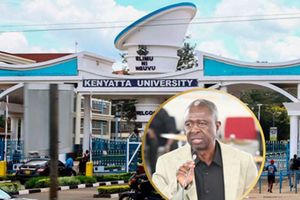
Prof Paul Kuria Wainaina, the outgoing Vice-Chancellor of Kenyatta University.
Photo credit: Dennis Onsongo | Nation Media Group
The new VC has been serving in an acting capacity since January 2026 after Prof Wainaina’s exit. During that period, he presided over the university’s 59th graduation ceremony held on July 17, which was attended by Education Cabinet Secretary Julius Migos Ogamba. During that occasion, Prof. Okumu oversaw the first graduation ceremony in his capacity as acting VC.
Kenyatta University Council Chairperson Prof Clara Momanyi presided over Prof Okumu's appointment ceremony on Monday.
Prof Okumu, who struck a confident tone, thanked the University Council for the confidence it had placed in him and pledged to provide visionary, inclusive and transformative leadership while safeguarding academic excellence.
“I am deeply honoured by the confidence the University Council has placed in me. I am committed to leading with humility, integrity and openness as we work together to strengthen Kenyatta University’s position as Kenya’s premier university and a globally competitive institution,” Prof Okumu said.
Prof Momanyi expressed confidence that the new VC's extensive academic and administrative experience would strengthen the university’s long-standing reputation in teaching, research, innovation, entrepreneurship and community engagement.
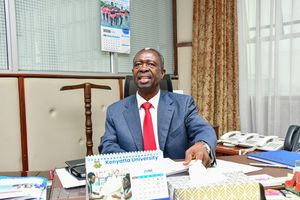
Kenyatta University Vice-Chancellor Prof John Okumu.
Photo credit: Pool
Prof Okumu assumes office as KU seeks to consolidate its standing as one of the country’s leading institutions of higher learning while navigating significant financial and operational challenges facing the public university sector.
His confirmation comes at a time when public universities are grappling with shrinking government funding, delayed Exchequer disbursements and increasing pressure from the State to generate more of their own revenue.
Education CS Mr Ogamba has acknowledged that KU faces the same challenges confronting most public universities, including financial constraints, rising student enrolment and mounting pressure to maintain the quality and relevance of higher education.
Speaking earlier during the university’s graduation, Mr Ogamba said the difficulties facing KU reflect a broader crisis within Kenya’s public university sector, one that the government hopes to address through ongoing reforms.
He said universities must evolve beyond their traditional role of awarding degrees and become centres of innovation capable of developing practical solutions to national challenges. Academic programmes, he added, should be aligned with changing labour market demands to produce graduates equipped with relevant and marketable skills.
For Prof Okumu, that means balancing financial sustainability with academic excellence.
According to the 2026/27 KUCCPS placement results, Kenyatta University admitted 11,224 first-year students, the highest in the country, ahead of Moi University (8,869) and the University of Nairobi (8,604).
Together, the three institutions enrolled 28,697 students, accounting for about 14.2 per cent of the 202,133 learners placed in degree programmes nationwide.
Kenyatta University Vice-Chancellor Prof John Okumu.
Photo credit: Pool
Education experts attribute their continued popularity to their established reputations, broad academic offerings, extensive infrastructure, experienced faculty, strong research output and strategic locations, making them the preferred choice for many government-sponsored students.
Prof Momanyi said the Council was confident Prof Okumu possessed the leadership qualities required to steer the university through its next phase.
“We are going to offer full cooperation to the new Vice-Chancellor, and we hope he will take this university to the next level through the strategies we have laid out. We have seen that he is hardworking, intelligent and calm, qualities we want in any leader,” she told the Nation.
The new VC acknowledged the challenges ahead but said he was optimistic that, working with management, staff and students, the university would continue to grow.
“I thank the University Council, the Ministry and the management of KU for giving me this opportunity to steer Kenyatta University to greater heights. I know we have challenges, but with my team and our staff, I am confident we will overcome them.
“I promise the student fraternity good leadership and quality education. We will continue striving to ensure they receive the best possible training while leveraging emerging technologies,” he said.
A physicist by training, he holds a PhD in Condensed Matter Physics from the University of Leeds, an MSc in the same field from Kenyatta University, and a Bachelor of Education (Science) specialising in Physics and Mathematics from the same institution. He began his undergraduate studies in 1983.
He has spent his entire academic career at Kenyatta University, rising from Tutorial Fellow in 1988 to Lecturer, Senior Lecturer, Associate Professor and eventually Full Professor in the Department of Physics in 2020.
His research has focused on thin-film physics, nanoparticle optics and electron-scattering theory, resulting in more than two dozen peer-reviewed publications and two books. He has also secured research grants and fellowships from organisations including the Alexander von Humboldt Foundation and Germany’s DAAD.
Beyond academia, Prof Okumu built an extensive administrative career that ultimately positioned him for the university’s top job.
He served as Deputy Vice-Chancellor (Academic) from 2010 to 2020, during which the university introduced 77 new academic programmes, secured accreditation for five campuses and expanded student enrolment from about 45,000 to 74,000.
Earlier, he served as Director of the Centre for Career Development and Placement and chaired the Department of Physics. Between 2011 and 2020, he also served as Acting Vice-Chancellor on more than 40 occasions whenever the substantive office holder was away.
Over the years, he has chaired numerous university boards and committees, including the Board of Postgraduate Studies and the E-learning Board, while cultivating international academic partnerships with institutions in Germany, South Korea, the United States, Canada and other countries.
The University Council believes that experience places him in a strong position to lead Kenyatta University as it seeks to strengthen its academic standing while navigating the financial and governance challenges facing Kenya’s public universities.