Behind ODM’s public assurances of unity and commitment to working with President William Ruto, a fierce contest is unfolding over what it stands to gain from a 2027 coalition and whether its traditional strongholds can withstand the growing challenge from rival political formations.
At the centre of the emerging divisions is the question of what ODM stands to gain from supporting Dr Ruto’s re-election, how much political space it will retain under the proposed arrangement and whether its leadership can prevent competing interests from fracturing its traditional strongholds.
ODM leaders demand a signed pre-election deal with UDA
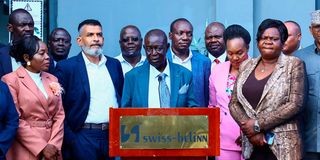
The tensions are emerging even as party leader Oburu Oginga insists that ODM remains united and committed to working with UDA, with the two parties expected to formalise their cooperation through a pre-election coalition agreement. ODM’s Central Management Committee meeting at Chungwa House in Nairobi yesterday sought to project unity, but the resolutions adopted exposed the difficult negotiations ahead.
Dr Oginga maintained that ODM had a clear political direction and would not be distracted by emerging competition.
“We know where we have come from and where we are headed; we shall not be distracted by anyone,” he said after receiving former Bureti MP Paul Sang, who defected from Kanu.
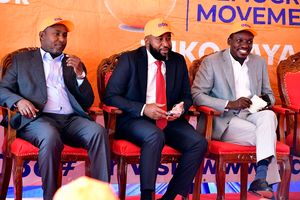
His remarks came amid growing concerns among party members over the emergence of the Movement for Democracy and Growth (MDG), led by Ugenya MP David Ochieng, and its increasing activities in Nyanza.
The party is increasingly being viewed by some ODM members as an alternative political vehicle for leaders who may feel disadvantaged by the Orange party’s nomination process or dissatisfied with its association with UDA. Dr Oginga dismissed the challenge, describing MDG as a one-man party and questioning its ability to compete with ODM.
“MDG is a one-man party. There is no way they can claim to teach us how political parties are run. We shall continue visiting all corners of the country with the aim of making our party visible and stronger,” he said.
But the emergence of MDG comes at a sensitive moment for ODM, which is attempting to negotiate a political partnership while defending its influence in a region where the party has enjoyed considerable support.
The challenge is particularly pronounced in Siaya, Kisumu, Homa Bay and Migori, where governor and parliamentary aspirants are already positioning themselves for nominations.
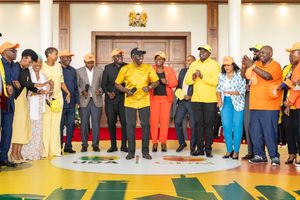
President William Ruto addresses Nairobi UDA and ODM leaders and delegates when he hosted them at State House, Nairobi on November 13, 2026.
Photo credit: PCS
Meanwhile, the coalition talks with UDA have entered a critical phase. However, the internal struggles within ODM and the battle to control its strongholds threaten to derail the alliance.
UDA and ODM are expected to agree on a common manifesto and a framework for political cooperation early next year ahead of the election.
In its resolutions, the Central Committee agreed to continue structured engagement with UDA and set January 31, 2027, as the deadline for completing the work of the joint manifesto team.
National Assembly Minority Leader Junet Mohamed, who read the resolutions, said the document would outline the policies and common issues that would guide the proposed coalition.
“We want to expedite the process by the manifesto team and ensure it is concluded by January 31, 2027. The report will outline issues and policies that will inform the formation of a coalition with UDA,” he said.
The deadline is significant because it is expected to move the partnership beyond the broad-based government arrangement into a formal electoral alliance.
ODM leaders have previously demanded a 50-50 sharing arrangement, including a claim to the Deputy President’s position, arguing that the party should receive an equitable share of government positions in return for supporting Dr Ruto.
UDA, however, has not publicly committed to that formula, leaving the negotiations over positions below the presidency, campaign structures and the distribution of influence unresolved.
ODM Party Leader Dr. Oburu Oginga (centre) addresses the media following a meeting of the party’s Central Committee on November 25, 2026.
Photo credit: Wilfred Nyangaresi | Nation
The two parties have also discussed establishing a joint campaign committee and treasury, while their technical teams work on a common manifesto.
For ODM, a written agreement is increasingly being viewed as an important safeguard against entering an electoral arrangement based on political assurances that may not translate into actual power after the election.
The party is also concerned about retaining its identity and organisational independence, particularly in areas where UDA is seeking to expand its influence.
The question of zoning has emerged as another major source of friction. ODM leaders in Nyanza want political arrangements that recognise the party’s historical strength in the region and prevent UDA from sponsoring or supporting rival political formations that could weaken its influence.
Junet warns UDA against undermining ODM's government role
However, Interior PS Raymond Omollo has cautioned against treating particular regions as exclusive political territories.
Speaking during the burial of Kibra MP Peter Orero’s brother, Joshua Orero, Dr Omollo warned ODM against alienating other parties through its zoning demands.
“Yes, we must strengthen the party, but let us be very careful how we do it. Let us not make other parties a scarecrow, which, at the end of the day, will make us all lose,” he said.
He also questioned the push to strengthen ODM at the expense of other political formations, arguing that political leaders should be careful not to undermine the broader partnership.
His remarks have unsettled a section of ODM, with some members interpreting them as an indication that UDA is uncomfortable with the Orange party’s demands for political space and recognition in Nyanza.
A source who attended the Central Committee meeting told the Nation that members were concerned about what they viewed as contradictory signals from their partners.
“The way the PS has been opposing zoning has made members feel that there is a hidden agenda and that UDA is competing with us through another vehicle. We do not fear competition, but why should we be in a 50-50 engagement when someone is going behind our backs and using another party to frustrate ODM?” the source said.
The source maintained that ODM would not abandon its demand for an equitable share of power or its efforts to consolidate its political base.
“We want to ensure that we get our fair share of the bargain so that if anybody from the opposition joins the arrangement, they can get a share of what UDA has and not ours. That is why we insist on having a strong party. But we have also agreed that nominations must be free and fair so that the people have their say,” the source added.
Led by Mr Ochieng, the party has been recruiting politicians in Nyanza and Western Kenya, presenting itself as an alternative political platform ahead of the 2027 elections.
Its growing activities have coincided with defections by politicians previously associated with ODM, raising concerns within the Orange party that dissatisfied members could use the outfit to challenge its dominance.
Former Deputy President Rigathi Gachagua has sensationally claimed that UDA had planted “a small wheelbarrow – MDG in Nyanza to fight ODM,” claims that have bene denied by the outfit.
ODM Party Leader Dr. Oburu Oginga (centre) addresses the media following a meeting of the party’s Central Committee at Swiss-Belinn Hotel in Kileleshwa, Nairobi, on November 25, 2026.
Photo credit: Wilfred Nyangaresi | Nation
MDG has also pledged to conduct free and fair nominations, an appeal that could attract aspirants concerned about their chances of securing ODM tickets.
The party has rejected allegations that it is being financed by State House to undermine ODM, insisting that it is an independent political formation entitled to compete for support.
Beyond the coalition negotiations, ODM is also facing an increasingly complicated internal nomination process.
In its resolutions yesterday, the ODM Party’s Central Committee sought to address the nomination concerns by promising free and accountable primaries.
Mr Mohamed warned disgruntled members against using the nomination process as an excuse to undermine the party.
Dr Oginga also cautioned party officials against accepting money from aspirants in exchange for nomination tickets, warning that those found engaging in bribery would be disqualified.
“Some people are saying they have money and they will just give me money and I give them a ticket. I will not take that money. What do I need that money for?” he said.
He further identified consensus as the preferred method of resolving nomination disputes, arguing that aspirants should first seek agreement before the party resorts to other mechanisms.
The challenge for Dr Oginga is that the coalition negotiations and nomination disputes are increasingly interconnected. How ODM distributes its tickets could determine whether it retains its political networks or loses some of its members to rival parties.
The party is also navigating the difficult task of preserving its national identity following the death of its long-time leader Raila Odinga, whose political influence helped hold together competing interests within the movement.
For President Ruto, the partnership offers an opportunity to consolidate support in regions where UDA has historically struggled to establish a comparable political foothold.
But for ODM, the arrangement carries the risk of weakening its independent political identity if the party fails to secure clear guarantees on power-sharing and its electoral interests.
The January 31, 2027 deadline for the joint manifesto could provide a clearer picture of the direction of the negotiations, but anakysts have warned that it will not necessarily resolve the outstanding questions over positions, zoning and the distribution of elective seats.