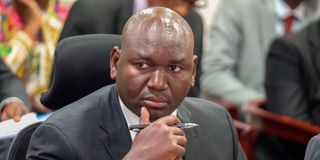
Basic Education Principal Secretary Julius Bitok is under mounting pressure over repeated snubs of the National Assembly Education Committee, with MPs now questioning the seriousness of his commitment to the education docket.
On Thursday, Prof Bitok, through his officers at the Ministry of Education, for the fifth consecutive time asked the committee to reschedule a scheduled meeting, citing prior engagements and proposing a new date.
Members of the committee expressed frustration over delays in getting the PS to respond to concerns on capitation, the transition to senior school, and scrutiny of key projects.
“The letter came in yesterday informing us that the PS will not be available today and that the meeting be rescheduled to May 6. It is unfortunate that this is the fifth time this is happening. Our Standing Orders allow us to summon him, and this will be done,” said committee vice-chairperson and Kabondo Kasipul MP Eve Obara.
Kibra MP Peter Orero said the repeated postponements suggested the PS was taking the committee for granted and failing the accountability test to Kenyans.
“These Members of Parliament travel from their constituencies to attend these meetings, only for them to be postponed at the last minute,” he said.
Siaya MP Christine Ombaka said the failure to appear signalled a casual approach to critical issues in the sector.
“It is clear he does not take seriously what is happening in the education sector. I am very disappointed,” she said.
While Prof Bitok has appeared before the Public Accounts Committee, he has consistently failed to honour summons from the Education Committee, which directly oversees his docket.
The committee has invited Prof Bitok to provide a comprehensive briefing on capitation, the senior school transition, and ongoing education projects such as the Secondary Education Quality Improvement Project (SEQUIP) and Kenya Primary Education Equity in Learning (KPEEL).
In a letter dated March 30, 2026, the PS indicated he would not attend a meeting scheduled for April 1 due to prior engagements, proposing April 23 instead, a date the committee accepted.
However, on April 22, a day before the rescheduled meeting, the State Department for Basic Education again wrote to the committee requesting a further postponement to May 6.
“This is to inform you that the Principal Secretary will not be available on the aforementioned date due to prior engagements. We therefore request a postponement of the meeting to May 6, 2026,” read the letter dated April 22.
The delays mean that pending matters in the basic education sector remain unaddressed, as public schools endure financial strain amid incomplete state capitation.
A section of boarding school principals sent learners home for the April holidays days ahead of the official date as debts mounted and essential supplies ran low.
The principals noted the Sh44.2 billion sent by the Ministry of Education (MoE) for Term One barely covered 50 percent of the expected funds and did little to clear debts accumulated over the years.
Aside from delayed capitation disbursements that have failed to keep pace with learner numbers, the country witnessed a chaotic transition of the pioneer Competency-Based Education (CBE) cohort to Grade 10.
The transition was marred by discontent from parents over the manner in which the placement was done, coupled with persistent delays in downloading admission letters from the placement portal.
This was followed by delays in the distribution of Grade 10 textbooks, as printing firms refused to produce them due to unpaid debts for books supplied to Grades 8 and 9 since 2022.
To remedy these challenges, the Ministry of Education proposed the formation of a technical committee to advise the government on policy decisions to manage Grade 10 placement challenges going forward.
The proposal made before the Senate was shot down even before take-off, with education stakeholders arguing that setting up the committee was unnecessary, insisting the government already possesses the data required to make informed policy decisions.
The KPEEL is a government-led initiative aimed at improving learning outcomes and promoting equitable access to quality education in Kenya’s primary schools, while the SEQUIP focuses on enhancing access to and the quality of secondary education.
The Committee on Education, chaired by Tinderet MP Julius Melly, is keen to check prudent resource use, learning outcomes, teacher effectiveness, and infrastructure across disadvantaged areas of Kenya.
A recent report by Usawa Agenda shows one in three Grade 6 learners cannot read and comprehend a Grade 3-level English story, raising serious concerns about readiness for junior school.
The Foundational Literacy & Numeracy Assessment Report (FLANA 2025) shows Garissa, Mandera and Turkana top the list of counties with the most students out of school, with those aged between four and five years being the most affected.
On average, 94.2 percent of children aged between four and 17 years are in school, and the 10 counties with enrolment rates below the national average are in the ASAL regions.