New data from the Ministry of Education has revealed a sharp imbalance in the distribution of public senior schools across the country, raising concerns about equity and access under the new senior secondary education structure.
According to the data, only 204 public schools are classified as Cluster One (national schools), compared to 692 Cluster Two (extra-county schools), 1,373 Cluster Three (county schools) and a staggering 7,234 Cluster Four (sub-county schools), the lowest-performing category.
The Rift Valley region leads in the number of senior schools across all categories reflecting both its size and population.
The region has 56 national schools—the highest in the country—alongside 189 extra-county, 408 county and 2,054 sub-county schools.
In the Central region, there are 33 national schools, 101 extra-county, 141 county and 888 sub-county schools. While the region has a relatively strong presence of Cluster One and Two schools, sub-county institutions continue to dominate.
The Ministry of Education says learners across Kenya were placed in senior schools using the County Revenue Allocation (CRA) formula designed to ensure fairness, equity and transparency.
Unlike the 8-4-4 system where placements were largely based on exam scores and ranking, the CRA formula considers population, learner performance, poverty levels, distance to schools and school size and infrastructure.
This means larger counties like Nairobi, Nakuruand Kakamega are likely to receive more slots.
“To ensure fairness in placement across the country, we have adopted the CRA formula to distribute students from all counties fairly across the four school clusters. This ensures that a child from Northern Kenya has the same opportunity as one from Western Kenya to join a school in Nairobi or elsewhere,” said Basic Education Principal Secretary Prof Julius Bitok.
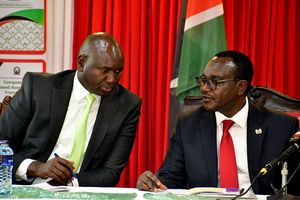
Education PS Julius Bitok during the 2025 Kenya Primary School Heads Association Annual Delegates Conference in Mombasa on November 12, 2025.
Photo credit: Kevin Odit| Nation Media Group
The Eastern region illustrates the imbalance most starkly. Although it has 33 national schools, equal to Central, it has 1,560 sub-county schools, the second-highest number after Rift Valley.
This means that for every national school in Eastern, there are dozens of sub-county institutions limiting access to higher-cluster schools for many learners.
In Nyanza, there are 31 national schools, 114 extra-county, 195 county and 1,299 sub-county schools. In Western region, the figures are 18 national schools, 80 extra-county, 184 county and 852 sub-county schools.
Similarly, in the Coast region, there are 17 national, 36 extra-county, 55 county and 392 sub-county schools.
The North region has the lowest numbers with only 6 national schools, 13 extra-county, 47 county and 120 sub-county schools raising concerns about access to quality education in arid areas.
Even Nairobi, despite being the capital, has relatively few senior schools: 10 national, 17 extra-county, 12 county, and 69 sub-county schools.
Analysts attribute this to land constraints, historical planning models and reliance on private institutions.
Learner distribution also reflects these disparities. Soem 512,000 learners secured slots in STEM schools, 420,000 in Social Sciences, and 115,000 in Arts and Sports pathways.
‘Cluster One schools with the highest infrastructure and specialization enrolled 105,000 learners. Cluster Two took in 254,000, Cluster Three 288,000 and Cluster Four, the largest group, absorbed 399,000 learners the biggest share of placements.
Learners are required to report to their senior secondary schools by Monday, January 12, 2026.
PS Bitok explained that placement follows a structured merit-based framework under the Competency-Based Education (CBE) system.
“Selection of learners is guided by guided by a clear framework that considers learners’ choices, performance in the Kenya Junior Secondary Education Assessment (KJSEA) and the availability of spaces in preferred schools and subject combinations,” he said.
According to the PS, placements consider three main factors: learner preferences, KJSEA performance, and vacancies in chosen schools.
Each pathway—STEM, Social Sciences, or Arts and Sports—is aligned to academic performance, school specialisation and capacity. Final allocation also considers approved school capacity and sub-county quotas, computed using a modified CRA formula to ensure fairness across regions.
The placement portal will remain open for seven days, allowing learners to revise their choices if they are uncomfortable with their assigned school or pathway.
“Being a pioneer undertaking, the Government appreciates the anxieties and uncertainties surrounding the transition to Grade 10. We are committed to making the placement process transparent, fair, and satisfactory, while taking into account learners’ preferences and school capacities,” Prof Bitok said.
The PS revealed learners were given 12 school choices (C1 to C4) earlier this year with guidance from parents and teachers. The CBE system evaluates learners through a combination of formative and summative assessments: 40percent from Kenya Primary School Education Assessment (KPSEA) in Grade 6, 20percemnt continuous assessment in Grades 7 and 8, and 60percent from KJSEA in Grade 9.
The Ministry will also address errors such as incorrect gender entries during the seven-day review period, starting Tuesday, December 23, 2025.