University education and training is set for a major overhaul if a draft competency-based framework for university education (CBFUE) is adopted by all universities to align with the competency-based education (CBE).
The draft that was presented yesterday for deliberation by vice chancellors from all universities in Kenya proposes a raft of reforms that touch on curriculum designs, teaching and learning approaches, assessment, quality assurance mechanisms, governance arrangements, industry linkages, and implementation strategies in Kenyan universities. The consultative conference was held at the United States International University-Africa (USIU).
The new approach includes having smaller classes, employing more staff, hands-on staff, incorporating ICT infrastructure, revision of curriculum to avoid repetition, revision of teaching and assessment methods (including potentially involving the industry in assessment of students) to focus more on demonstrable competencies
The process will also involve retooling of university lecturers on appropriate pedagogies before the first group of CBE students are admitted to universities in 2029.
According to the draft framework, the reforms are aimed at producing university graduates who will demonstrate what they can do more than what they know.
Speaking at the consultative, the Secretary for Higher Education at the Ministry of Education, Dr Carol Hunja, said the new framework aims to produce graduates who are equipped to navigate and thrive in an increasingly dynamic world.
“Higher education is undergoing profound transformation globally. We’re consistently talking about advances in technology, our demographics are changing every day, we have climate change issues, and the very nature of work is changing,” she said.
She said it was increasingly important for Kenyan universities to produce graduates who can keep pace with these changes and apply hands-on experience, solve complex problems, think critically and creatively, communicate effectively, collaborate across disciplines, use technology responsibly, and continuously learn and adapt.
The proposed changes will affect almost every aspect of university education, including what the students are taught, how the lecturers teach, how the students are tested and assessed, and what skills they are expected to demonstrate.
From left: United States International University–Africa (USIU-Africa) Vice Chancellor Prof. Mwenda Ntarangwi, Secretary for Higher Education Dr. Carol Hunja and Commission for University Education (CUE) Chief Executive Officer Prof. Mike Kuria during the first Vice-Chancellors’ Consultative Conference on the Draft Competency-Based Education (CBE) Framework for University Education, held at USIU-Africa in Nairobi on August 21, 2026.
Photo credit: Bonface Bogita | Nation
The framework has been benchmarked with training in other countries like: UK, the Netherlands, Finland and Australasia.
According to the CEO of the Commission for University Education (CUE), Prof Mike Kuria, universities will first have to review their curricula to ensure they build on, rather than repeat, what students have already covered under the CBE.
“There is no need to subject a student to learning something they already know,” he said. “So, once we establish the competence that has already been covered in the lower classes, then we revise and align our curriculum so that we are not repetitive.”
The changes will also affect what students learn, with demonstrable competencies being introduced across different disciplines, institutions and modes of delivery. These competencies include but are not limited to effective communication, critical and analytical reasoning, digital and information literacy, and creativity and entrepreneurship.
The shift will further require universities to rethink how those competencies are taught. Lecturers, who have traditionally worked within a content-heavy system, will need to adopt more hands-on approaches to teaching and learning. This, Prof Kuria said, could also mean adopting different approaches to support this, such as the reduction of class sizes and the availability of ICT infrastructure.
How those competencies are measured, however, will also have to change to include more practical methods that might even involve the relevant industries.
“What we have been doing has been very content-oriented. We sit students somewhere, give them an examination where they write down the content we’ve given them and then we mark it. But now we are saying having the theory is not enough. We need to see whether they can apply the knowledge they have.”
The emphasis on demonstrable skills is also expected to become increasingly important as universities grapple with the use of artificial intelligence (AI) by students.
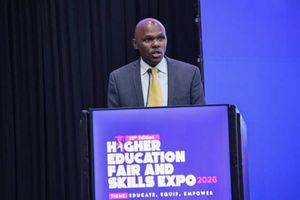
Commission for University Education (CUE) CEO Prof. Mike Kuria speaks during the first Vice-Chancellors’ Consultative Conference on the Draft Competency-Based Education (CBE) Framework for University Education, held at USIU-Africa in Nairobi on August 21, 2026.
Photo credit: Bonface Bogita | Nation
“In the context of AI, especially, where students can get a very nice grade that they have not worked for by using AI, having a nice certificate that shows you are a first-class graduate may not be that useful in the course of time because employers are going to start asking, but what can you do with the first-class degree that you have?” Prof Kuria observed.
However, the framework does not propose a single national curriculum for all universities since they are independent institutions.
“Graduate capability expectations should be reflected in all university qualifications in Kenya, irrespective of discipline, institution, or mode of delivery. These define the common expectations for what graduates should know, be able to do, and value on successful completion of a programme of study,” the document reads.
For students the changes could also influence how they approach university education, including how they choose where to study.
“It will no longer be about just choosing a university with a good reputation, but finding one with the right curriculum, teaching methods, and connection with the industry because ultimately, it is the skills that they acquire in these schools that will be of use,” Prof Kuria said.
For parents, reforms could come with requirement for greater investment in their children’s university education than before, particularly as technology becomes more central to learning. Prof Kuria said IT devices and equipment could become essential tools for student engagement, requiring parents to view them as an investment in their children’s education.
From left: United States International University–Africa (USIU-Africa) Vice Chancellor Prof Mwenda Ntarangwi, Secretary for Higher Education Dr Carol Hunja and Commission for University Education (CUE) Chief Executive Officer Prof Mike Kuria during the first Vice-Chancellors’ Consultative Conference on the Draft Competency-Based Education (CBE) Framework for University Education, held at USIU-Africa in Nairobi on August 21, 2026.
Photo credit: Bonface Bogita | Nation
The dons acknowledged that the transformation will require additional resources and capacity building as universities adapt their institutional culture and approaches, as well as investment in infrastructure, technology and new quality assurance mechanisms.
“These challenges should not be a deterrent,” Dr Hunja said. “They should help us develop a very realistic and adequately-supported implementation strategy so that we can ensure that a graduate leaving a Kenyan university possesses not only the qualification, but also the competence, confidence, and character needed to meaningfully contribute to the society.”