Lecturers and other workers in public universities have rejected the latest government proposal in the 2025–2029 collective bargaining agreement (CBA), saying it falls short of the demands they had placed on the table, to forestall a nationwide strike.
The dispute centres on the wide gap between what the three university staff unions initially demanded and what the Inter-Public Universities Councils Consultative Forum (IPUCCF), representing the employers, recommended for approval by the Salaries and Remuneration Commission (SRC).
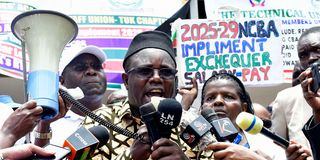
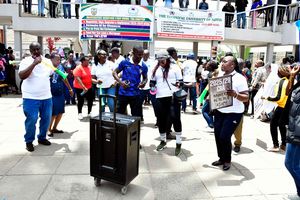
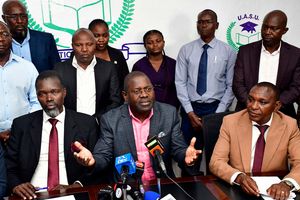
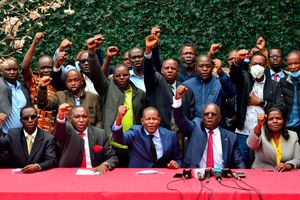
The unions — Universities Academic Staff Union (UASU), Kenya Universities Staff Union (KUSU) and Kenya Union of Domestic, Hotels, Educational Institutions, Hospitals and Allied Workers (KUDHEIHA) — have rejected the latest counter-offer and instructed their members to withdraw their labour.
The three unions had submitted their proposals for the 2025–2029 CBA early last year, with Uasu submitting its demands on February 3, 2025, Kusu on February 13 and Kudheiha on March 5. The negotiations were conducted through IPUCCF under the Labour Relations Act and SRC guidelines on collective bargaining in the public service.
At the heart of the disagreement is the amount by which salaries should be reviewed during the four-year CBA period.
UASU proposed basic salary increases ranging between 36 per cent and 68 per cent, depending on the grade. It also sought a 57 per cent increase in house allowance, a commuter allowance of up to Sh60,000 for grades 14A and 15A, and a Sh80,000 professorial allowance.
The union further proposed annual book allowances ranging from Sh65,000 to Sh90,000, depending on grade, annual leave allowances of between Sh50,000 and Sh70,000, and passage and baggage allowances ranging from Sh30,000 to Sh70,000. It also sought medical, dental and optical cover.
“Universities cannot negotiate on behalf of us. Allow us to negotiate. We want SRC to take our demand proposal, also get the recommendations from the employer, and then arrive at independent advice,” said Dr Constantine Wasonga, the national secretary-general of UASU.
“When you come up with a global figure which is final, what do you want us to do? Accept the figure? We are not allowed that. Allow us to negotiate,” he added
However, the employers’ position was considerably lower. IPUCCF considered three possible salary scenarios: a two per cent increase across the board, which would result in an 8.25 per cent cumulative increase over the CBA period; a two per cent increase for grades 11–15 and three per cent for grades 1–10; and a three per cent increase across all grades, which would result in a cumulative 12.56 per cent increase.
It ultimately recommended the first scenario — an 8.25 per cent cumulative review, implemented at two per cent annually over the 2025–2029 CBA cycle.
The latest offer that the unions have rejected is therefore being viewed against a much wider disagreement over what constitutes an adequate salary review.
“What do you mean by collective bargaining agreement? We agree collectively. But now, when a party comes with a final decision and you have already arrived at the figure of Sh9.76 billion, what do you expect from us? You want us to sign what you negotiated yourselves. You need to involve us,” said Dr Wasonga.
“Respond to our demand proposal word-for-word. Five SRC commissioners cannot select a few items from our demand proposal. You shall respond to our demand proposal. After we have negotiated is when you quantify the cost of the CBA. You cannot arrive at the cost of the CBA before parties negotiate. How did you arrive at the cost before we negotiated?” he added.
Why lecturers and university staff are on strike again
IPUCCF itself acknowledged that house allowance for university staff had been frozen by SRC for about 15 years, dating back to the 2010–2013 CBA cycle.
The employers’ document notes that this happened despite inflation and an erosion in purchasing power. It also acknowledges that rents in urban areas had increased significantly, putting pressure on university staff.
It further notes that other civil servants received increases in house allowance during the period while university staff had been left out. Despite those findings, IPUCCF recommended only a three per cent increase in house allowance across the board.
The dispute also extends to commuter, book, professorial and leave allowances.
IPUCCF found that universities were paying commuter allowances differently, with some institutions basing payments on grades, others on whether an employee owned a car, and others using standard rates
At the time, the document showed that staff with cars were receiving between Sh11,000 and Sh20,000, while those without cars received between Sh6,170 and Sh18,000. IPUCCF proposed harmonising the payments.
For book, passage and baggage, professorial and annual leave allowances, the employers proposed using a mean rate and allowing universities paying below the agreed level to progressively bridge the difference by 2029.
“After we have negotiated, that is when you will quantify the cost of the CBA. You cannot arrive at the cost of the CBA before parties negotiate. How did you arrive at the cost before we negotiated? We have not negotiated,” Dr Wasonga said.
Professors and associate professors have also been a point of contention. The IPUCCF noted that professors mentor junior academic staff, chair university committees and sit in senates, yet some other senate members receive management responsibility allowances while professors do not.
The employers nevertheless proposed that the allowance be harmonised around a mean rate and that universities below the agreed rate progressively close the gap by 2029.
IPUCCF noted that universities were operating different medical arrangements, including insurance schemes, in-house arrangements and direct procurement with hospitals.
It proposed standardising medical benefits within SRC limits, including outpatient cover of between Sh100,000 and Sh250,000, inpatient cover of between Sh750,000 and Sh2 million, optical cover of Sh30,000, dental cover of between Sh15,000 and Sh25,000 and maternity cover of between Sh50,000 and Sh150,000.
Kusu Secretary-General Charles Mukhwaya.
Photo credit: File | Nation Media Group
The employers also proposed onboarding the Social Health Authority into the medical arrangements and allowing universities that already had better insurance packages to retain their existing rates. Institutions with lower cover would progressively move towards the recommended rates by 2029.
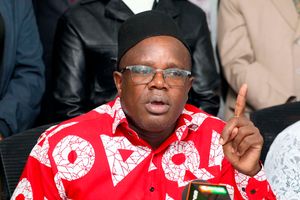
“We cannot continue negotiating endlessly, and because we already agreed on this matter through a return-to-work formula, there is no other way other than going to the streets to demand our rights. The CBA in question is not the 2017–2021 CBA. The CBA that we are contesting is the 2025–2029 CBA. The officers who are misadvising you on this matter are misleading you,” said KUSU chairman Dr Charles Mukhwaya.
For the unions, the disagreement is therefore not simply about a percentage increase in basic salary.
They are challenging the overall value of the proposed CBA, including salary, housing, allowances, medical benefits and other terms of employment. Uasu’s original salary proposal ranged from 36 per cent to 68 per cent, while IPUCCF’s recommendation was an 8.25 per cent cumulative increase, implemented at two per cent annually.
“The government is sending junior officers to come and engage us in conciliation on matters that are already concluded. We cannot continue moving around in circles forever on a single matter,” said Dr Mukwaya.
UASU has demanded a commitment from the Ministry of Education and the National Treasury that funding for the CBA will come through the National Exchequer. The union has argued that university staff should not have their salaries tied to student fees or institutions’ own-source revenue. The funding question became particularly contentious after SRC indicated that it had not received a written commitment from the Ministry and Treasury on funding the university CBAs through the Exchequer.
“We are saying no to this offer because it does not reflect what we asked for or what university staff deserve. We are asking for our grades to be expanded so that our members can progress in their careers. We cannot have people remain stuck in the same grades with no room for advancement,” said KUDHEIHA trustee Odoyo Genga.