Just hours before the groundbreaking of the Dangote East Africa Refinery, the Sh2 trillion project in Lamu nearly ground to a halt after 133 residents filed a case at the Environment and Land Court in Malindi seeking orders to stop its implementation.
The court, however, declined to certify the case as urgent and directed the residents to serve the court papers on the respondents, including government agencies and the Office of the President.
The decision cleared the way for the groundbreaking ceremony and allowed the project to proceed despite the pending legal challenge.
The dispute centres on ancestral land and compensation. The residents argued that their families had occupied, farmed and developed the land for generations.
Residents take part in demonstrations against the Sh2 trillion Dangote East African Refinery in Lamu on Tuesday, September 29, 2026.
Photo credit: Kalume Kazungu | Nation
They accused the government and project developers of moving ahead without adequately recognising their interests, completing proper valuation, paying compensation or providing a resettlement plan.
The case presented an early legal hurdle for the Kenyan refinery, even as President William Ruto and Nigerian billionaire Aliko Dangote remained determined to proceed with the investment.
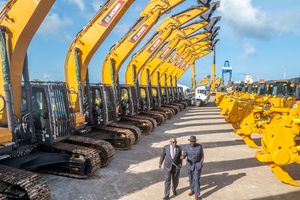
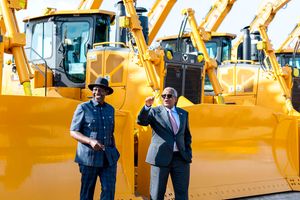
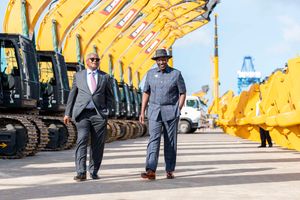
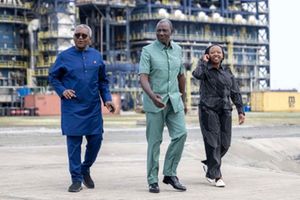
Kenya's President William Ruto and President and Chief Executive Officer (CEO) of Dangote Group Aliko Dangote walk amid heavy machinery, on the day of a groundbreaking ceremony for the construction of an East African oil refinery in Lamu, Kenya, September 30, 2026.
Photo credit: PCS
A few days later, the project found itself in the court corridors again. This time round, the High Court certified as urgent a case seeking disclosure of agreements and public commitments behind Kenya’s planned stake in the refinery.
The petitioner, Mr Francis Onyango Awino, questioned the proposed use of public money, land, tax measures and guarantees.
During the groundbreaking ceremony on September 30, Dr Ruto and Mr Dangote signalled that legal challenges would not derail the project, which is expected to create tens of thousands of jobs and strengthen Kenya's fuel security by increasing local refining capacity.
Aliko Dangote speech during launch of Dangote oil refinery in Lamu
The Nigerian industrialist was categorical that court cases are normal, vowing that he would be undeterred in his quest to achieve his vision of making Africa self-reliant.
“If you want to go to court to stop the Lamu Refinery, go ahead; we are ready for you. This is normal for us in Africa,” he said.
Dangote: We’re not scared of people taking us to court
Mr Dangote's statement showed that his refinery ambitions have faced legal and regulatory challenges before.
In Nigeria, the Dangote Petroleum Refinery has encountered a series of disputes involving regulators, competitors, government agencies and other stakeholders.
The battles have centred on crude oil supply, imports of refined petroleum products, regulatory requirements and alleged market practices.
The Lagos refinery, which began operations after years of construction and delays, was designed as a 650,000-barrel-per-day facility, making it the largest single-train refinery in Africa.
Before construction began at its current location in Lekki, Lagos, the project was initially planned for the Olokola Free Trade Zone (OKFTZ), a coastal site spanning the boundary between Ogun State's Ode-Omi area and Ondo State's Ilaje area.
In 2013, Dangote entered into a partnership with the Nigerian government to develop the refinery at the site. The plan, however, collapsed amid political friction, bureaucracy and disagreements with the Ogun State administration under then-Governor Ibikunle Amosun.
President William Ruto and Dangote Group President and CEO Aliko Dangote during a tour of the Dangote Refinery in Lekki, Lagos State, Nigeria on September 25, 2026.
Photo credit: PCS
Nigerian media reported that the project faced administrative delays, changing operating conditions and prolonged negotiations over tax concessions and infrastructure approvals.
Like the Lamu project, it also faced opposition from host communities over compensation.
After initial surveys and mobilisation in areas including Ode-Omi and Igbokoda, local landowners and traditional institutions reportedly increased their demands, including higher land compensation, equity participation and stronger corporate social responsibility commitments.
The project was also caught up in a territorial dispute between Ogun and Ondo states. The poorly defined boundaries created uncertainty over land leases and raised the risk of prolonged legal disputes.
Aware of the potential legal and political complications, Dangote pulled out of the OKFTZ in late 2013 and moved the project to the Lekki Free Zone in Lagos State, where the state government fast-tracked land allocation. The move to Lekki, however, did not end the challenges.
During the early stages of development, local non-governmental organisations, fishing associations and environmentalists raised concerns about the fragile coastal ecosystem and questioned the Environmental Impact Assessment (EIA) for the project.
Nigerian law requires a comprehensive EIA for major projects of this nature, with approval from the Federal Ministry of Environment before physical site clearance.
Environmental groups accused Dangote of beginning large-scale dredging, swamp-filling and sand-filling works before a definitive and fully audited EIA was transparently presented to host communities.
The company dredged millions of tonnes of sand from the Atlantic Ocean to raise the swampy Lekki site.
Aliko Dangote, Founder and Chief Executive Officer of the Dangote Group, speaks during the commissioning of Dangote Petroleum refinery in Ibeju-Lekki, Lagos, Nigeria, May 22, 2023.
Photo credit: Temilade Adelaja | Reuters
The work drew opposition from local fishing cooperatives, including the Idasho association, which argued that the coastal modifications had damaged fish breeding grounds and threatened their livelihoods.
Determined to avoid another construction setback, Dangote sought to shield the project from disputes that could result in construction-halting orders by operating within the legal framework governing the Nigeria Export Processing Zones Authority (NEPZA).
The refinery's location within the Lekki Free Zone became an important part of its regulatory strategy, providing a framework distinct from ordinary municipal and state-level regulation.
The project also faced a separate legal challenge over the acquisition of the land on which the refinery was built.
Two groups representing indigenous residents, the De Renaissance Patriots Foundation and the Ibeju-Lekki Peoples Forum, jointly filed the suit against senior Lagos State officials, including the governor, attorney-general, accountant-general and permanent secretary of the Lands Bureau.
The plaintiffs sought records showing how the roughly 7,000-acre site had been acquired.
The case followed public remarks by Mr Dangote that his company had bought the land from the Lagos State Government for $100 million (Sh12.9 billion). The disclosure differed from the widely held belief that the state had provided the land for free.
The plaintiffs asked the Federal High Court in Lagos to compel the state government to disclose details of the transaction. They alleged that while Dangote's company paid $100 million, only about $1.4 million was reflected in state records, leaving $98.6 million unaccounted for.
They also raised concerns that communities around the refinery continued to lack basic infrastructure and electricity despite the value attached to the land.
Justice Ayokunle Olayinka Faji dismissed the suit, ruling that the court could not compel the Lagos State Government to release the information under the federal Freedom of Information Act because the law had not been domesticated by the Lagos State House of Assembly.
On his part, Dangote also sought to address community grievances directly to reduce the risk of local disputes escalating into prolonged legal battles. The company entered into out-of-court Memoranda of Understanding with traditional rulers of 10 host communities and five neighbouring communities.
Under the agreements, Dangote upgraded access roads through grading, sand-filling and stone-base works to reduce flooding associated with changes caused by the refinery's construction.
It funded vocational training for local youths, including programmes leading to City & Guilds certification in electrical and mechanical engineering, creating a pathway to employment at the refinery.
The company also supported the construction of classrooms, provided scholarships and distributed learning materials. Solar-powered boreholes were installed to improve access to clean water and address concerns over possible groundwater pollution linked to coastal dredging.
The community agreements, however, did not end the refinery's legal and regulatory battles. One of the major disputes now concerns the importation of refined petroleum products.
In mid-2026, Dangote Petroleum Refinery sued the Nigerian government and downstream regulators at the Federal High Court in Lagos over import licences issued by the Nigerian Midstream and Downstream Petroleum Regulatory Authority (NMDPRA) to the Nigerian National Petroleum Company Limited (NNPC) and other fuel marketers.
The refinery argues that the licences breach an existing court order requiring the parties to maintain the status quo and violate the Petroleum Industry Act, which permits fuel imports only where there is a verified domestic supply shortfall.
NNPC and independent fuel marketers have opposed the case, arguing that Dangote's action is an attempt to secure a domestic fuel monopoly that could affect competition, supply and prices.
The dispute follows a N100 billion suit filed by Dangote in 2025, which was withdrawn before the refinery returned to court with a fresh challenge in 2026.
Last month, on September 11, the Federal High Court in Lagos issued and later extended an interim injunction restraining NMDPRA from shutting down, sealing or interfering with the operations of the Dangote Petroleum Refinery.
The order followed an urgent application by the refinery's lawyers after NMDPRA directed the suspension of loading and trucking of petroleum products from the Lagos facility.
The dispute centres on regulatory differences over product testing standards, particularly for propane and liquefied petroleum gas (LPG), as well as whether NMDPRA has jurisdiction over activities inside the Free Trade Zone where the refinery operates.
The cases show that while the current Lamu disputes are primarily about land ownership, compensation, the rights of residents and transparency, the Nigerian refinery has faced a broader mix of legal, regulatory and commercial challenges.
President William Ruto with Aliko Dangote and other Heads of State during the groundbreaking ceremony for the East African Refinery in Lamu.
Photo credit: Kevin Odit | Nation Media Group
The scale of the proposed Kenyan facility is broadly comparable to Dangote's Lagos operation, though they differ in a few aspects.
The Lagos refinery has a current processing capacity of about 650,000 to 700,000 barrels of crude oil a day, with plans to eventually increase this to 1.4 million barrels per day. The Lamu refinery is designed to process 700,000 barrels per day, putting its planned capacity at the upper end of the Lagos facility's current range.
The difference is also reflected in the scale of the investment. The Lagos refinery occupies about 6,511 acres within the Lekki Free Zone and cost an estimated $19 billion (Sh2.5 trillion).
Dangote: Lamu Refinery to source crude oil from East Africa and other markets like the Middle East
The Lamu project is expected to cost about $16 billion (Sh2 trillion), rising to as much as $20 billion (Sh2.6 trillion) when port and petrochemical infrastructure are included.
On power generation, the Kenyan project is planned on an even larger scale. Its proposed 1,000-megawatt petcoke power plant would generate roughly twice the power output of the Lagos facility.
“This is bigger than a refinery. It is an investment in energy security, industrialisation, and regional integration. Above all, it is a declaration that Africa has entered a new age in which we will increasingly finance, build, process and add value here at home,” Dr Ruto said during the groundbreaking ceremony.
Construction of the Lagos refinery generated an estimated 30,000 to more than 40,000 direct and indirect jobs, while the operational facility now supports thousands of permanent workers and tens of thousands more through logistics and other services.
For Lamu, the construction phase is projected to create more than 60,000 jobs as the project moves towards its targeted 2030 completion.
This indicates that Dangote is not simply seeking to reproduce the Lagos refinery in Kenya but that he is proposing a facility of comparable refining capacity, with a potentially larger power-generation component and a significant employment footprint.
Experts estimate that East Africa consumes about 450,000 barrels of refined petroleum products a day. Against this demand, the planned 700,000-barrel-per-day Lamu refinery would have capacity to supply well beyond Kenya's domestic market.
According to Petroleum Commissioner Joseph Otieno, a refinery processing 700,000 barrels of crude a day could produce more than 100 million litres of petrol, diesel and jet fuel combined each day.
This means that the Lamu refinery could meet Kenya's domestic requirements while leaving substantial volumes for export to neighbouring markets, strengthening the region's security of supply.
However, industry players say the country's exposure to the international crude oil market will still determine domestic oil prices since the project will still depend largely on crude oil sourced from outside Kenya.
This was buttressed by President Ruto who cautioned that although Kenya’s high fuel import bill highlights the need to develop local refining capacity and build industries around petroleum processing, a refinery alone would not immediately eliminate the cost of imported crude and fuel.
“Let me be clear: A refinery will not make that bill disappear overnight. Crude must still be bought. Fuel must still be produced and delivered at a competitive price,” he said.
The current structure of Kenya's fuel prices demonstrates why local refining alone cannot determine what motorists pay. Kenya's petroleum prices are influenced by the cost of imported fuel, crude oil prices, exchange rates, shipping and insurance costs, taxes and other components of the supply chain.
The Energy and Petroleum Regulatory Authority's latest pricing cycle put a litre of super petrol at Sh214.03 in Nairobi and Sh210.87 in Mombasa, while diesel was Sh217.86 in Nairobi and Sh214.58 in Mombasa. Even when one component of the cost falls, the reduction does not necessarily translate into an equivalent fall at the pump.
In Nigeria, Mr Dangote maintained that local refining has already helped drive down petroleum prices in Nigeria because his refinery must compete with imported fuel.Additional reporting by Anthony Kitimo