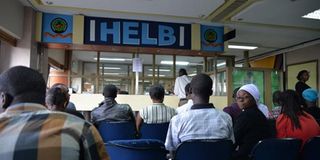
A section of students who have joined public universities for their first year of study are yet to receive financial support from the government, setting them up for a challenging start to university life as they struggle to pay for accommodation and upkeep.
A number of students interviewed by the Nation said they have not received money from the Higher Education Loans Board (HELB) despite assurances by the Ministry of Education that the disbursements comprising tuition and upkeep money would be aligned with the opening schedules for universities.
A spot check at the universities revealed that some students were surviving on roadside meals and borrowing from friends after their parents had exhausted their resources paying hostel and tuition fees.
“I applied for financial support from the government a long time ago on the Higher Education Financing (HEF) website but nothing has come my way,” said a journalism student at the University of Nairobi. She reported on campus a week ago.
She said that while some of her colleagues have received the funds, life has been tough and she has been forced to buy snacks sold by the roadside since it is forbidden to cook within the campus hostels. The students asked for anonymity so as not to jeopardise their chances of funding.
“For me, the portal shows that the disbursement is under processing but nothing has landed in my account to date,” said a biotechnology student at Kenyatta University.
Similar sentiments are echoed by a statistics student at the same university, who missed out on hostel accommodation and is currently sharing a house with another student in a neighbouring estate outside the campus.
“Sometimes I feel like I’m bothering my parents with the numerous phone calls asking for money, but I have to feed mostly on ‘smocha’ since I cannot afford the meals at the students’ mess,” he said.
Smocha is a wrap made up of chapatis, smokies and kachumbari (a mix of chopped-up tomatoes and onions) going for Sh60.
In 2023, KU revised food prices sold at its messes with a meal of beef increased to Sh70 from Sh22, ugali from Sh8 to Sh25 and beans from Sh12 to 25. A proper meal could go for around Sh120.
When the Nation visited the main campus on Thursday, we saw several entrepreneurs who have set up smocha stalls outside the main gate to tap into the growing demand, as first-year students learn the ropes of survival amid delayed government financial support
However, students who have received government funding say their university experience has so far been smooth. An anthropology student at the UoN said he received the money on August 25, 2025, which comprised tuition fees of Sh127,564 and upkeep of Sh27,200. His household contribution for this semester is Sh12,000.
The same goes for an economics student at KU who says his household contribution for the semester has been pegged at Sh18,500.
Last week, the Cabinet Secretary for Education, Julius Ogamba, said the HELB had disbursed Sh9.46 billion, comprising Sh5.76 billion for tuition and Sh3.7 billion for upkeep, to support 309,178 university students.
Education Cabinet Secretary Julius Ogamba before the National Assembly Committee on Implementation at Bunge Tower, Nairobi, on August 19, 2025.
Photo credit: Dennis Onsongo | Nation Media Group
He explained that the funds will be released in phases, noting that students whose semesters begin in October may not immediately see the allocations reflected in their portals.
The majority of those who apply for Helb loans come from low-income households and rely on the financial support to cover tuition, accommodation, and upkeep.
Last week, Helb chief executive Geoffrey Monari said applications on the HEF portal are ongoing and will run up until August 31 2025 and that all students who apply will be awarded.
Under the funding model, an estimated 600,000 students from both the universities and TVETS are set to benefit, alongside 98,000 students funded under the former model.
The increased enrolment in higher education institutions has increased pressure on Helb’s funding which has not kept pace with the growing number of candidates making the minimum university grade of C+ and above.
Helb which is a revolving fund where beneficiaries, upon completing studies, pay back to support a fresh group of students. However, this has not been seamless with a growing number of loan defaulters has weakened the agency’s ability to support the university and college students.