President William Ruto is expected to receive a political endorsement and a raft of demands from school administrators when he officially closes the 63rd Kenya Comprehensive School Heads Association (KECSHA) annual conference in Mombasa on Thursday.
More than 15,000 public school administrators attending the conference have praised his administration for reforms and investment in education, with their chairman, Mr Fuad Ali, rallying members to support the President's re-election bid.
Basic Education Principal Secretary John Ololtuaa announced that the President would be in Mombasa on Thursday to meet the school heads, urging delegates to remain until the official closure.
“You must remain until Thursday at 9am sharp. We will be here, so if you had plans of leaving early, you had better break those plans. This administrations has ensured capitation hits schools accounts on time,” said the PS.
Mr Ololtuaa said the annual conferences provide administrators with opportunities to learn, exchange ideas and engage with other sectors, including health, banking and teacher welfare.
But as the school heads celebrate what they consider gains under the current administration, they want Dr Ruto to address longstanding concerns affecting their careers, remuneration and authority in institutions operating under the Competency-Based Education (CBE) system.
Among the issues they want him to address are career stagnation, disputes between primary and Junior School administrators over the management of comprehensive schools, the fate of teachers serving as acting heads of institutions and challenges with the teachers' medical scheme under the Social Health Authority (SHA).
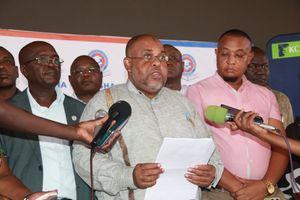
Kenya Comprehensive School Heads Association (KECSHA) National Chairman Fuad Ali (centre) and members of the national executive board address a press briefing in Mombasa on November 8, 2026.
Photo credit: Winnie Atieno | Nation Media Group
The medical cover was among the key issues discussed at the conference, with SHA chief executive officer Dr Mercy Mwangangi outlining the benefits accessed by teachers and their dependents since the Mwalimu Cover was introduced.
She said 406,268 beneficiaries had accessed SHA services in the past 11 months, including 374,949 who received outpatient care and 30,623 who were admitted to hospital.
Dr Mwangangi said teachers in job group C5 have an inpatient cover of Sh1.8 million, while those in D1 have Sh2 million. Other benefits include dental cover of Sh45,000, optical cover of Sh60,000, overseas treatment of Sh2.2 million, last expense of Sh300,000 and in-vitro fertilisation cover of up to Sh600,000.
However, she acknowledged challenges raised by teachers, including inactive accounts despite salary deductions, denial of services, requests for cash payments, delays in pre-authorisation and biometric verification, gaps in the facility network and exhaustion of benefits.
“We have heard your concerns on inactive accounts despite salary deductions, denial of service and cash requests, pre-authorisation and biometric delays, gaps in the facility network and specialised care, benefit exhaustion and dual teacher spouses, chronic medicines and maternity, dependents and disability support, last expense and overseas referrals,” she said.
She said SHA and the Teachers Service Commission had established a coordination unit to address the concerns.
From the opening day, Mr Ali used his address to rally school heads behind the President, crediting his administration with addressing some of the challenges affecting the education sector.
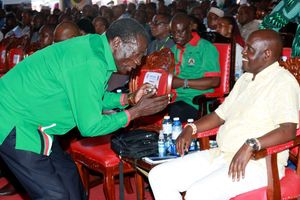
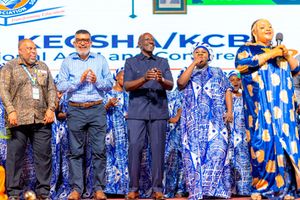
Head Teachers attending the Kenya Comprehensive School Heads Association (KECSHA) National Annual General Meeting in Mombasa on November 11, 2026.
Photo credit: Kevin Odit | Nation
“We are grateful to the President for employing 100,000 since he took over leadership. He has stirred Competency-Based Education and addressed the challenges. When he comes to close this forum, we will tell him our agenda,” said Mr Ali.
He also led delegates in chanting slogans in support of Dr Ruto's second term, turning the professional gathering into a political platform ahead of the 2027 General Election.
The recruitment of 100,000 teachers over the past three years is among the administration's major education interventions. The government has also indicated plans to recruit an additional 20,000 teachers to address staffing gaps.
Other investments include the construction of more than 23,000 classrooms and plans to establish 1,600 laboratories to strengthen science, technology, engineering and mathematics education.
However, Kenya National Union of Teachers Secretary-General Collins Oyuu said the government needed to resolve the challenges facing school administrators, particularly those serving in acting positions.
“We have some heads of institutions who are in acting capacities, so I wonder how much they will actually take charge in that capacity. Kindly address this with TSC so that we don't have anybody manning an institution or capitation fund in that position,” he said.
Mr Oyuu said all heads of institutions should start at Grade D1, noting that some were still in C5 despite holding leadership responsibilities.
He also said teachers had exceeded expectations in implementing CBE, but their career progression and welfare needed attention.
Head Teachers attending the Kenya Comprehensive School Heads Association (KECSHA) National Annual General Meeting in Mombasa in on November 9, 2026.
Photo credit: Kevin Odit | Nation
The transition to CBE, including the rollout of Junior School, has also exposed disagreements over the management of comprehensive schools. Primary school heads and Junior School administrators have raised concerns over leadership responsibilities and control of shared resources.
The school heads want the President to provide direction to prevent the disputes from disrupting the running of institutions.
The National Parents Association (NPA) has separately praised the President's education reforms, particularly the proposed new higher education funding model expected to take effect in January 2027.
NPA chairman Silas David Obuhatsa described the proposal as a major step towards easing the financial burden on parents and improving access to university and college education, particularly for students from low-income households.
“A student's future should not be determined by the financial circumstances of their parents,” he said.
Mr Obuhatsa said the reforms should support the promise of 100 per cent transition beyond senior school to universities, TVET institutions, the Kenya Medical Training College and other higher learning institutions.
“It would be a national disappointment to invest in a learner for twelve years, nurture their talents and prepare them for the world of work, only for that learner to be denied further education because their parents cannot afford the cost,” he said.
The association urged the government to ensure the proposed funding model is supported by clear guidelines, transparent processes, adequate financing and timely support to eligible students.
This year's conference has combined praise for the administration's education record with demands for solutions to persistent challenges in school management and teachers' welfare.