Private schools have been urged to strictly employ teachers registered by the Teachers Service Commission (TSC) and to prioritise continuous professional development as part of efforts to support the full implementation of the Competency-Based Education (CBE) curriculum.
Speaking during the official opening of the Kenya Private Schools Association (KPSA) annual conference in Mombasa, the Director General at the Ministry of Education Dr Elyas Abdi said Kenya’s education sector is undergoing a major transition with the rollout of CBE, including the progression of Grade 10 learners to Senior School.
The DG commended private institutions for their critical role in supporting this shift through investments in infrastructure, teacher preparedness, and institutional capacity. However, he said that private schools must employ qualified and TSC-registered teachers, alongside implementing continuous professional development programmes to strengthen curriculum delivery.
He also underscored the need for strict adherence to safety, safeguarding and child protection standards, describing them as non-negotiable.
“Quality assurance must therefore be institutionalised as a core function of school management,” he told more than 16,000 private school proprietors attending the annual conference.
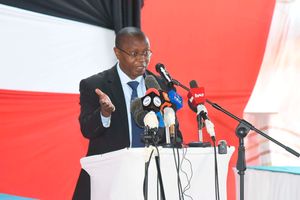
The Director General at the Ministry of Education, Dr Elyas Abdi.
Photo credit: Kevin Odit | Nation Media Group
Dr Abdi reminded proprietors that private learning institutions must operate within the law, citing the Constitution of Kenya, the Basic Education Act (2013) and the Children Act (2022) as key frameworks that guarantee every child’s right to free and compulsory basic education. These laws, he said, outline the shared responsibility of government, parents, and institutions in ensuring access, quality, and continuity of learning.
While acknowledging the sector’s expansion driven by demand for quality, flexibility and innovation Dr Abdi cautioned that growth must align with national priorities, regulatory requirements and quality assurance mechanisms.
“This growth must safeguard the credibility and integrity of our education system,” he said.
As enrolment continues to rise, he noted the need for sustained investment in facilities, learning resources and teacher development to ensure no learner is left behind. He highlighted emerging challenges such as rising operational costs, teacher shortages, infrastructure strain and increasing expectations from parents and regulators.
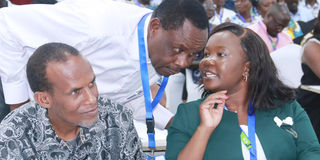
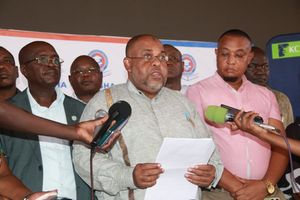
The National Chairman, Kenya Private Schools Association (KPSA), Charles Ochome (centre) with Dr Elyas Abdi (right) with Rukia Omar (left) and Rosabella Ojiambo (centre), the National Executive Committee (NEC) Members of KPSA, respectively, during the 29th Annual General Meeting of the KPSA in Mombasa, in this photo taken on 21st April 2026.
Photo credit: Kevin Odit | Nation
Teacher retention, he said, remains a major concern, with many educators leaving private schools for public institutions whenever TSC announces recruitment drives.
“Every time the TSC recruits, there is a mass exodus of teachers from private to public schools. This ‘teacher drain’ poses a serious retention challenge. What mechanisms can be put in place to retain teachers?” he posed.
He warned that frequent teacher turnover disrupts learning continuity. “If a learner is taught Mathematics for three years under CBE by 10 different teachers, it inevitably affects learning outcomes,” he added.
The DG also raised concerns about child welfare, citing cases particularly in Nairobi where pre-primary learners are picked up as early as 5am and older pupils dropped home as late as 9pm.
“When you see a four-year-old in PP1 or a five-year-old in PP2 waiting in the cold to be picked up, we must ask ourselves whether we are truly adhering to basic education regulations,” he said, reminding schools that lessons are required to begin at 8am.
Beyond academics, Dr Abdi stressed the importance of holistic child development. He noted that quality assurance officers often report low participation in co-curricular activities such as sports, drama and music in private schools.
“It is not just about teaching Mathematics and English we are developing an all-round child,” he said, urging institutions to strengthen co-curricular programmes.
He challenged private school leaders to look beyond business interests and prioritise the welfare of learners.
“Are we just business minded, or are we thinking about the child? These are real questions we must ask ourselves,” he said.
Dr Abdi called for deliberate investment in teacher development through in-service training and encouraged schools to collaborate with institutions such as KNEC and KICD for capacity building.
He further urged schools to strengthen internal quality assurance systems to monitor lesson delivery, infrastructure integrity, and regulatory compliance. He warned against the use of unapproved teaching materials, noting that some contain factual inaccuracies.
“Adhere to the approved curriculum as guided by KICD. While innovation is encouraged, it must align with national frameworks,” he said.
He also called on institutions to embrace digital learning and emerging technologies to enhance curriculum delivery, while maintaining compliance with national standards.
In conclusion, Dr Abdi urged private school proprietors to demonstrate bold, strategic, and forward-looking leadership in addressing challenges such as teacher shortages, infrastructure demands, and rising costs.
“In education, it is about learning and the holistic development of the child. These challenges call for bold leadership,” he said.
KPSA Chairman Charles Ochome echoed the DG’s sentiments, noting that this year’s theme “Redefining Private Education in Kenya: Bold Leadership, Uncompromising Quality, and Global Excellence”is both timely and relevant.
Mr Ochome said bold leadership requires courage to make difficult decisions, pioneer new approaches, and remain resilient in a rapidly evolving education landscape. He stressed that uncompromising quality means excellence in teaching, infrastructure, and learner development is non-negotiable.
“Every learner entrusted to our care deserves the highest standards,” he said.
On global competitiveness, Mr Ochome urged schools to look beyond national borders and equip learners with skills to thrive internationally.