More than 700,000 students in public universities are bearing the cost of the lecturers’ strike, now in its second week, after negotiations collapsed yesterday, prolonging the disruption of learning.
Students have lost valuable learning time and fear their upkeep money will run out before teaching resumes. Some face a choice between remaining on campus without lectures and spending more money travelling home.
The strike has disrupted the transition to university life for first year students, many of whom are demoralised and uncertain when their studies will resume, barely weeks after the academic year began.
University Academic Staff Union (Uasu) Secretary General Constantine Wasonga said the government had failed to demonstrate sufficient commitment during negotiations.
Dr Wasonga said lecturers wanted a counteroffer reflecting the cost of their demands under the current collective bargaining agreement (CBA). He criticised the government’s proposed Sh12 billion package, arguing that it did not adequately cover its obligations.
He said the 2013 to 2017 CBA cost Sh15 billion, while the 2017 to 2021 agreement cost Sh16.5 billion. The 2022 to 2025 agreement cost Sh9 billion for basic salaries and automatic annual increments.
“How then is it possible that the current CBA, which has the above plus commuter allowance, medical cover, among others, costs Sh12 billion?” Dr Wasonga asked.
He said the government’s counteroffer should be calculated using a transparent, evidence-based method before being compared with the union’s demands.
With teaching paralysed in several institutions, leaders under the Kenya University Student Unions umbrella want Education Cabinet Secretary Julius Migos Ogamba to fast track negotiations with Uasu and secure an agreement on implementing the 2025 to 2029 CBA.
They say students and their families are bearing additional maintenance costs, uncertainty over academic calendars and the emotional strain of an unpredictable learning environment.
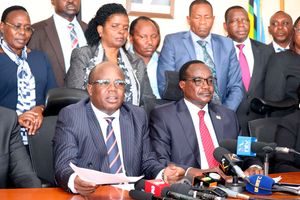
Kenya University Staff Union (KUSU) Secretary General Dr Charles Mukhwaya (centre) gestures during a media briefing on October 01, 2026, where they declared a nationwide strike from Friday, October 2, for university staff members. With him are Universities Academic Staff Union (UASU) National Organising Secretary Jacob Musembi (right) and Kenya Union of Domestic, Hotels, Educational Institutions, Hospitals and Allied Workers (KUDHEIHA) National Trustee Odoyo Genga.
Photo credit: Francis Nderitu | Nation
The lecturers began the strike last week and have vowed not to resume teaching until the dispute is resolved.
“Even when lecturers are on strike, we still have financial obligations. The money we budget for when the semester is in session continues to be spent, and when learning resumes and the semester is extended, our financial needs become even more constrained,” said Remmy Osoti, a fourth year student at Multimedia University.
“For me to travel upcountry, I spend about Sh2,500. When the strike is called off, I have to spend another Sh2,500 to return. That is already Sh5,000, money I could have used for other things. If you budget carefully, that amount can sustain you for nearly half a month or even a month.”
Student leader Lillian K said the strike had disrupted academic programmes, raising fears of delayed graduation. Some students had returned home, while others remained on campuses where she said their safety was a concern.
“Most of the students, especially first years are demoralised considering that the strike kicked off less than a month after they reported to the institutions. Some students have been forced to go home, while others who are still in the institutions face safety risks,” she said.
Tom Mboya University students’ union chairperson Collins Ouma warned that prolonged idleness could expose students to negative peer pressure and criminal influences.
“Homa Bay is known for goonism and the leaders of these criminal groups are always looking for new members. They are likely to target students who are currently stuck at home,” he said.
Mr Ouma said some part time lecturers had continued teaching while their full time colleagues were on strike, creating a perception that some students were gaining an unfair academic advantage.
At the Technical University of Mombasa, student leader Peter Obiero said many students had returned to their rural homes because classes had stopped.
“We don’t know when the strike will end. The students have decided to go back home because there are no classes and they cannot continue staying in hostels doing nothing,” he told the Nation.
The dispute has also exposed tensions among academic staff. At Tom Mboya University, Uasu members accused part-time lecturers of undermining the union’s push for better working conditions.
The university’s union secretary general, Dr Maurice Ndolo, criticised part time lecturers, particularly those visiting from neighbouring universities, for allegedly weakening collective bargaining efforts.
“They are the final beneficiaries of our struggle, yet they refuse to join the strike. We ask part time lecturers from neighbouring institutions to respect our collective action,” Dr Ndolo said.
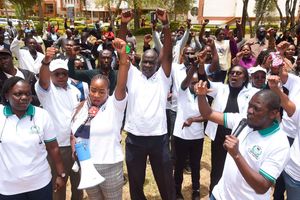
Universities Academic Staff Union (UASU) Secretary General Constantine Wesonga briefs union members gathered at the Technical University of Kenya (TUK) on the first day of the nationwide lecturers' strike on October 02, 2026.
Photo credit: Francis Nderitu | Nation
At Maseno University, students are considering returning home, saying remaining on campus without lectures has become an unnecessary financial burden.
Michael Owuor, a third year student at the University of Nairobi, said the strike had complicated students’ financial planning.
“When the strike is eventually called off and the semester extended, students face additional financial pressure because they have to stretch their resources for longer than planned,” he said.
At Tharaka University, lecturers vowed to continue striking, citing disparities in medical cover, workloads and allowances. Uasu chapter secretary Dr Lusweti Walumoli said lecturers lacked medical insurance benefits available to colleagues at other public universities.
“We are striking because we have suffered for so long. We are a university, yet we do not have medical insurance, while our colleagues in other universities enjoy access to specialised care in hospitals. We are left struggling,” he said.
At Dedan Kimathi University of Technology in Nyeri County, chapter secretary Reverend Anthony Mutwiri urged academic staff to stay away from lecture halls.
At Alupe University, student union president Joel Wafula said learning had stopped and appealed to the government and Uasu to resolve the dispute.
“As students, we stand to lose a lot in terms of the time it takes to complete our programmes and maintenance costs. Our appeal is that both parties find a solution to this matter,” he said.
At Koitalel Samoei University College, a constituent college of the University of Nairobi, student leader Gideon Kipruto said the impasse had caused mental anguish among students and their guardians.
“Most students are now idle due to the ongoing lecturers’ strike, and it is unsafe for them. It is our appeal that this matter is resolved amicably,” he said.
Karatina University student president Gideon Mukaria urged the government to find a lasting solution to recurring strikes, which he attributed to delayed CBA implementation.
“Some of these strikes have in the past gone on for months, and it is high time the government found a long-lasting solution to the issue to facilitate smooth learning activities in public universities,” he said.
At Moi University, secretary general Enock Kwena said the strike had disrupted academic schedules, increased living costs and placed additional pressure on students and their families.
“The strike has affected the sequence of events, including the academic programme, resulting in high costs of living and burdening students and families,” he said.
Professor Daniel Mugendi, chairman of the Vice Chancellors Committee of Public Universities, warned that some courses might struggle to recover lost learning time even after teaching resumed.
Public Universities Vice-Chancellors Committee Chairperson Prof Daniel Mugendi.
Photo credit: File | Nation
“When students lose learning time, they have to try to catch up when they return. However, there are programmes like Medicine where it may not be possible to recover the lost time because they run back to back,” he told the Daily Nation .
He urged the government and university unions to reach a compromise quickly, warning that prolonged disruption could have lasting consequences for students.
“The best situation is for the lecturers not to strike because when teaching is disrupted, it affects students and their programmes. We hope that if the parties agree quickly, students will return to class and teaching will resume,” he said.
Prof Mugendi called for negotiations to be concluded before each new CBA cycle to prevent disputes from disrupting the academic calendar.
“There is a way to prevent this. We need to negotiate and finish the negotiations and sign the agreement as the year starts. If we can agree and conclude the negotiations early, then we can move on without these disruptions,” he said.
He said timely negotiations would give universities and lecturers greater certainty while protecting students from repeated interruptions.
Reporting by Mercy Simiyu, George Odiwuor, Domnic Odiwuor, Mercy Mwende, Winnie Atieno, Barnabas Bii, Ezra Nanjendo, Vitalis Kimutai and Joseph Openda.