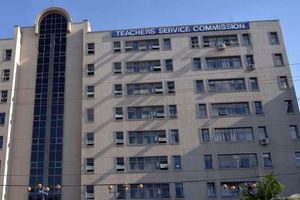
The Teachers Service Commission (TSC) has told the Supreme Court that ending the intern teachers programme would trigger a staffing crisis in junior secondary schools, disrupt learning and create major financial and administrative pressure on the public education system.
In its application before the Supreme Court, TSC is seeking to suspend a Court of Appeal judgment that declared the internship programme unconstitutional, arguing that enforcing the decision now would destabilise schools across the country.
At the centre of the Commission’s case is an argument that has drawn attention to the structure of staffing in schools: that the education system, particularly junior secondary, is currently dependent on intern teachers to fill critical gaps.
Kenya Union of Post-Primary Education teachers protest on the streets of Nyeri town on August 26, 2024 to demand full implementation of the 2021-2025 CBA agreement and the employment of intern teachers on permanent and pensionable terms.
Photo credit: Joseph Kanyi | Nation Media Group
TSC warns that if the Court of Appeal decision is implemented immediately, schools relying on intern teachers would face severe staffing shortages, potentially disrupting learning for thousands of learners.
“Terminating the engagement of Intern teachers will cause serious disruption, or even the complete failure, of curriculum delivery in Public Schools, particularly in Junior Schools. This would violate the constitutional rights of more than 3.2 million students to access quality education, as protected by Article 43 of the Constitution,” TSC said in its application.
The Commission is also arguing that the ruling carries broader implications beyond the courtroom, saying it affects teacher recruitment, deployment and public wage obligations, and therefore touches on public interest and education policy.
"The stipend of Sh20,000 as their only source of livelihood stand to lose their engagement and the aforesaid stipend on account of the declaration of unconstitutionality of the Programme by the Employment and Labour Relations Court and the Court of Appeal thereby adversely affecting their social and economic rights under Article 43 of the Constitution. The said intern teachers will, in effect, leave their work stations to retire to their villages and hamlets,” TSC said.
In the application, TSC says the matter raises issues of general public importance and should be heard fully by the Supreme Court before any structural changes are enforced in the education sector.
A key concern raised is the financial implication of the appellate court decision. TSC argues that it would be compelled to immediately absorb all intern teachers into permanent and pensionable terms.
“The implication of the judgment that the Commission may only engage teachers on Permanent and Pensionable terms, which would necessitate the recruitment of the 44,000 currently serving Teacher Interns on such permanent and pensionable terms, will compel the national government to mobilize substantial funds exceeding sh30.9 billion. This budgetary provision was not incorporated into the Applicant's current budget. It cannot be secured immediately due to the constitutional and statutory processes governing public finance, resource allocation,” said the commission in its application
The Commission further argues that enforcing the judgment now would have cascading effects on payroll management, teacher recruitment strategies and long-term staffing policy in public schools.
Junior Secondary School teachers demonstrate on the Kenyatta Avenue in Nakuru Town on May 13, 2024.
Photo credit: Boniface Mwangi | Nation Media Group
TSC is therefore asking the Supreme Court to suspend the Court of Appeal ruling pending the determination of its appeal, saying this would preserve the current staffing arrangement and prevent what it describes as immediate disruption in schools.
It also argues that without a stay, the appeal would be overtaken by events, as the internship programme would already have been dismantled or fundamentally altered before the Supreme Court makes its final decision.
In the judgment delivered on February 27, 2026, the Court of Appeal upheld findings of the Employment and Labour Relations Court that teachers hired as interns were in fact employees and had been unfairly treated.
“The Court finds that designating the teachers as interns was obviously designed to escape the inescapable effect of the employment relationship and legal safeguards,” the judges ruled.
The court further held that the teachers had been discriminated against because they were denied the terms and conditions ordinarily accorded to teachers hired at entry grade.
“The teachers subject of the instant petition… were unfairly treated and discriminated as they were denied the terms and conditions of service the 1st respondent ordinarily paid to teachers it employs at entry grades,” the court said.
The case arose after TSC issued a circular on January 4, 2023 inviting applications for 35,550 teaching positions, including 21,550 secondary school internship positions and 4,000 primary school internship posts, alongside 10,000 permanent and pensionable positions.
The constitutionality of the internship programme was challenged by the Forum for Good Governance and Human Rights, which argued that qualified and registered teachers were being subjected to unfair labour practices.