More than 400 lives lost. Families shattered. Fortunes surrendered. A preacher whose deadly influence went unchecked. Shakahola was more than a forest of mass graves. It was a tragedy of manipulation, institutional failure and the exploitation of faith. In a special six-part series, the Nation goes beyond the horror to uncover the people, money, machinery and failures behind Kenya's deadliest cult tragedy.
Paul Mackenzie interpreted Revelation 12:5-6 to his followers, particularly the passage about a woman fleeing into the wilderness, as a prophecy. He told them that his followers were the chosen remnant who had to separate themselves from society.
Many followed him into the wilderness in a tragic journey of faith that has left at least 429 people dead, families shattered and countless relatives still searching for answers. Mackenzie’s followers were drawn into a movement that promised salvation through extreme fasting.
Beyond the harrowing accounts of starvation and death are stories of how followers were brought together, what they sacrificed in pursuit of spiritual redemption and the financial interests that operated behind the scenes.
For many, the journey to the Shakahola wilderness was not a sudden decision. It followed a process of mobilisation, persuasion and radicalisation that drew people from across the country into the orbit of controversial preacher Paul Mackenzie.
The followers came from the 35 branches of Good News International Ministries (GNI), a church that used biblical teachings to lure believers.
Some abandoned jobs, businesses, property and family ties. Others travelled with their children, convinced they were preparing for eternal life.
Suleiman Nyanje Zero last saw his wife Mbeyu Chombo and five children aged 22, 20, 18, 12 and one-and-a-half in 2019.
Chombo, 42, sold their Majengo Mpya plot for Sh400,000 without disclosing the information to her husband, then moved to Shakahola with the children. Zero was away from home, working as a mason.
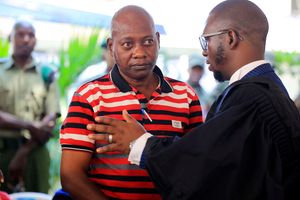
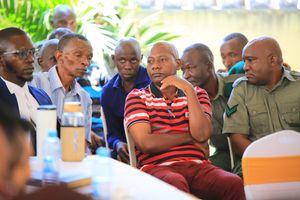
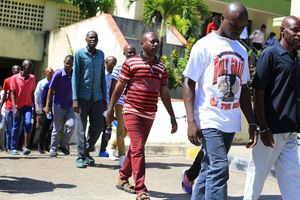
Pastor Paul Mackenzie with his Co-accused during the reading of the Judgement in a case where is charged with murder of 191 Children in the Shakahola Massacre.
Photo credit: Kevin Odit | Nation
Chombo became close to the preacher, who gave her a stipend to cater for the children.
Later, she relocated to Shakahola, telling Zero that she had found farmland and asked Zero for Sh6,000 to purchase two acres.
“I lost my family and my land too. I just want to know where my children are. If Mackenzie killed them, I want him to show me where he buried the bodies,” Zero told the Nation in an interview.
George Keya Okaka’s wife, Alice Nyangesa Osieko, and three of their five children died in Shakahola and were identified through DNA testing.
The DCI informed him on October 25, 2025, and the family collected their remains for burial. In court, Okaka revealed that his wife stopped taking the children to school and hospital after joining Mackenzie’s church. She also sold property he had helped her acquire for a school-related business.
Kevin Sudi Asena, a Mombasa fabricator who established his own yard in 2016, disappeared in 2017, leaving behind a wife and five children.
He was among those charged with murder in the Shakahola case but died before the case was determined.
Issa Ali Mwamure lost his mother, Jumwa Chea Karega, after she joined Mackenzie’s Furunzi church following her conversion from Islam. He and his sister were withdrawn from Madarasa and formal school.
His mother moved to Shakahola in 2020, saying she had acquired farmland. When she returned in February 2023, she was emaciated but refused hospital treatment. She went back to the forest, and communication ended two days later.
“We have never been given the body of my mother for burial. It has never been confirmed to us that her body has been found,” he told the Nation on Friday at his home in Muyeye village, Malindi.
Enos Amanya, alias Aleluyah, Shakahola’s former head of security, dug graves and carried children who resisted fasting. Six of his seven children died. Mackenzie served Amanya’s family their “last supper” before the deaths began.
Court accounts revealed that Grace Daudi’s mother, Agnes Ayuma Abdalla, died during the fast, while two children in the family remain unidentified.
Bodies exhumed at Shakahola Forest in this photo taken on May 13, 2023.
Photo credit: FILE
Stephen Mwiti’s son Samuel died by strangulation, while four other children remain missing. His wife, Bahati Joan, went into the forest with five children, including Hellen Karimi (9), Samuel Kirimi (7), Jacob Kimathi (3), Lillian Amunde (2) and Angelina Gatumi (1). Mwiti never saw another child Joan delivered while in Shakahola.
Joan is an accused person before the court, facing radicalisation charges at the Shanzu court.
Simeon Muhonja Ingutia had two daughters, Flowerate Masista and Christine Aying, who were identified and buried. But his wife, Eglay Chiluyi Mutenyo, and youngest son remain missing.
Lilian Kazungu’s mother, Janet Kazungu, and her three siblings – Grace Kadzo, Purity Masha and Right Masha – also disappeared into the forest after purchasing land from Mackenzie.
The migration to Shakahola followed years of teachings that gradually persuaded followers to abandon education, employment, medical treatment and contact with the outside world in preparation for what Mackenzie described as a journey into the wilderness.
The idea of jangwani, or wilderness, was introduced while congregants were still worshipping in the church’s 35 branches across the country.
“Wilderness was initially presented as a spiritual place for the chosen before becoming a physical destination. We were still in Nairobi when this idea of wilderness was introduced to us,” Amanya revealed during his court appearance.
A network of preachers reinforced the teachings, including Pastor George Mwaura, who joined GNI after following Mackenzie’s sermons on KBC TV in 2011.
He worked alongside the preacher between 2018 and 2020, spreading doctrines that discouraged education, hospital treatment and worldly employment.
Mackenzie persuaded Mwaura to abandon his job as a bus driver and become a preacher. His daughter also left school to become an editor, working on Mackenzie’s sermons.
Mwaura also revealed that the mobilisation was strengthened by a white preacher identified as Jude, whom Mackenzie introduced as a messenger sent by God.
Jude reinforced teachings against education, hospitals, the Huduma Number and worldly beauty.
The phrase Kazi ya Mteule, meaning the duty of the chosen one, was taught as the only legitimate occupation for believers.
After months of indoctrination, the promised wilderness became a physical destination in Shakahola Forest.
The closure of the church in 2019 did not stop the mobilisation. Mwaura revealed that when authorities shut down the physical church, Mackenzie announced that the congregation would move into the wilderness because the teachings had already taken root in believers’ minds.
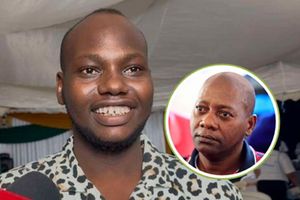
Dan Mackenzie, son of controversial preacher Paul Mackenzie (inset), speaks to the media after the High Court found his father guilty of 191 counts of murder in the Shakahola case.
Photo credit: Brian Ocharo | Nation Media Group
Amanya recalled that Mackenzie had anticipated restrictions on preaching and rebranded the operation as Times TV Church. Followers were told that if broadcasting was stopped, they would continue through seminars. When Times TV was eventually closed, the wilderness became their destination.
Amanya sold property in Nairobi for Sh700,000 and relocated with his wife, younger children and his brother to Malindi, then into Shakahola. They thought Amanya had acquired agricultural land there.
They cultivated crops and harvested them, but Mackenzie gradually shifted the message from farming to preparing to meet Jesus. About 40 families were still trying to farm when Mwaura left.
Dr Oscar Wangutu Githua, a forensic psychologist and expert in preventing and countering violent extremism, drew similarities between Shakahola and other deadly movements like Jonestown in Guyana and Waco in the US.
Their common features included charismatic leadership, end-times beliefs, portraying the government as evil, social isolation, rejection of government services and unquestioning obedience to a leader.
“My assessment was not a theological judgement on Mackenzie’s interpretation of the Bible, but an examination of the consequences of the teachings,” Dr Githua told the court.
In Shakahola, separation from society intensified.
Amanya revealed that Mackenzie banned mobile phones and demanded that followers cut off communication with outsiders. The restrictions, however, were not applied equally. Wealthier families were allowed to retain phones, visit trading centres, withdraw money and receive visitors – privileges denied to poorer residents.
“You would hear Mackenzie was visiting the rich families, but you would not see him doing the same to the poor,” he revealed.
The settlement was divided into nine villages. Galelee hosted church officials. Elders, including Evans Sirya, relayed instructions, while security teams enforced restrictions.
When Amanya and his brother continued worshipping privately, emissaries were sent to warn them.
“The forest should remain silent, and no one should be seen worshipping and praying,” Mackenzie was quoted as instructing followers.
Security personnel monitored residents in shifts, including those hiding under the canopy, seeking water or resisting the fast.
Followers surrendered money after selling their belongings, thinking they were securing agricultural plots in a new settlement.
Unknowingly to them, Mackenzie had leased the property followers thought they were buying.
Amanya, who joined the church in 2019, revealed that he learned from Mwaura that Mackenzie was selling agricultural land in Shakahola. He sold his Nairobi property for Sh700,000 and sent Sh100,000 to Mackenzie through M-Pesa as payment for the plots. He transferred another Sh100,000 to Mwaura after being advised that carrying the money in cash was unsafe.
But when he arrived in Malindi in 2021, he was not shown the land. He paid a further Sh20,000 to facilitate the process, yet months passed without him being allocated a plot.
Amanya later learnt from Mwaura that Mackenzie was not giving followers permanent ownership of the land but allowing them to occupy plots as squatters.
Mwaura moved him to Chakama Ranch, about five kilometres from Shakahola, where followers cleared bushes and built temporary houses. Their stay was short-lived after the landowner arrived and ordered the structures demolished.
“I told Mwaura to refund my money, but he referred me to Mackenzie, saying the preacher owed him Sh100,000. Mackenzie later told me to leave Mwaura as he was a con and showed me another plot where I constructed my house,” Amanya revealed in court.
His account exposed conflicting claims between the two preachers over money and land, as well as the uncertainty facing followers who had sold property to relocate.
In June 2022, elders of the Mwabaya Mwaro clan demanded that Mackenzie’s followers either buy the land or vacate after it.
A meeting assessed the value of structures and other property occupied by the followers at Sh4 million. The amount was presented to the elders as compensation to allow the believers to leave voluntarily. The elders rejected the proposal and threatened to invade the settlement.
Instead of preparing to leave, Mackenzie instructed followers to fast to escape the impending attack.
“Mackenzie then told us that instead of waiting to be attacked, we must start fasting so that by the time the elders come to attack us, we would have gone to meet Jesus,” Amanya revealed.
The evidence of property sales, payments and gifts, but does not establish the total amount collected by Mackenzie or his net worth.