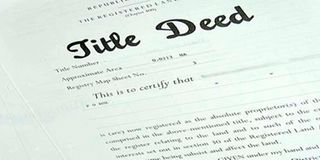
Local banks are facing losses running into hundreds of millions of shillings after falling prey to sophisticated land title fraud schemes that have exposed deep flaws in the country’s land registry system.
Several lenders now hold worthless securities tied to non-existent or illegally acquired property rights, leaving financial institutions, genuine landowners and investors dangerously exposed.
One case illustrates the crisis. In 1994, David Wakaimba lawfully purchased a 1.2-acre plot in Ruiru. Seventeen years later, strangers appeared at his gate with title documents issued by the Thika Land Registry that seemed genuine. Investigations revealed that, in 2009, a fraudulent title had been created in another person’s name and transferred in 2010 to a third party, who used it to secure a Sh7 million loan from Equity Bank.
When police attempted to verify the ownership, they discovered the land’s green card was missing from the registry. Mr Wakaimba petitioned the Environment and Land Court, presenting proof of his legal purchase and registration.
On March 6, 2025, Justice Oscar Angote ruled in his favour, declaring him the rightful owner and ordering the cancellation of the fake title and the bank’s charge. In a landmark ruling, the judge relied on a 2023 Supreme Court precedent which held that titles with defective roots are invalid, even if they were obtained in good faith.
“The apex court’s decision is clear: there can be no protection offered to a purchaser with respect to a title whose root is defective or marred by illegality,” Justice Angote said. “A charge over an invalid title cannot create a valid interest in land.”
Mr Wakaimba’s case is not isolated. In one of the most high-profile scandals, Equity Bank, Co-operative Bank and Commercial Bank of Africa (now NCBA) were defrauded of a combined Sh466 million over a half-acre plot in Dagoretti/Riruta. Between 2010 and 2014, each bank advanced loans after being presented with what appeared to be authentic title documents.
Registry searches revealed no encumbrances, and the lenders even retained the originals as security. Co-op Bank advanced Sh166 million, CBA Sh100 million and Equity Sh200 million. The scheme unravelled when Co-op Bank moved to auction the land to recover unpaid loans, only to discover rival claims from the other two lenders.
The Court of Appeal described the situation as “perplexing.” “Three of the country’s top banks appear to have been caught up in an intricate web of fraud hatched by their mutual customers,” the court observed.
“Without collusion within the Lands Ministry, such transactions could not have succeeded.” The judges warned that the banks could lose customer funds running into hundreds of millions, adding it was “perplexing that none of the perpetrators has been subjected to the criminal process.”
Smaller lenders have also been targeted. Consolidated Bank lost Sh1.2 million after advancing a loan against land that had belonged to a man who died in 1987. In 2012, a fraudster obtained a new title for the parcel and used it to secure credit.
The scam was discovered when the bank attempted to auction the land. Relatives of the late Kipkoech Tele investigated and found the property had been fraudulently transferred. The Environment and Land Court later nullified the fake title and charge, restoring the land to the Tele family. The bank argued that it was an innocent purchaser for value, having relied on a clean search from the registry. The court disagreed, ruling that fraud in the chain of ownership invalidated the bank’s interest.
In another drawn-out battle, rival claimants—including Barclays Bank International, Muchanga Investments Ltd, businessman John Gohard Mburu and Habenga Holdings Ltd—fought over a 135-acre parcel in Nairobi’s Karen suburb. Dozens of titles, deed plans and correspondences dating back to 1973 surfaced, each purporting to prove ownership.
After years of litigation, the courts ruled all contested titles invalid, declaring the land belonged to the estate of the late investor Arnold Bradley. Barclays Bank International, as executor and trustee of the estate, was deemed the last lawful titleholder. Other claimants’ titles were declared fraudulent and void.
The spate of fraudulent dealings has rattled not only Kenya’s banking industry but also the investment community. A recent report by the United States Trade Representative flagged fake and double-issued titles as a serious threat to Kenya’s investment climate. It warned that foreign investors leasing undeveloped land faced heightened risk of being duped.
In response, the Ministry of Lands has embarked on a Sh35 billion digitisation programme aimed at securing records, improving transparency and reducing opportunities for fraud. Lands Cabinet Secretary Alice Wahome said the phased roll-out would introduce stronger title security features and modernise service delivery. “Land digitisation is a complex exercise requiring extensive resources, but it is necessary to modernise our systems,” Ms Wahome said. “Across Africa, only a few countries have managed such a transition successfully. Kenya must join them.” Fifteen more counties are expected to be onboarded in the next phase.
Despite these efforts, the fraud epidemic continues to widen. Banks including Equity, Co-op, NCBA, Absa and Consolidated Bank remain entangled in cases that could leave them with huge losses.
Courts, citing the Supreme Court precedent, have consistently ruled that no lender can claim security over a title whose root is fraudulent. For now, lenders must tighten due diligence, property owners must remain vigilant, and the government must accelerate reforms—lest Kenya’s land market, long a source of bitter disputes, becomes an even greater liability for the economy.