After a marathon six-hour session of solemn praise and worship, sermons, and prayers, the 38th edition of the National Prayer Day at the Hill of Prayer, Subukia Shrine, was just about to come to an end at 2pm.
On Holy Saturday, October 4, the Nyeri Archdiocese mass choir had just struck the closing hymn, its powerful voices reverberating across the hills, when suddenly the Master of Ceremonies interrupted.
“Please hold on for just five minutes. We have a crucial announcement,” he said.
The recessional hymn ground to an abrupt halt as murmurs swept across the sea of worshippers—between 50,000 and 60,000 strong, according to priests and police estimates.
From the decorated pulpit, stepped up Archbishop Maurice Muhatia Makumba of Kisumu Archdiocese, his hands clutching two unopened bottles of wine.
Known for his humour and warmth, the Chairman of the Kenya Conference of Catholic Bishops (KCCB) walked calmly, smiling broadly, and immediately captured the attention of the faithful.
“Next year,” he declared, “the National Prayer Day will be animated (given life) by Kisumu Archdiocese. From Kisumu Dala, God willing, it will be our turn—and I promise it will be as massive as this year’s!”
Amid cheers, while holding up the bottle for all to see, the archbishop dropped his bombshell.
“From today, this wine (one of the bottles) will no longer be used in all Holy Masses in our churches in Kenya. We now have a new wine that has been approved by the KCCB (the other bottle).”
The change, which will see the church adopt a South-African-brewed wine produced by Lutzville Vineyards (RF) (Pty) Limited, took effect on October 4, 2025.
In his address, Archbishop Muhatia did not explain why the old wine was being phased out. Still, sources in the church cited unrestricted public access to the phased-out holy drink, which could easily be bought in liquor shops, hotels, bars and supermarkets.
The Nation’s subsequent telephone calls and text messages to the KCCB chairman and his vice, Archbishop Anthony Muheria of Nyeri Archdiocese, to shed more light on the change were not responded to.
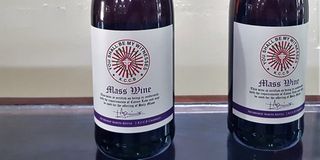
The newly approved Catholic altar wine on display at the Catholic Bookshop in Nakuru City on October 7, 2025.
Photo credit: Francis Mureithi| Nation Media Group
During the Subukia address, the omission of the explanation sparked a flurry of reactions among clergy and the faithful alike.
“I don’t know whether I received the Holy Communion today with the old wine or the new one,” said a laughing Ruth Mwongela from Kitui Diocese.
“I wish Archbishop Muhatia had clarified that. But either way, I think the bishops have our best interests at heart.”
Archbishop Muhatia also did not name the current and new suppliers, but a spot check by the Nation at Nakuru Catholic Bookshop, where the new wine is stocked, indicated that the old wine was supplied by Kenya Wines Agencies Limited.
The new sacred drink, on the other hand, is imported and distributed in Kenya by Wow Beverages.
“As far as I know, Kenya Wines Agencies Limited, a local wine manufacturer based in Nairobi, has been supplying KCCB with the old wine. The new supplier is from South Africa,” said the priest, who requested anonymity as he is not an authorised spokesperson for the KCCB.
Unlike the old wine that had 18 percent alcohol content, the new 750ml bottle has an alcohol content of 17 percent. Branded simply as “Mass Wine”, it has a warning indicating that excessive alcohol consumption is harmful to users’ health and can cause liver cirrhosis.
“The fruit of the vine and work of human hands will become our cup of joy. It conforms with the requirements of Canon Law, is certified and approved for the celebration of the Holy Mass,” reads another label on the bottle:
Archbishop Muhatia explained that the newly approved altar wine carries the coat of arms of the KCCB, along with the chairman’s signature, to regulate its authenticity.
The current stock is signed by the former KCCB chairman, Archbishop Martin Kivuva of Mombasa Archdiocese.
“Different dioceses have their ways of distributing this wine. Please check with your parishes to know the approved outlets,” he instructed.
The newly approved Catholic altar wine on display at the Catholic Bookshop in Nakuru City on October 7, 2025.
Photo credit: Francis Mureithi| Nation Media Group
“Some dioceses have designated specific persons to purchase the wine,” he added, emphasising that this was a collective decision by the Kenyan bishops, not a Vatican directive.
The financial value of wine consumed by Catholics in Kenya, estimated at 9.7 million in the 2019 census, runs into tens of millions of shillings per year— pointing to a significant expenditure that sustains the celebration of Mass across the country.
A 750ml bottle of sacramental wine that was supplied to Catholic bookshops by Kenya Wine Agencies was bought at Sh1,200 and sold at Sh1,700, while Wow Beverages is supplying a bottle at Sh1,500 and sold to authorised faithful at Sh1,800.
According to a procurement official at the Kisumu Archdiocese, the quantities of wine purchased depend largely on the liturgical calendar and the number of church activities in a given season.
“We normally buy between 10 and 20 cartons to last for a period of three months, and each carton contains 12 bottles. In a year, we buy about 60 cartons,” the official explained.
Kenya currently has 28 Catholic ecclesiastical jurisdictions, including 26 dioceses, an apostolic vicariate, and the Military Ordinariate.
The official noted that wine consumption varies and is much higher in major archdioceses such as Nairobi, Nyeri, and Mombasa.
These are metropolitan sees, each serving as the spiritual centre for a large Catholic population spread across multiple dioceses.
“I estimate the annual consumption in these archdioceses could be between 60 and 90 cartons of wine each, depending on the liturgical season and the volume of church activities. For instance, during Easter, Christmas, or major diocesan events, the numbers rise significantly,” he added.
Across the Kenyan diaspora, the announcement of the new wine stirred equally strong emotions.
Father Kibaki Robert, a Kenyan priest serving as Associate Pastor at St John the Evangelist Catholic Church in Encinitas, California, praised the move.
“I think changing the altar wine in Kenya was long overdue,” he said.
“It was really annoying. Everywhere you went, clubs, supermarkets, wine and spirit shops, altar wine was being sold on the shelves. You could not tell what was genuine anymore.”
“Even other Christians had begun using our altar wine. But Catholics don’t like sharing—we want what is Catholic to remain Catholic. The bishops have made the right call.”
“We don’t want to see this new altar wine sold in clubs, supermarkets, or bars. It should remain special, protected, and hard to get—reserved for the Eucharist alone. I pray the love of money does not corrupt this holy intention.”
“It had been reduced to secular use rather than church use, because of its lower-than-average alcohol content and its labelling as ‘grape wine with natural flavours’”, said Fr William Kambo of St Martin Nyamarutu Parish, Nakuru.
He reminded the faithful that despite its alcohol traces, altar wine poses no harm to priests who consume it.
“Its alcohol content is negligible. For us, it is consecrated into the Blood of Christ and holds no danger to the celebrant.”
For ordinary Catholics, the bishops’ directive provoked surprise, nostalgia, and in some cases, a tinge of regret.
“I used to buy the old wine on the streets of Nairobi at Sh700,” confessed John Kamande. “It was sweet. I started sipping it when I was an altar boy. Now I guess that chapter is closed.”
The newly approved Catholic altar wine on display at the Catholic Bookshop in Nakuru City on October 7, 2025.
Photo credit: Francis Mureithi| Nation Media Group
“I love the decision,” said Margaret Nyambura. “I had been uneasy seeing altar wine at family parties. I was asking myself—what is happening to our sacred symbols?”
Reynah Mkala agreed. “Altar wine should remain where it belongs—in church. I’m glad the bishops have spoken with one voice.”
For Francis Kimata, the change was about faith at its deepest level.
“We Catholics believe it is truly his body and blood—not just a symbol but the real presence of Christ. That is why the wine must remain holy, authentic, and uncontaminated by the market.”
The bishops’ decision may appear to be about a bottle of wine, but for many it touches the very core of Catholic identity.
“The Eucharist is the 'source and summit' of the faith. Ensuring the purity of altar wine,” noted Fr Kambo, adding, “it is not just a matter of logistics—it is about safeguarding reverence for the sacrament,” said a catechist based in Nakuru.
“It was a reminder that the Church must be vigilant about symbols that point to God’s presence,” he said.
The National Prayer Day itself, under the theme “Pilgrims of Hope: Renewing Our Nation”, was filled with solemn prayers, vibrant choirs, and bishops’ calls for moral renewal.
The bishops dedicated the country to the Virgin Mary's intercession and called for divine guidance amidst corruption and injustice, fostering integrity and social conscience.
They also encouraged young people to be "protagonists of hope" and to be guided by faith and charity.