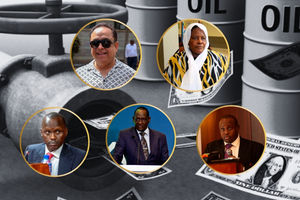
Cabinet Secretary Opiyo Wandayi on Tuesday directed a firm owned by a Mombasa tycoon to take a Sh11.8 billion haircut in an evolving fuel import saga, as the businessman’s One Petroleum Ltd maintained that it shipped in the product after winning a tender in the Ministry of Energy.
In a statement, Mr Wandayi ordered One Petroleum, owned by Mr Mohamed Jaffer, to withdraw the 60,000 tonnes of super petrol from the market, arguing that it was illegally imported.
Hours later, One Petroleum issued a statement yielding to the withdrawal order, but stating that the Ministry of Energy had, in March, awarded four firms contracts for import of petroleum products outside the Government-to-Government framework.
Mombasa businessman Mohamed Jaffer whose company One Petroleum has been ordered to withdraw the 60,000 tonnes of super petrol from the market.
Photo credit: File | Nation Media Group
Through the Government-to-Government framework, Kenya sources fuel from the United Arab Emirates and Saudi Arabia.
Mr Wandayi said that a similar consignment under the Government-to-Government framework would have cost Sh8.4 billion.
The CS held that allowing the petroleum imported by Mr Jaffer’s One Petroleum Ltd would have pushed prices at the pump up by Sh14 per litre.
“…However, a 60,000-metric-tonne consignment of super petrol was recently imported in contravention of the procedures set out under the G-2-G framework with international suppliers… This consignment is priced at Sh198,000 per tonne, compared to Sh140,000 per tonne under the G-2-G arrangement, an increase of Sh58,000 per metric tonne, which would result in an approximate rise of Sh14 per litre in pump prices on this consignment alone,” Mr Wandayi said.
But Mr Jaffer maintained that the importation was done in line with the emergency procurement process.
One Petroleum Ltd said in its statement that four firms were also picked to supply petroleum to avert a fuel crisis.
“In March, One Petroleum Ltd was one of the four bidders that successfully responded to an emergency request issued by the Energy ministry. Following consultations with the government, One Petroleum Ltd confirms that it has forthwith taken steps to ensure that the petroleum cargo that was brought in on March 27, 2026, via MT Paloma does not enter the Kenyan market,” the firm said in its statement.
How multi-billion shilling fuel scandal was engineered between top govt officials, business tycoons
Correspondence seen by the Nation last week showed that Swiss-owned Oryx Petroleum had also ordered 60,000 tonnes of petroleum in a similar arrangement to that of One Petroleum. The Oryx consignment was expected to arrive in Mombasa this week. The identity of the other two importers remains unknown, as the Energy ministry and the Energy and Petroleum and Regulatory Authority (Epra) had not responded to our queries by the time of going to press.
Also unclear are the contractual terms. Earlier correspondence between Epra and One Petroleum and Oryx, however, show that the pump price regulator had agreed to cushion both importers from overheads arising from the steep prices fuelled by the Iran crisis.
This could expose the government to litigation, as Mr Jaffer’s firm stares at potential losses of over Sh11.8 billion or is forced to scout for buyers for the already discredited consignment.
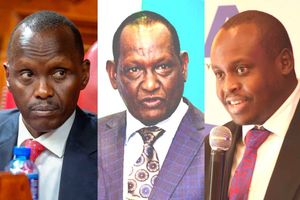
The Directorate of Criminal Investigations (DCI) officers on Tuesday continued questioning former Kenya Pipeline Company (KPC) Managing Director Joe Sang, former Epra Director-General Daniel Kiptoo and former Principal Secretary Mohamed Liban over the imports saga.
From left: Former Kenya Pipeline Company MD Joe Sang, outgoing Petroleum PS Mohamed LIban and outgoing EPRA DG Daniel Kiptoo. The trio resigned amid investigations into the procurement of substandard fuel.
Photo credit: Nation
Two KPC employees, Mr Joseph Wafula and Mr Joel Mburu, are also under investigation. They were taken into custody last Friday morning, but released on police cash bail of Sh100,000 each on Sunday. Police are investigating the energy sector honchos for alleged collusion to import substandard petroleum at inflated prices. The petroleum, initially intended for Angola, allegedly had higher levels of Sulphur, Manganese and Benzene than allowed by the Kenya Bureau of Standards.
Mr Wandayi on Tuesday ordered One Petroleum to remove the petroleum from Kenya, and directed oil marketing companies not to settle invoices for orders that they placed.
Usually, oil marketing companies are invoiced by the importers after receiving their orders. This means that if the usual procedure was followed, some of the flagged cargo could already have found its way into motorists’ fuel tanks.
The Government-to-Government framework uses a post-delivery invoicing model. Under this model, importers send invoices to individual oil marketers after the ordered quotas have been delivered. The oil marketers then have 180 days to settle the invoices.
Some petrol stations had recorded stock-outs weeks before the imports saga, as the government insisted that some industry players were creating a shortage so as to profiteer from the expected price rises at the time.
“Oil marketers should neither pay the invoices nor uplift products from this consignment… One Petroleum Ltd is directed to exit this product from Kenya as soon as possible, and the Energy and Petroleum Regulatory Authority is directed to subsequently exclude this product from the monthly computation of petroleum products,” Mr Wandayi said in the statement.
The statement by the Energy CS did not specify where the petroleum is. However, petroleum is usually stored in KPC infrastructure and transferred either to marketers as per their orders or reserve tanks.
Mr Wandayi’s statement also indicates that the fuel imported by Mr Jaffer’s firm was heading to the open market, yet correspondence between former PS Mr Liban, two importers and Kebs showed that it was to be stored in Kenya’s reserves.
Trade and Investments Cabinet Secretary Lee Kinyanjui, in a letter to the Energy ministry on March 28, allowed Kebs to waive some standard procedures governing fuel imports, but held that the incoming product must be commingled with previous consignments so as to lower the sulphur, manganese and benzene levels.
Investments, Trade and Industry Cabinet Secretary Lee Kinyanjui.
Photo credit: Lucy Wanjiru | Nation Media Group
By the time the Trade CS was penning his letter, the MT Paloma had already been in Kenya for 24 hours. It docked in Mombasa on March 27 at approximately 4.14pm, and left on March 30. By yesterday, the ship had just entered South African waters. Her last known port before Mombasa port was Fujairah in the UAE. It was initially destined for Angola, but diverted to Mombasa.