
A Sh600 million trust property fraud case before a Mombasa court has raised a critical legal question: can an advocate represent accused persons in a matter in which he is also alleged to be a key witness?
At the centre of the dispute is Mombasa-based lawyer Adams Muthama, who is on record as defence counsel for six accused persons facing multiple charges linked to the alleged fraudulent disposal of prime property in Diani, Kwale County.
However, the prosecution now seeks to bar him from representing the accused, arguing that his role in the transactions under investigation places him at the heart of the case and creates a conflict that could undermine the fairness of the trial.
In court filings, investigators contend that Mr Muthama possesses first-hand knowledge of how funds from the disputed transactions were handled, making him a material witness whose continued participation as counsel would be legally untenable.
“An advocate who is a material and necessary witness cannot appear as counsel in the same matter,” the Directorate of Criminal Investigations (DCI) said in a sworn affidavit, describing the principle as central to safeguarding the integrity of judicial proceedings.
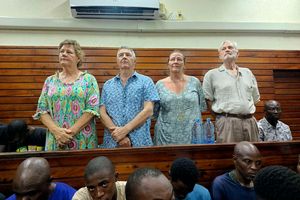
The criminal case involves five elderly Kenyans of British origin — Annelise Lulu Archer Clark, John Christopher Clark, Hellen Kay Hartley, Richard Hartley and Christine Inger Clark — alongside a Kenyan, Peter Mutwiwa.
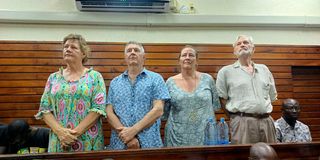
From left: Annelise Lulu Archer Clark, John Christopher Clark, Hellen Kay Hartley and Richard Hartley, before Mombasa court on March 9,2026.
They are accused of conspiring to defraud beneficiaries of parcels Kwale/Diani Beach Block 806, 807 and 808 between 2017 and 2021.
According to the charge sheet, the accused subdivided the land into six portions and transferred them to three companies — Snapdragon Ltd, Kamakawaida Properties Ltd and Baroness Holdings Ltd — in transactions the prosecution says were designed to unlawfully deprive beneficiaries of their interests.
The alleged victims are James Howard Archer, Joana Trent and Robert Archer.
Prosecutors further allege that the accused obtained registration of titles by false pretences and orchestrated transactions that misrepresented them as legitimate beneficiaries.
In a separate count, Annelise Archer Clark is charged with perjury for allegedly swearing a false affidavit in a 2021 Court of Appeal case in which she claimed the properties had been lawfully transferred for value.
All the accused have denied the charges and were released on a bond of Sh1 million or cash bail of Sh300,000.
The court has also issued warrants of arrest against directors of the three companies who failed to appear in court, with Interpol enlisted to assist in tracing them.
The criminal proceedings stem from a long-running family dispute over the property, which dates back to 2012 and has moved through multiple courts, including the Environment and Land Court and the Court of Appeal, which issued a ruling in 2023.
In the civil case, the claimants argued that the land — which once hosted Diani House — was acquired in the 1960s through a family arrangement, with their father, Howard Archer, contributing £5,000 towards its purchase in 1967.
The property was registered in the name of Christopher John Archer, then the only Kenyan citizen among the siblings, with the understanding that he would hold it in trust for the wider family.
It is this trust arrangement that now forms the foundation of the criminal charges, with prosecutors alleging that subsequent transactions were designed to defeat the rights of the beneficiaries.
At the heart of the State’s case is the assertion that Mr Muthama was not merely acting as a lawyer but played a direct and central role in facilitating the disputed transactions.
Investigators allege that proceeds of the Sh600 million deal were processed through his law firm, placing him within the financial trail that prosecutors say is key to establishing how the alleged fraud was executed.
They further claim that he was involved in the subdivision and transfer of the properties despite existing court-ordered restrictions, and that he prepared or oversaw agreements used to effect the transactions.
According to the DCI, these actions go beyond routine legal representation and instead point to active participation in the transactions under scrutiny.
The prosecution has also pointed to a complex ownership structure involving offshore-linked entities, arguing that the arrangement was designed to obscure the true beneficiaries of the property and complicate efforts to trace ownership.
Investigators say that Baroness Holdings Ltd, the company used in the final transfer, was linked to nominee arrangements through which beneficial ownership could be concealed, raising further questions about the destination of the Sh600 million proceeds.
The State also accuses the advocate of failing to surrender key documents, including sale agreements and account details, which it says are critical to ongoing investigations.
According to investigators, such non-disclosure risks shielding material evidence behind claims of legal privilege, potentially obstructing the course of justice.
The prosecution argues that allowing Mr Muthama to continue acting as defence counsel would create an inherent conflict of interest, including the possibility that he could be required to challenge or defend his own evidence during trial.
It maintains that such a scenario would prejudice the proceedings and erode public confidence in the administration of justice.
“This is not a peripheral issue. It goes to the core of whether the trial can proceed fairly,” the State argues in its filings.
Beyond the immediate case, the dispute raises broader questions about professional boundaries in legal practice, particularly in complex commercial and trust-related transactions where advocates often play multiple roles.
Legal experts note that while lawyers routinely handle financial transactions and documentation on behalf of clients, the line between representation and participation becomes critical when criminal liability is alleged.

A view of Diani Beach on Kenya's Coast.
The court is now expected to determine whether Mr Muthama can continue representing the accused or should be barred from the case as a potential witness.
The decision is likely to shape not only the conduct of the trial but also set an important precedent on the limits of legal representation in cases where advocates are closely linked to disputed transactions.
For now, the case continues, with both the criminal trial and the question of the advocate’s role set to test the boundaries between legal representation and alleged complicity in one of the most complex property disputes to reach the Mombasa courts in recent years.
Follow our WhatsApp channel for breaking news updates and more stories like this.