A crisis meeting under the National Security Council Committee (NSCC) chaired by Chief of Staff and Head of Public Service Felix Koskei instructed the State Department of Petroleum to explore alternative sources of fuel outside the government-to-government framework, official documents now show.
It is this meeting held on March 9, 2026 at the Office of the President just weeks into the escalating Iran war that triggered a series of policy decisions leading to the bad fuel scandal.
Documents reveal that it is the NSCC meeting that instructed Petroleum Principal Secretary Mohammed Liban to seek alternative sources beyond a single region so as to avert a looming fuel shortage as a result of the war crisis in the Middle East.
Kenya sources its fuel products from Saudi Arabia and the United Arab Emirates (UAE) under the G-G arrangement.
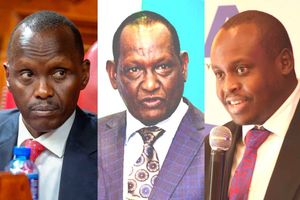
Mr Liban, Kenya Pipeline Company (KPC) Managing Director Joe Sang and Energy and Petroleum Regulatory Authority (Epra) Director General Daniel Kiptoo have since been forced to resign and are facing probe over the alleged scandal that involves a deal to import two petroleum consignments totaling 128,000 tonnes outside the G-to-G framework.
While communicating their resignation, Mr Koskei said the three may have manipulated data on in-country fuel stocks in the alleged attempt to ‘exploit rising global prices and public anxiety, thereby creating a false impression of an impending supply shortfall.”
“The shipment in question was procured in blatant breach of the G2G framework, at a price significantly above the contracted rates, in complete disregard of established emergency procurement procedures, and was of substandard quality,” Mr Koskei said on Friday when the scandal unfolded.
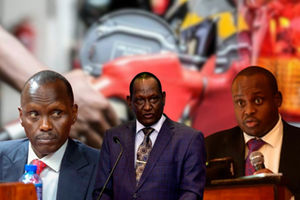
From left: Former Kenya Pipeline Company MD Joe Sang, outgoing Petroleum PS Mohamed LIban and outgoing EPRA DG Daniel Kiptoo. The trio resigned amid investigations into the procurement of substandard fuel.
Photo credit: Nation
But a letter by Mr Koskei in possession of the Nation authored immediately after the NSCC crisis meeting listed radical contingency measures, including an instruction to Mr Liban to seek alternative sources of fuel.
The crisis meeting noted that the escalating conflict in the Middle East, involving the United States, Israel and Iran, was likely to degenerate into a wider geopolitical, security and economic repercussions beyond the region, with Kenya standing to suffer vagaries of the war thousands of miles away.
“Given the Middle East’s central role in global energy supply, international trade routes, and security dynamics, prolonged instability may affect Kenya through volatility in global oil prices and disruptions in maritime trade,” states Mr Koskei in the letter.
Consequently, NSCC instructed Mr Liban ‘to explore and implement strategies to diversify petroleum import sources beyond a single region, reducing regional dependency and enhancing national energy security.”
The letter was copied to the country’s top security chiefs including National Intelligence Service Director General Noordin Haji, Chief of Defence Forces Gen Charles Kariri, Inspector General of Police Douglas Kanja, Principal Secretaries Dr Patrick Mariru (Defence), Dr Raymond Omollo (Internal Security and National Administration) and Dr Korir Sing’oei (Foreign Affairs).
It is presumed that it is on the basis of these instructions that PS Liban would on March 26 write to Kenya Bureau of Standards (Kebs) seeking temporary waiver on standard procedures to allow loading of petroleum products that were meant for other markets.
“As you are aware, the ongoing conflict in the Gulf Region has affected marine traffic flow, especially those that have to pass through the Strait of Hormuz. The International Oil Companies (IOCs)/ Suppliers under the Government-to-Government arrangement through their local counterparts i.e nominated Oil Marketing Companies (OMCs) must actively source for refined products to meet the delivery schedule to ensure security of supply,” said Mr Liban in a letter to Kebs Managing Director Esther Ngari.
“As a result, they have needed to be flexible with their loading points and sources. Sometimes, the products found in the market were originally meant for other markets, where specifications do not completely match those required by East Africa or the receiving terminal.”
In a subsequent correspondent, Trade and Investments CS Lee Kinyanjui in a letter to the Energy ministry on March 28 allowed KEBS to waive some of the requirements, but held that the incoming product must be commingled with previous consignments so as to lower the Sulphur, Manganese and Benzene levels.
Mr Kinyanjui also directed that the next time an imported consignment that met KEBS standards arrived, it be commingled into that reserve batch to further lower the excess chemical levels. By the time the Trade CS was penning his letter, the MT Paloma had already been in Kenya for 24 hours.
The MT Paloma docked in Mombasa on March 27 at approximately 4.14pm, and left on March 30.
On Tuesday when Energy and Petroleum CS Opiyo Wandayi was directing One Petroleum, owned by Mohamed Jaffer, a Mombasa tycoon, to withdraw the 60,000 tonnes of super petrol from the market, arguing that it was illegally imported, the ship had just entered South African waters and was sailing to Port Elizabeth in the Eastern Cape Province.
Energy and Petroleum Cabinet Secretary Opiyo Wandayi.
Photo credit: Nation Media Group
Her last known port before Mombasa port was Fujairah in the UAE. The vessel was initially destined for Angola but diverted to Mombasa after One Petroleum purchased the 60,000 tonnes of petroleum onboard.
Mr Wandayi said that a similar consignment under the Government-to-Government framework would have cost Sh8.4 billion.
The CS held that allowing the petroleum imported by Mr Jaffer’s One Petroleum Ltd would have pushed prices at the pump up by Sh14 per litre.
“…However, a 60,000-metric tonne consignment of super petrol was recently imported in contravention of the procedures set out under the G-2-G framework with international suppliers… This consignment is priced at Sh198,000 per metric tonne, compared to Sh140,000 per metric tonne under the G-2-G arrangement, an increase of Sh58,000 per metric tonne, which would result in an approximate rise of Sh14 per litre in pump prices on this consignment alone,” Mr Wandayi said.
But Mr Jaffer maintained that the importation was done in line with the emergency procurement process. One Petroleum Ltd said in its statement that four firms were also picked to supply petroleum and avert a fuel crisis.
“In March, One Petroleum Ltd was one of the four bidders that successfully responded to an emergency request issued by the Kenya Ministry of Energy and Petroleum. Following consultations with the government, One Petroleum Ltd confirms that it has forthwith taken steps to ensure that the petroleum cargo that was brought in on 27th March, 2026 via MT Paloma does not enter the Kenyan market,” the firm said in its statement.
In the NSCC meeting, Mr Koskei led the team in coming up with other contingency measures to mitigate possible economic impacts while addressing the country’s strategic vulnerabilities for the future.
“To this end, the committee underscored the need to progressively build resilience by reducing dependence on imported petroleum, accelerating energy transition and diversifying oil import sources. The NSCC also highlighted the need to develop the National Energy Security and Resilience Plan in order to strengthen long-term energy stability.
Mr Liban and his Energy PS Alex Wachira were also instructed – by the NSCC meeting – to develop and implement the National Energy Security and Resilience Plan in diversifying Kenya’s energy so as to reduce dependence on imported petroleum. The two bureaucrats were instructed to develop a draft by August 3, 2026.
The meeting further resolved to have the country exploit the conflict to revitalize its economy by reinforcing its strategic position as a regional financial and connectivity hub through Nairobi International Financial Centre (NIFC) and strategic aviation layovers.
This, the meeting said, would help the country diversify its export markets on top of implementing “trade disruption measures to strengthen resilience, strategic autonomy and capacity to absorb external shocks.”