The government was forced to act and temporarily reduce Value Added Tax (VAT) on petroleum and petroleum products from 16 per cent to 8 per cent as it monitors turmoil in the Middle East, which has disrupted crude oil supply.
The reduction, effected through the VAT (Amendment) Bill 2026 now awaiting presidential assent, came a day after the opposition rallied Kenyans for mass action to protest the punitive and insensitive increase in prices of the critical commodity.
It was one of those rare occasions in which a Bill is introduced in the National Assembly, debated and passed in a single sitting on the afternoon of April 16, 2026, highlighting the urgency with which the government acted to cushion Kenyans from price shocks.
The changes made in Section 5 of the VAT Act shall, however, be in force for 90 days, within which period the government hopes that normalcy in the Middle East will be restored.
The Cabinet Secretary for the National Treasury, through a gazette notice, also has the power to extend the reduced tax rate period for a further 90 days.
“Notwithstanding the provisions of subsection (2), the rate of tax for the following items shall be eight per cent of the taxable value,” the new law states.
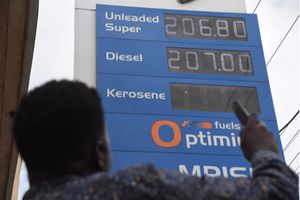
A petrol station displaying the new fuel prices after a reduction in VAT by the government, pictured on April 16, 2026.
Photo credit: Francis Nderitu | Nation
The petroleum products affected by the reduced VAT rate include petrol (gasoline), kerosene and diesel.
The increased fuel prices announced by the Energy and Petroleum Regulatory Authority (EPRA) in its monthly price review were partly driven by the government’s lack of strategic fuel reserves to last at least 90 days amid the ongoing turmoil in the Middle East, which has disrupted crude oil supply.
Kenya relies heavily on fossil fuels for production, and the recent fuel price hikes have been attributed to disrupted crude oil supply in the Strait of Hormuz due to the US-Israel conflict with Iran.
Following opposition threats to mobilise Kenyans against the increased petroleum prices, President William Ruto, at a rally in Kisii, indicated that the government would review VAT on petroleum and its products by three per cent.
This, however, was subject to the National Treasury CS, John Mbadi, gazetting the new rates. Still, the move was seen as insufficient in the face of already overtaxed Kenyans.
Section 6(1) of the VAT Act states that the CS for the National Treasury “may, by order published in the Gazette, amend the rate of tax by increasing or decreasing any of the rates of tax by an amount not exceeding 25 per cent of the rate specified.”
“Every order made shall be laid before the National Assembly without unreasonable delay,” the law states.
The order shall, however, “cease to have effect if a resolution of the House disapproving the order is passed within 20 days of the day on which the National Assembly next sits after the order is laid, but without prejudice to anything previously done thereunder.”
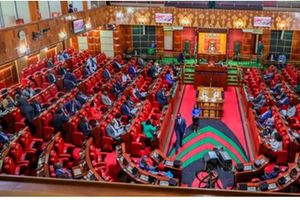
The National Assembly in a past session.
Photo credit: File | Nation Media Group
The limitations in the law regarding the extent to which the CS can reduce tax rates prompted the Executive to introduce the Bill, which provides more room to adjust rates.
The passage of the law was preceded by an EPRA gazette notice of April 15, 2026, indicating that the National Treasury CS had revised the VAT rate from 13 per cent to 8 per cent.
“EPRA recalculated the maximum retail pump prices that will be in force, taking into account the revised VAT rate,” said EPRA Acting Director-General Dr Joseph Oketch.
Based on the reduced rates, Dr Oketch announced that the pump price per litre in Nairobi for super petrol and diesel would decrease by Sh9.37 and Sh10.21 respectively, while kerosene remained unchanged.
“Consequently, the level of subsidy on kerosene reduces from the current Sh108.10 per litre to Sh96.56 per litre,” he added.
The need to amend the law is based on the fact that taxpayers and consumers of petroleum products have been adversely affected by price hikes, which have been described as punitive to an already overtaxed population.
Runyenjes MP Gitonga Mukunji led a section of MPs in seeking clarity on whether there are other reasons, beyond taxation, contributing to the sharp rise in the cost of petroleum products.
Enhanced VAT on petroleum products is an International Monetary Fund (IMF) conditionality for Kenya to comply with in order to access concessional credit for budgetary support.
The reduction of the rates may therefore not be welcomed by the Bretton Woods institution, which maintains that Kenya faces risks in financing its rising public debt, currently standing at Sh12.8 trillion.
The enhanced VAT was intended to mitigate continued borrowing by increasing locally generated revenue through taxation and other austerity measures aligned with IMF recommendations.
The net effect of the reduction is that it will deny the government expected revenue to finance its operations, as the adjustments affect already legislated revenue measures and may lead to increased borrowing to plug the budget deficit.
The VAT on petroleum products was first introduced under the VAT Act of 2013, with a three-year grace period that was to take effect in 2016 but was deferred to September 1, 2018.
A vessel in the Strait of Hormuz, off the coast of Oman’s Musandam province, April 12, 2026.
Photo credit: REUTERS/File Photo
The VAT on petroleum products was eventually introduced through the Finance Act of 2018 at a reduced rate of 8 per cent, down from 16 per cent, to cushion the economy from the impact of fuel taxation.
The Strait of Hormuz is currently experiencing an acute crisis, with shipping traffic reduced to a trickle following its blockade by Iran in response to US-Israeli military action prompted by the killing of Iran’s supreme leader, Ali Khamenei, on February 28, 2026.
The Strait of Hormuz is a narrow but strategically critical waterway connecting the Persian Gulf to the Gulf of Oman and the Arabian Sea.
It is the only sea passage out of the Persian Gulf, making it the world’s most important oil transit chokepoint and a primary export route for Kuwait, Iraq, Saudi Arabia, the United Arab Emirates (UAE) and Qatar.
About 20 to 25 per cent of the world’s daily seaborne oil trade, and around 20 per cent of liquefied natural gas (LNG), passes through the Strait of Hormuz.
The conflict in the Gulf has escalated global oil prices as tankers carrying crude oil remain stranded in the strait.