Energy Cabinet Secretary Opiyo Wandayi’s much-anticipated appearance before MPs over the Sh12 billion fuel import scandal on Monday raised more questions than answers, coming off less as an accountability session and more as a distancing act.
Facing the National Assembly’s Energy Committee for the first time since the scandal broke, and following lawmakers’ threat to sanction him after skipping the Thursday summons, the CS repeatedly disowned the controversial deal— telling lawmakers he neither knew about it nor approved it, effectively painting himself as a bystander in a ministry he heads.
Throughout his testimony, Mr Wandayi maintained that the importation was carried out without his knowledge and outside the legally recognised Government-to-Government (G-to-G) framework, leaving MPs grappling with how such a high-stakes decision could bypass the very office mandated to oversee it.
“The approval of the CS in the importation of this fuel was not sought,” said CS Wandayi. “Procurement of the consignment was recommended by a technical committee. The PS (Mohamed Liban) approved it in his wisdom.”
The CS added that had the matter reached him, he would have escalated it to the Cabinet and the President for direction.
CS Wandayi, KPC, Epra Officials appear before National Assembly Energy Committee
“On March 30, it emerged this consignment came out of G-to-G and I moved swiftly and briefed the president. His excellency advised me to stop the second vessel which was coming in,” he said.
But it was his admission that he could not explain the sudden resignation of three senior officials at the centre of the scandal that further deepened concerns, reinforcing the impression of a ministry operating beyond his control.
Former Petroleum Principal Secretary Mohamed Liban, Kenya Pipeline Company (KPC) Managing Director Joe Sang and Energy and Petroleum Regulatory Authority (Epra) Director-General Daniel Kiptoo resigned after the scandal erupted during the Easter holidays.
"I cannot say why they resigned. What I know is that investigations are going on. There is no evidence of coercion. There is no reason for stopping me to continue to discharge my duties as CS for Energy,” Mr Wandayi told the committee.
Pressed by MPs to account for what he knew, the CS insisted he only learnt of the importation after the fact, at which point he moved to contain the fallout.
He said he instructed Mr Liban to take corrective action, including directing Oryx Energy, the firm that imported the fuel, to re-export it and withdraw all invoices issued to local oil retailers.
Mr Wandayi told the legilstors that the G-to-G framework is anchored in Cabinet resolutions and law and that any deviation from it would require Cabinet approval.
“Had it been brought to my attention, I would have escalated it at a higher level to the President and the Cabinet for necessary action,” he said.
Kenya entered into a G-to-G arrangement with Saudi Aramco, Emirates National Oil Company and Abu Dhabi National Oil Company to supply fuel on credit.
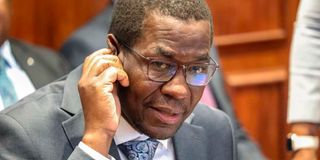
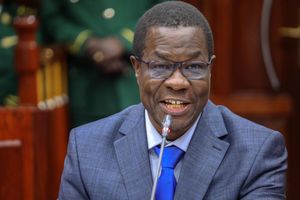
CS Opiyo Wandayi when he apeared before the National Assembly Departmental Committee on Energy on Monday, April 13, 2026.
Photo credit: Dennis Onsongo | Nation
Implemented in March 2023, the G-to-G importation framework was designed to ease pressure on foreign exchange reserves and stabilise fuel supply
The agreement allows for the importation of petroleum, diesel, and jet fuel under a deferred payment plan of 180 days, coordinated centrally by the ministry.
Mr Liban is said to have justified the importation as necessary due to dwindling fuel stocks in the local market, citing supply disruptions linked to the ongoing US-Israel–Iran conflict in the Middle East.
However, Mr Wandayi hinted at possible irregularities, suggesting that fuel stock data may have been manipulated to justify the importation.
Although the three Energy bosses were reportedly held in police custody over the Easter weekend, they have yet to be charged, with the Directorate of Criminal Investigations (DCI) said to be investigating the matter the matter.
On whether Kenyans should expect a fuel price jump in the latest monthly review, Mr Wandayi remained noncommittal, saying he was unaware of what Epra would announce.
“I don’t know what Epra will declare. But we are not sitting pretty. We are taking proactive measures, among them taxation, to ensure that Kenyans are not disadvantaged by what is happening in the Middle East,” he said.
Cabinet Secretary, Ministry of Energy and Petroleum, Opiyo Wandayi (Left) Kenya Pipeline Company (KPC) acting Managing Director Pius Mwendwa (Right) and Acting Director General of the Energy and Petroleum Regulatory Authority (EPRA), Joseph Oketch (Centre) before the National Assembly Departmental Committee on Energy, on Monday, April 13, 2026.
Photo credit: Dennis Onsongo | Nation
Asked if the illegally imported and expensive fuel would push the prices upwards, the minister responded:
"Take it from me, the cost of this consignment will not be factored. We ask Kenyans to be patient and wait for tomorrow to see measures the government has taken to cushion them."
The fuel crisis facing Kenya and other African countries has been compounded by escalating tensions in the Gulf, particularly disruptions in the Strait of Hormuz, a key global oil transit route, following military confrontation involving the United States, Israel and Iran.
The strait, which connects the Persian Gulf to the Gulf of Oman and the Arabian Sea, handles between 20 and 25 per cent of global seaborne oil and a significant share of liquefied natural gas.
Shipping traffic through the route has reduced sharply following its blockade by Iran in response to military action linked to the killing of Iran’s Supreme Leader, Ali Khamenei, on February 28, 2026.
The disruption has driven up global oil prices, raising fears of a knock-on effect on domestic fuel costs.
While Wandayi acknowledged the pressure on global oil markets, he maintained that measures are being taken to cushion Kenyans from the impact.
Although his remarks hinted at a possible increase in fuel prices, he suggested any adjustment would be moderated.
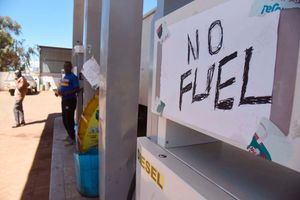
"There is no shortage of fuel in the country. If there is any shortage, it has been caused by oil market players."
Energy and Petroleum Regulatory Authority Acting Director-General Joseph Oketch said they had issued show-cause letters to dealers fingered for hoarding fuel.