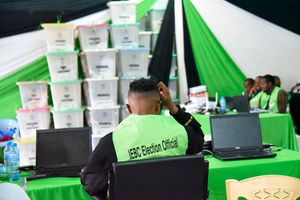
Every disputed election in Kenya's recent history has pivoted on the same fault line: what the results say at the polling station, and what gets announced at the national tallying centre.
In 2017, the Supreme Court nullified the presidential election and ordered a fresh vote, a first on in Africa; that a court had annulled the re-election of a sitting president. The court found that there were substantial failures in the transmission of results from polling stations to constituency tallying centres and to the national tallying centre, which affected the integrity of the election.
A decade earlier, a disputed presidential result had been far more destructive. The 2007-2008 post-election violence claimed the lives of over 1,100 Kenyans and displaced another 650,000.
A screengrab displaying the People's IEBC platform after logging in to submit the Form 34As.
A mechatronics engineering graduate from Dedan Kimathi University of Technology, Mr Miringa grew up in Juja, Kiambu County and has spent much of his adult life thinking about how intelligent systems can solve practical problems. Until recently, that work was mostly commercial, building AI-powered tools to automate processes for clients and institutions. But after Kenya marked the first anniversary of the 2024 anti-government protests last June, something shifted for him.
"That reflection pushed me towards one issue that was repeatedly emerging in conversations among young Kenyans," he said. "The growing distrust in elections."
The problem, as he sees it, is not simply that elections are disputed after the fact. It is that many Kenyans, particularly young voters, have already stopped believing their participation matters before they ever enter the polling booth.
"We already have democratic elections where citizens are given the opportunity to choose leaders," he said. "But many people do not vote because they believe the process is rigged and that their votes will not matter."
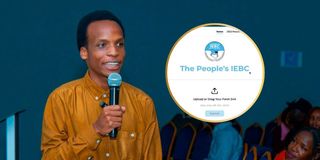
His answer is a platform called People's IEBC, a citizen-led, AI-powered system designed to independently tally presidential election results during the 2027 General Election. The model is straightforward: volunteer agents stationed at all of Kenya's approximately 22,000 polling centres photograph the Form 34A results posted outside polling stations once voting closes. Those images are uploaded to the platform, where AI processes them, extracts the vote tallies and aggregates the numbers in real time, running in parallel to the official count.
The team behind it is five people. They are aged between 21 and 26, mostly recent graduates. They started in September 2025 with no funding, no institutional backing and nothing but a social media post on TikTok, Instagram and X, inviting anyone interested in civic technology and governance to get involved.
"At the beginning, we did not have funding or institutional support," Mr Miringa said. "We only had an idea and the willingness to build it."
Since then, the initiative has recruited around 2,800 volunteer agents across all counties, about 70 per cent of them young people. The target is 22,000 agents by July 2027. The team has spent about Sh60,000 on cloud infrastructure, funded mostly through small online contributions from ordinary Kenyans.
A screengrab displaying the People's IEBC platform with the list of some presidential aspirants.
That visibility has also made them a target. The platform has suffered three cyberattacks this year alone, the most recent in April 2026. The team has since built in decentralised backup systems, distributing election images to node operators in multiple countries so that tallying can continue even if local infrastructure is disrupted. If internet access is shut during the election, agents can fall back on SMS.
The threats have not stayed online. Mr Miringa says he now pays closer attention to his surroundings in a way he did not before, conscious of the political sensitivity of what he is building.
"I try to be more careful about places I go to and situations I place myself in," he said.
For a young developer who started this by posting a concept on social media, that is a significant weight to carry. He credits his family for keeping him grounded through the pressure.
"Sometimes you just need people who listen and encourage you to keep going," he said.
But the core of what Mr Miringa is building responds directly to a documented, recurring failure in Kenya's electoral history. The gap between Form 34A and the final announcement has derailed two elections in the last two decades. He is not proposing to replace the IEBC. He is proposing to make the raw data visible to everyone, in real time, so that the gap has nowhere to hide.
"This is not about replacing institutions," he said. "It is about giving citizens confidence that their participation matters."
Mapping corruption, one asset at a time
Alongside People's IEBC, Mr Miringa and his team are building a second platform with a different but related ambition. Called ‘Finding Corrupt Assets in Kenya’, it maps properties, businesses and land parcels linked to corruption convictions involving individuals prosecuted through the legal system, cross-referenced against publicly documented cases from institutions including the Ethics and Anti-Corruption Commission.
So far, the platform has mapped 103 assets, including residential houses, apartments and land parcels tied to corruption-related convictions.
The goal is not to name and shame. It is to make publicly available information actually public, in a form ordinary Kenyans can access and act on.
"People should know which assets were acquired through corruption," Mr Miringa said. "That awareness itself can promote accountability."