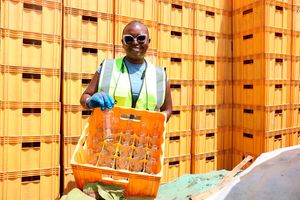
Less than five kilometres off the Mombasa–Malindi Road in Mtwapa town, Kilifi County, broken glass has become the foundation of hope and a source of livelihood for 27-year-old James Julo, who lives with albinism.
For Julo, a young graduate once confronted by the harsh reality of unemployment, discarded bottles are no longer waste but an opportunity. His story is one of resilience, creativity, and determination to carve out a livelihood where none seemed possible.
After graduating in 2020 from Mount Kenya University with a degree in Community Health and HIV Management, Julo struggled to get employment. Months turned into years, but instead of succumbing to despair, he chose to reinvent himself by venturing into an uncommon trade.
“One day, as I sat in deep reflection, I asked myself, ‘Why not try the glass recycling business?’ That is how it all began,” he recalls.
From the outset, he was determined not only to create a future for himself but also to open doors for others. His idea was to collect discarded glass bottles, cut them into reusable containers, and crush the remaining pieces for sale to recycling companies. Where others saw trash, Julo saw potential. He seized the opportunity, noting that no one else in Mtwapa had ventured into the same business. He required no starting capital, only discarded bottles and a place where he could crush them manually using a metal rod.
To establish an identity and brand, he named his enterprise Climate Cleaner Glassworks, a small company that now provides direct employment to three people and indirectly supports five women who wash and disinfect bottles, as well as suppliers who collect and deliver glass to the workshop.
When Climate Cleaner Glassworks began operations in 2022, the process was entirely manual.
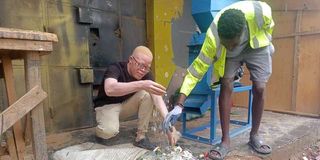
Glass bottles collected from the neighbourhood were packed into cement bags before being crushed with a metal rod. It was slow, cumbersome, and risky work that required the effort of three to four people at a time. That changed in November 2025 when Riziki Source, an organisation that supports small businesses, donated a modern crushing machine. The machine can process up to three tonnes of glass per day, significantly reducing labour demands and operational costs.
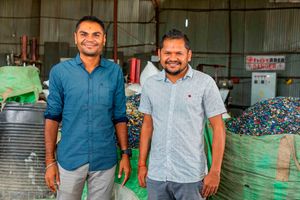
James Julo (left) and Daniel Ng’ang’a at their glass recycling workshop in Mtwapa on April 19, 2026. They have transformed discarded glass into a source of livelihood through their innovative recycling enterprise.
Photo credit: Brian Ocharo | Nation Media Group
“We appreciate Riziki Source because the machine has the capacity to crush the glass into fine particles that fit compactly into cement bags,” says Julo.
With the machine, one bag now holds 50 kilogrammes of crushed glass compared to the 15 to 18 kilogrammes achieved through manual crushing.
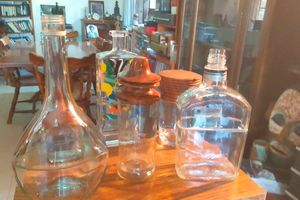
So, what is the art and science behind the glass-cutting method employed by the business? The process begins with a glass cutter mounted on a wooden stand. A symmetrical line of weakness is drawn around the bottle by rolling it against the cutter’s sharp edge. The bottle is then immersed in hot water, causing it to expand, before being plunged into cold water. This sudden change in temperature creates a fracture along the weakened line. Repeating the hot and cold immersion process separates the bottle into two parts: the upper section, which is crushed into cullets, and the bottom section, whose edges are softened to create a durable drinking glass.
This innovation has enabled the enterprise to produce reusable glasses for homes, restaurants, and bars.
Customers have welcomed the idea, with sales steadily growing. Between January and April this year, Julo says the enterprise sold 420 glasses, and demand continues to rise as awareness spreads. More finished products await buyers on the workshop shelves.
Nothing goes to waste. The upper halves of the bottles, once separated, are crushed into cullets and sold to companies such as Milly Glass in Liwatoni at Sh7.50 per kilogramme. In one sale, Julo says 14.7 tonnes of cullets generated Sh81,125, with a profit margin of Sh48,320 due to reduced production costs. Meanwhile, the refined bottom halves are softened at the cut edges and transformed into durable drinking glasses that retail at Sh100 each, significantly increasing the value of what was once considered waste.
On average, by combining cullet sales and reusable glass sales, the enterprise earns up to Sh120,000 during a good season.
The enterprise has also become a social hub, motivating local residents to bring in discarded bottles for a small fee. About 15 agents collect between three and four tonnes of glass weekly, ensuring a steady supply of raw materials.
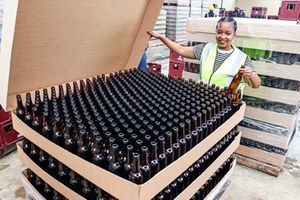
Women have also been economically empowered through the business, with five employed to wash and disinfect bottles before they are cut or resold. Depending on their workload, they earn between Sh500 and Sh700.
Since its inception, the business has collected 764 tonnes of glass, helping to reduce environmental hazards caused by discarded bottles on beaches and in the ocean.
“Glass waste causes physical harm and endangers the marine ecosystem. I call upon the youth to come on board so that our society can be free from glass waste,” he says.
Looking ahead, the enterprise hopes to modernise its production further once they acquire specialised machines for cutting, grinding, engraving, and branding glass products.
“With modern equipment, we can produce high-quality glasses, engrave names or logos, and create beautiful designs according to customer preferences. This will help us expand and create more employment opportunities for the youth,” he says.
Fredrick Ouko, the Executive Director of Riziki Source, says the organisation offered its support because of the important role played by the informal sector in creating employment and empowering communities.
“Through our work with artisans, we are supporting inclusive economic participation beyond formal employment, ensuring that opportunities reach a wider community,” he says.
Riziki Source is part of a consortium of Organisations of Persons with Disabilities championing the enforcement of Kenya’s five per cent employment quota for persons with disabilities. In Kilifi County, the organisation runs parallel initiatives, offering disability and gender inclusion training while promoting self-reliance through economic empowerment programs tailored for persons with disabilities.
Julo appeals to both the national and county governments to extend support to small-scale recycling enterprises like his. He is seeking funding, modern equipment, training opportunities, and market linkages to strengthen their operations.
“We believe such support would enable us to expand our activities, enhance efficiency, and create more employment opportunities for young people and vulnerable groups within the community,” he comments.