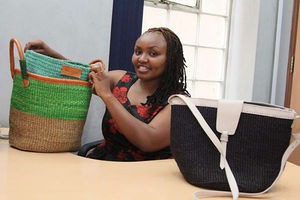
In Bypass Arcade on the outskirts of Nairobi, Janet Athanas has built a business around leather.
As the founder of Zanna Leather Crafts, she has turned a personal interest into a small-scale manufacturing enterprise producing handmade bags, belts, wallets, sandals and accessories.
The workshop is located in Kasarani, a neighbourhood defined by dense housing, informal commerce and the daily movement of workers in and out of the city. Within this environment is a production space where hides are cut, shaped and stitched into finished leather products for individual buyers, retailers and corporate clients.
“There is satisfaction in creating something bespoke for a customer, particularly when the process begins with raw material and ends with an item intended for regular use,” says Janet, adding that the transformation from unprocessed leather to a functional product defines the enterprise.
It is also at this point that craft and commerce intersect in small-scale manufacturing. Zanna Leather Crafts was established six years ago. The idea did not emerge from industrial planning but developed over time from personal interest. Janet, who had previously been drawn to creative expression, began exploring leatherwork as a medium that allowed both structure and experimentation.
“Bags became the product through evolution, as early experiments with form and stitching gradually found stability in that category,” she explains.
The early stages were defined by trial and error. Leather, unlike fabric, does not forgive mistakes. A misplaced cut cannot be reversed, while a stitch misaligned at the start of a seam affects the entire finish.
Handmade leather bags produced at Zanna Leather Craft’s production facility in Nairobi on April 1, 2026.
Photo credit: Bonface Bogita | Nation Media Group
Learning required repetition and patience, as well as access to tools that support accuracy. Over time, small-scale experimentation gave way to a workshop system where production processes could be carried out more reliably. As the work expanded, the product range extended to include belts, wallets and sandals. Retail prices range from Sh1,500 to Sh55,000, depending on design and specification. Each category carries distinct technical requirements.
Belts, she says, require precise measurement and edge finishing, while wallets call for internal stitching and compartment structuring. Sandals, meanwhile, require durability and comfort specifications alongside design requirements, prompting adjustments in production methods depending on the product.
“Every stage has to be deliberate because handling directly affects the outcome of the material. You cannot afford to be casual with it,” she says, adding that to meet rising demand, she increased her workforce from 1 to 5 artisans.
Her customers include individual buyers purchasing for personal use, as well as retail stockists requiring standardised products in small to medium quantities. The business also serves wholesale buyers with larger orders requiring fixed delivery timelines, alongside corporate clients requiring branding, embossing and batch uniformity.
Production is organised according to order type, material availability and labour capacity, with cutting, stitching and finishing taking place across different stations within the workshop. The sourcing of materials forms part of a wider production chain that includes livestock farming, slaughterhouses and local tanneries.
“This supply chain is not always stable. Quality varies depending on processing methods, and availability can fluctuate based on demand and seasonal factors,” she says, explaining that working within these constraints requires adaptation, particularly in matching material characteristics with product design.
Hides are selected and prepared before being cut into specific patterns using a template, with each stage requiring precision due to the limited margin for correction. Stitching is carried out depending on product type, followed by finishing, where edges are trimmed and final details added. Employment within the workshop is structured around artisans drawn through local networks.
Janet explains that the workers acquire knowledge through practice rather than formal training institutions. Their work involves translating designs into physical products using tools and techniques that require judgement and experience. Wages form part of the arrangement, but so does the transfer of skill.
“We introduce new workers to techniques gradually, beginning with basic tasks before moving into more complex stages of production,” she says.
Training in such settings is largely on the job, with skills developed through practice rather than formal instruction, a pattern common in informal and semi-formal manufacturing sectors.
A handmade leather bag being sewn at Zanna Leather Craft’s facility in Nairobi on April 1, 2026.
Photo credit: Bonface Bogita | Nation Media Group
Collaboration shapes design development, and ideas for new products are not generated in isolation.
“Our designs emerge through discussion with the artisans who bring practical knowledge of materials and construction methods. These interactions influence decisions on shape, structure and finishing,” she says.
Janet notes that in some cases, a design concept may be significantly modified once it is tested in production.
“What can be drawn on paper is not always what can be executed in leather,” she says. Thickness, flexibility and grain structure all affect outcomes. As a result, the workshop functions as both a production site and a space where adjustments are made throughout the process.
Artisans are involved in day-to-day production processes and contribute to how items are made, even where final design decisions are made by Janet. Their input influences production methods, particularly in contexts where technical skill levels vary and access to formal design training is limited.
While the leather industry in Kenya is characterised by availability of raw materials and established craftsmanship traditions, the sector is constrained by limited industrial scaling, inconsistent quality control systems and reliance in some segments on imported finished goods. Also, local manufacturers often operate within narrow margins, balancing material costs, labour and market pricing pressures. Regional and continental trade frameworks also influence the sector. The African Continental Free Trade Area has introduced expectations of increased intra-African trade in goods, including leather products.
“In theory, this opens opportunities for producers who can meet quality and regulatory standards. In practice, it also introduces competition from other manufacturing hubs within the continent,” she notes.
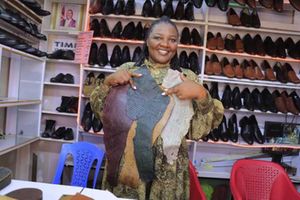
Zanna Leather Craft Director Janet Athanas displays handmade leather bags produced at her company on April 1, 2026.
Photo credit: Bonface Bogita | Nation Media Group
For small workshops, positioning across retail, wholesale and corporate orders is important for maintaining stable output. Each category responds differently to economic conditions.
Individual consumers tend to prioritise price and design, while corporate clients focus on branding and uniformity. Wholesale buyers prioritise consistency and delivery timelines. Production planning, therefore, varies depending on the order mix.
Sustainability considerations are also present in small-scale manufacturing. She says that in leather production, waste reduction is a practical concern as material costs are directly tied to yield efficiency. Offcuts from hides represent lost value if not used effectively.
At Zanna Leather Crafts, patterns are adjusted to reduce waste, including the use of digital tools that map material surfaces and guide layout decisions before cutting begins.
Gender in the leather industry is shaped by the traditional dominance of men, particularly in technical roles such as cutting, stitching and machinery operation. Janet says this affects women’s access to training and progression opportunities, and has expressed interest in increasing participation in leather work, particularly at entry-level stages where skills are first introduced.
Structured training focuses on foundational techniques, with early exposure to processes often acquired informally. Access to skills is a factor in participation in manufacturing, alongside capital and market access.
“We are focused on gradual expansion rather than rapid scaling, with attention on strengthening production capacity, improving consistency and maintaining quality across output,” she says.
This includes refining internal processes, investing in tools that support precision and exploring opportunities within regional markets under existing trade frameworks.
The direction is shaped by conditions within the wider leather value chain, including material availability, skills development and market access, which influence how small-scale manufacturers operate over the longer term.