63 years to parity: Women are entering leadership, but the top jobs remain out of reach
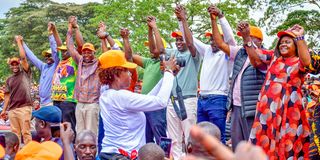
Women remain underrepresented in political leadership. Only one woman was among the 10 political leaders pictured during President William Ruto's public rally at ATC Grounds in Kisii Town, Nyaribari Chache Constituency, on November 11, 2026.

What you need to know:
- Women could wait another 63 years to achieve equal representation in national parliaments.
- In Kenya, the Two-Thirds Gender Rule remains largely unimplemented in elective politics.
It could take another 63 years for women to reach equal representation with men in national parliaments, if the current rate of change continues.
That is the projection in the 2026 Gender Snapshot by UN Women and the United Nations Department of Economic and Social Affairs. Equal representation remains a distant goal, held back by financial constraints, institutional barriers, cultural attitudes and violence against women in politics. Despite growing recognition of the importance of women in leadership, women still face major hurdles in winning elective seats and rising to influential decision-making roles.
In Kenya, the 2010 Constitution provides for the Two-Thirds Gender Rule, which seeks to ensure that neither gender occupies more than two-thirds of elective and appointive positions. Years after its adoption, however, the provision remains largely unimplemented in elective politics.


Globally, women hold only 27.4 per cent of parliamentary seats and 22.4 per cent of cabinet positions. Their numbers are even lower in other influential institutions: women account for just 31 of the world's 175 chief justices. In the corporate sector, women hold only 5.8 per cent of chief executive positions in publicly listed companies, although they occupy 25.1 per cent of board seats. The figures show that while women are increasingly gaining access to institutions, their representation at the highest levels of decision-making remains limited.
The report also highlights the wider benefits of having women in leadership. Countries where women hold more than 20 per cent of parliamentary seats record immunisation rates that are up to 12 percentage points higher, alongside improved child survival outcomes. Women leaders also tend to put greater emphasis on policies addressing healthcare, social protection and economic security.
Gender-related issues
According to the report, women have raised gender equality issues almost three times as often as men during the United Nations General Assembly's General Debate. Their contributions have focused on parental leave, unpaid care work, pensions, savings and workers' protection.
Rwanda is cited as an example of progress, with women holding 64 per cent of parliamentary seats. The country has also integrated gender equality into its education policies and curricula, and students show considerable awareness of gender-related issues.
Also read: Unpacking misconception: The two-thirds gender rule was never meant to guarantee men a majority
The report further points to evidence from francophone Africa showing that pupils in primary schools headed by female principals perform better in mathematics and reading than those in schools led by male principals, with gains equivalent to at least six additional months of learning. It argues that women's representation in leadership can influence outcomes beyond politics, including education, justice and the protection of fundamental rights.
In the justice sector, the report notes that electing a woman mayor in US cities is associated with a six per cent increase in the likelihood of arrests of perpetrators of violence against women. It also points to a 13-percentage-point increase in the reporting of crimes by female victims. Women have also played important roles in peace negotiations and in rebuilding essential services in conflict-affected countries, including Colombia and the Democratic Republic of the Congo, despite being excluded from many formal peace processes.
The journey to greater representation is still difficult, particularly because of the threats and intimidation women face when seeking political office. The report indicates that 76 per cent of women parliamentarians have experienced public intimidation or violence, compared with 68 per cent of their male counterparts. The attacks on women are often gender-specific and include sexual harassment and other forms of abuse.
In Kenya, UN Women Country Representative Antonia Sodonon has called for strict enforcement of the electoral code of conduct, particularly the provisions aimed at preventing violence against women during elections. She said a safe and fair political environment is essential if women are to take part meaningfully in democratic processes. As the country prepares for the next General Election, UN Women is engaging political parties on issues affecting women's participation and representation.
Political interests
Ms Sodonon also cautioned that limited engagement between established women politicians and younger aspiring leaders could undermine efforts to increase women's representation. She warned that individual political interests should not overshadow the collective goal of getting more women into leadership. While acknowledging the progress made, she said significant challenges remain, including budgetary constraints that could affect programmes designed to advance gender equality.
For women aspiring to elective office, the cost of taking part in politics remains one of the biggest obstacles. Grace Kanya, who contested the Kasarani Ward MCA seat, said high party nomination fees and the enormous cost of running campaigns discourage many women from seeking office. She argued that although many women have the ambition and ideas to serve, their limited access to money puts them at a disadvantage against better-funded competitors. Ms Kanya said the cost of securing party tickets and financing campaigns is especially prohibitive for first-time female aspirants.
The challenges point to the need for deliberate action on the financial, institutional, cultural and security barriers women face in politics. Without sustained reforms and stronger political commitment, equal representation in national parliaments will remain a distant prospect.