Defiled at 12, a mother at 15 and married at 16: Faiza’s fight to reclaim her life

Faith Karambu aka Faiza. She was married as a teenager.

What you need to know:
- After dropping out of primary school, becoming a mother at 15 and enduring years of abuse, the Meru activist is urging girls to prioritise education.
- Faiza’s painful childhood and abusive relationships highlight the lasting consequences of family neglect, child marriage and gender-based violence in Meru.
Faith Karambu, also known as Faiza, pauses an interview to reflect on the pain and suffering she endured even before she became a teenager. By the time she was 12, she had been a survivor of defilement by her biological father, from whom he sought refuge after falling out with her stepfather.
A firstborn in a family of three girls, Faiza believes she is a victim of retrogressive culture and family disintegration that left her to her own devices. Having been neglected by her mother and abused by her father, she dropped out of school at Standard Six and started doing odd jobs in Meru and Nairobi to earn a living.
“My two sisters and I were doing well until our mother moved in with our stepfather. I was not on good terms with him because I did not recognise him as my father. One day, I was sent home from school to buy a textbook; our stepfather ordered me to go look for my father. I trekked 13 kilometres to my father’s home where my life turned for the worse,” she says.


At first, her father and stepmother were welcoming and she continued with her education. But her relationship with her father disintegrated after she said no to his sexual advances. “He started touching me inappropriately and inserting fingers in my genitals. After several days, I rejected his attempts because of the pain I was feeling. He sold my new uniforms and bag to a neighbour and that was the end of my education. I could not talk to anyone,” she says.
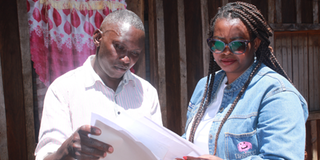
Faith Karambu, aka Faiza, with Daniel Kairithia, a gender-based violence survivor, on August 26, 2026.
After several attempts to get assistance from relatives and the mother could not bear fruits, she turned to odd jobs. In the midst of the struggle, she became a mother at the age of 15 and had her second born when she turned 17. She was married on paper at 16 and entered into a second marriage at 17.
“The father of my first child lived in Nairobi where I worked as a house girl. I had left Nairobi while pregnant and did not want anything to do with him. However, he tracked me to Meru and was on good terms with my mother. One day, he came with an Imam who officiated the signing of a marriage certificate. They did not care about my age; there were no witnesses.”
Also read: Early pregnancy, forced unions and violence: The hidden struggles of young mothers in Kibra
They entered a fake Muslim name she used while working as a house girl in Majengo, Nairobi. However, this marriage remained on paper, as she shortly after, in 2002, moved in with her late husband and father of the three her children. Faiza says when she met him, she had suffered rejection and neglect from parents.
“We met in Maua as I was selling fruits near his shop. He supported me in the business and showed that he cared about me. One thing led to another, I became pregnant and we moved in together against my mother’s wishes. He embraced me even though I had a child from my previous relationship,” she explains.
The mother of four and grandmother of one says she was born in 1985, but her national ID reads 1983 because of the events of 2002. “One day, my husband brought a government official to the shop where I worked. They filled out documents and I was asked to put my thumb print and sign. I did everything without questioning. I would later learn that he had applied for an ID for me without my knowledge,” she recounts.
Assault
Faiza would later learn that she had an ID when her husband was arrested for assaulting her and put on the spot for living with a minor. She says that while they already had a child together, this was the day they moved in together after sorting out their differences at the police station.
While their first year in marriage was blissful, Faiza says later, he turned violent. She was often battered and barred from interacting with other people. “He became violent and overprotective. I would be beaten up for going out of the house or for being greeted by male neighbours or anyone who knew me. I could not do anything or go anywhere without his instructions. I was like a slave even when on the streets.”
Unable to bear with the violence and isolation, they separated in 2005 before getting back together in 2007. Faiza says she could not make decisions over her body, having been married as a child. “My husband made decisions on when to get children and would often take me to the gynaecologist whenever I did not conceive. One time, I miscarried because of beatings and two months later, I had another pregnancy.”
She says that because she was a bright pupil, she could be far better in life if she concluded her education. In 2022, she was in the news after reporting back to primary school. She did not manage to write her KCPE examination because of a registration hitch.
Faiza had been involved in detergent-making business in Nairobi before she moved back to Meru, where she is a GBV activist. She says the community has yet to understand the impacts of child marriage as cases are remain rampant in Meru.
“Girls should pursue their education and dreams irrespective of how difficult it may be. Do everything you can to have an education and make money. Marriage can come at any point in life,” she advises.
Due to her experiences, she says she has had to be forthright in her counsel to children. “I use my life experiences and challenges to show them how cruel life can be. Whenever they want to make a decision, I show them that there are good and bad consequences for every move,” Faiza says.