Growing up in the shadow of violence: The lifelong impact of childhood trauma
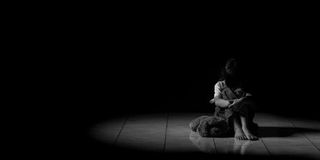
Many child survivors suffer from complex grief and post-traumatic stress.

What you need to know:
- Christine’s story sits within a much bigger conversation that recently played out on Facebook, when a post asking people to share their experiences growing up in dysfunctional families drew hundreds of comments.
- What followed was an outpouring of childhood trauma at the hands of parents users described as toxic and abusive, ranging from domestic violence to homes that became refuges for women and children fleeing danger in the middle of the night.
Christine* was in Form Two when her mother stopped waking up to get her ready for school. It wasn’t the first time her father had beaten her mother, but it was the first time the injuries kept her down the next morning.
“One time, my father attacked my mother while she was pregnant, leaving her with serious injuries. For the first time, the following morning, she was unable to wake up to prepare us for school,” says Christine, now 28.
For years, she watched her father punish her mother for things that were never her fault.


“Sometimes she would receive beatings simply because we failed to register good grades. At times it was because the rest of the family got home late, or because meals were delayed. The list went on and on.”
He would flog her mother with a belt, raining kicks and blows on her. Christine and her siblings would huddle together in a corner, hoping the violence would not reach them.
“Sometimes, out of pity, I would move to rescue my mother, but that would also expose me to physical assault.”
Despite the beatings, her mother still rose every morning to prepare Christine and her siblings for school, often trying to hide her injuries.
“After that incident, I could hardly concentrate in class for weeks. My biggest fear was losing my mother to the endless abuse,” Christine says.
In 2013, her mother was diagnosed with throat cancer. She died the following year, when Christine was still in Form Two. Two years later, having just sat her Kenya Certificate of Secondary Education, an 18-year-old Christine fell out with her father and fled home. She moved in temporarily with her best friend, then found a job at a bookshop, earning Sh5,000 a month.
“I was bitter at my father, who ended up remarrying barely a year after my mother’s burial. There are days I questioned why he did not die instead,” she says.
Two years on, her father reached out and offered to enroll her at university. She agreed on the condition that it be far from home. She has not returned since 2018, though she has seen her father a handful of times at family functions.
“I am yet to think about marriage despite turning 28 this year. I am still healing. If I am to get married, however, I never want to end up with a man like my father,” she says.
Now a mental health advocate, Christine says her siblings share the same wariness and are quick to end relationships at the first sign of violence.
Christine’s story sits within a much bigger conversation that recently played out on Facebook, when a post asking people to share their experiences growing up in dysfunctional families drew hundreds of comments. What followed was an outpouring of childhood trauma at the hands of parents users described as toxic and abusive, ranging from domestic violence to homes that became refuges for women and children fleeing danger in the middle of the night.
“I was in Form Two when hell broke loose at around 8pm. I embraced my younger brother and sister, trying to console them while I also battled tears. To date, I hate being shouted at or lied to. I do not think I will ever be the same again,” wrote one user.
“One time, my father physically assaulted my mother, who remained unconscious the entire night. In the morning, we had to pass her body, which lay motionless in the sitting room, and could not stop fighting the thought that maybe she was dead,” wrote another.
Others described cutting ties permanently with abusive parents, or staying quiet simply because they did not want to remember. One recalled a phrase that has never left them: their father, after assaulting their mother, sending the family out of the house with only the words, “Tokeni mfuate mama yenu.”
“This is why I constantly tell people to be kind to everyone. Look at the loads of pain people carry around, and yet we are still expected to be happy and okay,” wrote another user.
Some who joined the thread said they felt fortunate to have grown up in peaceful homes, while others offered words of comfort to those who had shared their pain, hoping they would find healing.
According to the World Health Organization, childhood and adolescence are critical periods for mental health as rapid brain development shapes the cognitive and social-emotional skills children carry into adulthood. The agency estimates that globally, eight per cent of children and 15 per cent of adolescents experience a mental disorder, yet most never seek help or receive care.
A 2023 study found that children with mental health challenges risk delays in age-appropriate development, which can affect their functioning and quality of life. Children exposed to constant conflict, aggression, abuse, neglect, domestic violence, or separation, whether through divorce or parents working long hours away from home, are more likely to develop behavioural and emotional struggles, the study found.
"Witnessing violence by one parent against the other affects children emotionally and psychologically. When they grow up, such children tend to use violence to resolve conflict, rather than communication," the study notes.
Kisumu-based psychologist Gloria Achieng says a family setting should be a safe place for young people, but often isn't. Children raised amid domestic conflict or neglect, she says, tend to struggle with expressing themselves, may become violent, or may constantly seek to be noticed, while others take on adult responsibilities to fill the gaps left by their parents.
At school, she says, such children may either excel, driven by a need for their parents' attention, or struggle to concentrate and perform poorly.
"Some children are likely to turn violent, because that is the only environment they know," says Achieng.
Without psychosocial support early on, she says, children carry that trauma into adulthood. Many become peacemakers out of fear of conflict, constantly seeking validation and trying to please those around them. Poor self-esteem and violent relationships are also common, she adds.
"There are those who will choose to completely avoid relationships as a precaution, while others will do everything possible not to end up in broken families like those of their parents," she says.
Healing, Achieng says, starts with accepting that help is needed, followed by forgiving the abusive parent and letting go of blame, before finally embracing growth. She adds that there is a need for greater awareness around childhood trauma, and for society to be trained on how to support those carrying it.
For Christine, therapy, though costly, has been the only way through. Years of ulcers, panic attacks, and a deep fear of relationships, she says, all trace back to the home she grew up in. She is still healing. But she is no longer silent about it.