Love beyond loss: Lamu widower defies tradition to honour late wife’s wish
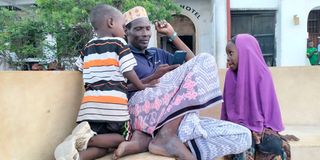
Isak Nyangu Jaldesa, 47, at Lamu Old Town's seafront, watches cartoons on the phone with his daughter, Sumeiya Isak, and son, Mohamed Isak, on March 16, 2026. Mr Jaldesa was widowed in 2024 and vowed never to remarry but raise his children single-handedly until they reach adulthood.

What you need to know:
- A grieving father in Lamu Old Town is defying cultural norms to honour his late wife’s final wish.
- After losing his wife to cancer, Isak Nyangu Jaldesa's promise is reshaping fatherhood and tradition in Kenya.
Isak Nyangu Jaldesa is walking along the seafront in Lamu Old Town, holding the hands of his two young children, one on each side. He looks weary but purposeful. He is wearing a kikoi loosely wrapped around his waist and a plain navy-blue polo shirt.
"I am looking for a place to purchase food for my children before the sun sets. They need to eat and sleep early," says Jaldesa, 47.
In February 2024, his wife, Fatuma Mohamed Omar, died of throat cancer. Two years on, Jaldesa is still navigating life after her death, alone, by choice, and determined to keep a promise he made to a dying woman.


The wife had one last wish: to raise the children alone until they reached adulthood before considering remarrying. Jaldesa has not wavered.
"I can't go against my wife's wishes. She told me to focus on raising the children alone until they reached adulthood. Fatuma was everything to me. We were married for seven years before her death. Our home was always peaceful," he says.
He describes the wife as loyal, respectful and down-to-earth, a woman who kept their home calm in ways he still misses.
"My wife was a supportive partner who prioritised our family, always communicating with kindness. That alone brought peace to our home rather than the usual dramas we see in many marriages today," he says.
Fatuma first fell ill in early 2022, complaining of a persistent sore throat and difficulty swallowing. Her voice became hoarse. A lump appeared on her neck. She had recurring ear pain and, eventually, unexplained weight loss. Jaldesa took her to hospitals in Kilifi and Mombasa, tried herbalists, and spent more than Sh600,000 trying to save her life.
"I just wanted to save my wife's life. I sold everything that we had as a family, provided she recovered. Unfortunately, she didn't make it," he says.
By the time they got a conclusive diagnosis, throat cancer was already at an advanced stage; it was too late.
When Fatuma died, their son, Mohamed Isak, was only eight months old, and their daughter, Sumeiya Isak, was two and a half. Today, Mohamed is over two and a half years old, and his sister is four and a half. Jaldesa says watching them grow gives him the strength to keep going.
"It's two years now, and here I am with my children. They are my only treasure in this world.”
Jaldesa hails from the Orma community, a pastoralist group primarily based in Tana River County. The community is deeply patriarchal, with traditional structures that place men in positions of authority and ownership. Widowed men are expected to remarry. Bathing children is considered a woman's duty. Jaldesa has done both and taken the laughter that came with it.
"I knew the laughter from my community members was a way of pushing me into giving marriage a second chance. But I vowed to keep Fatuma's spirit alive, ensuring that even though she is gone, her values, warmth and tenderness live on in our home," he says.
He has received pressure from elders, family members and neighbours to remarry. He has felt the weight of a community that does not easily make room for a man who chooses to raise his children. He has not moved.
"I've stood my ground to remain single as an acknowledgement that Fatuma's place can never be filled," he says.
To escape the pressure, Jaldesa relocated from his home village of Tarasaa in Tana River County to Lamu Old Town in February 2025, a year after Fatuma's death. He rents a house in Mkomani, where, on a typical evening, he and the children watch cartoons together on his mobile phone.
Livelihood
Before Fatuma died, Jaldesa worked as a meat dealer and supplier in Mariakani. That job required him to be away from home, which was no longer possible. He left it and has since been piecing together a living through casual labour in Lamu, ferrying cargo on handcarts, boat operations and tutoring.
On the days he works, he is up by 5am, well before the children wake.
"I cook tea, buy some snacks at a hotel and ensure we have an early breakfast together. I then wash and dress them before leaving them with my neighbour to go and look for a livelihood," he says.
He had hoped his mother would help, and for a while she did, particularly with his daughter. She died in February last year, leaving him entirely on his own.
"I have my extended family, but I can't trust them to raise my children. I am now both the dad and mother of these kids, and I don't complain," he says.
The days are long, and the challenges are real and daily.
"Getting children dressed, ensuring they are fed, all of that is my greatest challenge. You can imagine how hectic it will be when they start school. I will be having that extra duty of preparing them every morning.”
He is already teaching them, at their young ages, how to wash, dress and help around the house. He says he wishes he could afford to enrol them in a day-care or boarding school to give him more time to work.
On remarrying, he is categorical: not yet, and not for a long time.
"Meeting my goal means when these children reach 18 years and above. Maybe that's the time I will think about remarrying. But for now, every time I look at Sumeiya and Mohamed, they constantly remind me of the loss of my dear wife and her last wish. I will respect that wish first," he says.
He has also made a point of keeping Fatuma present in the children's lives, telling them about their mother regularly and allowing himself to grieve openly in front of them.
"I don't hide the fact that their mother was humble, hardworking and respectful. To instil that character in them, I have been telling them to grow up and be good, just like their mother," he says.
"I want them to know me as a loving dad full of sacrifices, respect and one who fulfils promises. Nothing else."
His neighbour, Khadija Adan, has watched all of this closely. She says Jaldesa is among the few men she has seen defy long-held tradition to raise their children alone while carrying the emotional weight of a spouse's absence.
She notes that in the Orma community, there is a strong belief that a man should move on and have his own life after the death of his wife, even when there are children left behind.
"They always push men like Jaldesa to remarry, arguing that the small children left behind might eventually grow up and leave, leaving the grieving father alone. But I am happy. Every time I have seen this man walking, he is always with the children by his side," she says.
Juma Boga, the Lamu County Children Services Coordinator at the State Department of Social Protection and Security, tells Nation that Jaldesa could qualify for the government's Cash Transfer Programme, Inua Jamii, once a new registration window opens. The programme currently focuses on citizens aged over 70, orphans and caregivers of persons with severe disabilities, providing a bimonthly stipend of Sh4,000, equivalent to Sh2,000 per month.
"That particular widower might end up becoming a beneficiary once a new registration window opens. His children are considered orphans now that one parent has died. He might automatically be enlisted as the caregiver," says Juma.
He also notes that Kenyan law gives the surviving biological parent priority in the care and custody of children upon the death of the other parent, adding that Fatuma's dying wish further cements Jaldesa's position.
"There is also the position of the court whenever there is something like a deceased having chosen someone else as caregiver. In this case, Jaldesa's wife wished that her husband be the custodian and caregiver of the children. May that wish be fulfilled," says Juma.
Concern about daughter
Andrew Masama, chairperson of the Kenya Psychological Counselling Association Lamu Branch, welcomes Jaldesa's commitment to his children but raises a concern about the girl.
"The first mentor of a girl is the mother, and for the boy, it is the father. Now that the mother is dead, it means the girl will be lacking a mentor even if the father provides everything," he says.
He does not insist on remarriage but urges Jaldesa to build a support system around the children, extended family, neighbours and religious communities, to provide care, emotional guidance and some financial relief.
Masama acknowledges that single parenting in Kenya has been rising steadily due to divorce, death and abandonment, and that the journey can become overwhelming.
"That is why I insist on single parents finding comfort and resilience through community strength. Counselling is also crucial to help one adapt to the public pressure, particularly the pressure around remarrying," he says.
For Jaldesa, the decision is made. Every morning, he wakes before his children do, cooks the tea, buys the snacks and gets them ready for the day. Every evening, he walks them to dinner before the sun sets. He is, without question, doing the work of both a father and a mother. He is doing it because he promised Fatuma he would.