Teacher who quit her job now exports medicinal herbs from Isiolo to Europe
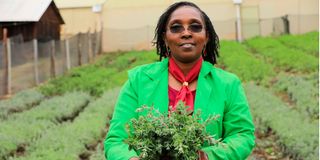
Lydia Wanja displays some of the medicinal herbs she grows at her Lidsam Farm in Isiolo on February 24, 2026. The former teacher exports her produce to the United Arab Emirates, France and Europe.

What you need to know:
- Former teacher Lydia Wanja quit the classroom in 2019 to grow medicinal herbs in Isiolo, one of Kenya's harshest farming environments.
- Today her Lidsam Farm exports to the UAE, France and Europe, and employs 20 women and trains others in the community to farm.
When Lydia Wanja quit teaching in 2019 after 15 years in the classroom, many of her colleagues and relatives thought she was making a mistake. Some even tried to persuade her to reconsider.
She did not.
Lydia had already made up her mind. She wanted something different. She planned to build a farming venture from scratch in Isiolo, one of Kenya’s toughest environments for agriculture, where the sun is harsh, rainfall is unreliable, and the land is slow to yield.


Seven years later, she runs Lidsam Farms, a climate-smart operation exporting medicinal herbs to the United Arab Emirates, France and Europe.
The contrast with the surrounding landscape is striking. While neighbouring plots are covered in dry thickets, Lydia’s greenhouses stand in neat rows, growing herbs rarely associated with farming in this arid region.
She drilled a borehole for irrigation and built a dam to harvest rainwater. The farm runs on greenhouse technology, drip irrigation and solar power to cope with erratic rainfall and extreme heat.
Today, she grows a wide variety of herbs, including basil, mint, chives, oregano, tarragon, lemon grass, thyme, sage and rosemary, as well as vegetables and fruits such as lettuce, tomatoes, coriander, avocados and watermelons.
The numbers reflect how far she has come. Each of her 10 greenhouses produces 120 kilograms of basil per season, giving her 1,200 kilograms in total. She sells at an average of three Euros, translating to about Sh540,000. Every month, she harvests about five tonnes of herbs.
"I farm on contract. The client tells me what he needs and in what quantity. I then farm, harvest, do the grading and put the produce in the cold room before a refrigerated truck takes it to the airport. I export to the United Arab Emirates, France and Europe," she says.
Prices vary depending on the season, the variety and the level of value addition, which includes dried herbs packaged in special packets.
Besides exports, Lydia also sells fresh and dried herbs to local pharmaceutical companies. She acknowledges that the local market has not fully embraced medicinal herbs, but says the situation is changing.
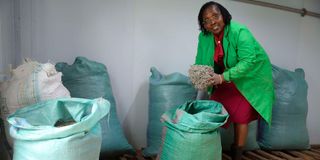
Lydia shows some of the dried medicinal herbs she produces.
Getting to this point was not easy. She started by selling through local exporters before eventually obtaining her own export licence. She is firm that anyone going into this line of farming must follow the guidelines set by the Kenya Plant Health Inspectorate Service, the clients and their agronomist.
"A farmer has to ensure that she follows all the guidelines as set out by the government through the Kenya Plant Health Inspectorate Service, the clients and the agronomist," she says.
Access to market remains her biggest headache. She has learnt the hard way that not every business partner can be trusted.
"Some exporters are not trustworthy. They refuse to pay and claim that the consignment was bad or substandard. This normally leads to unforeseen losses," she says.
But Lydia has not kept what she knows to herself. She runs training and awareness forums to encourage local communities, particularly women, to take up medicinal herbs farming. Every season, she buys herbs and avocados from the women she has trained, giving them a ready market. The farm employs about 20 women and offers free day-care for their children while they work.
"I buy the herbs and avocados from these women. The farm employs about 20 women, and we ensure they get their daily bread. We also offer free day-care services so that their children can be taken care of as they work," she says.
For Joyce Kinyua, a farmhand at Lidsam Farms, the opportunity has meant a great deal.
"As local women, we really appreciate that this farm has been our source of livelihood. In my case, I can get money to feed my grandchildren, which I really appreciate," she says.
Lydia is a beneficiary of the UAE Strategic Partnership Framework programme, through which the UN Women Kenya Programme supports women entrepreneurs with capacity-building in Gender-Responsive Procurement, Women's Empowerment Principles and access to finance and trade. She says the programme changed how she does business, particularly around e-procurement, a tool she did not know before.
"Before the training, I did not know anything about e-procurement. Through it, I learnt how to apply for tenders from different exporters. I can say that e-procurement has been a game-changer for me," she says.
The training also opened her eyes to digital marketing, she adds.
Antonia N'Gabala Sodonon, the UN Women Representative in Kenya, says the organisation is committed to women's economic empowerment as a path to gender equality and sustainable development.
"Gender-responsive procurement creates enabling ecosystems for women entrepreneurs and women-owned businesses to thrive, compete and drive economic development. The UAE-SPF programme provides much-needed momentum by expanding economic opportunities for women entrepreneurs in Kenya, including through making procurement policies and practices more gender-responsive," she says.
Despite her own success, Lydia is clear-eyed about the obstacles that women entrepreneurs still face. Communities that believe only men can run a successful business remain a real barrier, she says. She is calling for a special fund to provide grants for women interested in farming, as well as capacity-building and mentorship opportunities.
"Women still face community resistance from people who believe only men can start a farming venture or a business for it to succeed. Women are equal to the task, only that they face challenges like lack of capital," she says.
Her farm has a pack house, a drier and a cold room where herbs are stored before being transported to the airport.
Asked whether farming pays, she does not hesitate.
"Yes, farming pays very well, and it has money. I encourage women and youth to venture into it," she says.


