The irony of Kenya’s teaching workforce: Women are the majority, but men dominate leadership
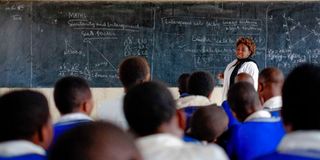
A new audit by the National Gender and Equality Commission shows that women account for 50.2 per cent of teachers employed by the Teachers Service Commission.

What you need to know:
- A new NGEC audit reveals that while women form the majority of Kenya's public teaching workforce, men continue to dominate school leadership positions.
- The report highlights persistent gender disparities in education leadership and urges mentorship and career development to help more women become school heads.
Women make up the majority of Kenya’s public teaching workforce. But when it comes to leading schools and teacher training colleges, men hold most of the top positions.
A new audit by the National Gender and Equality Commission (NGEC) shows that women account for 50.2 per cent of teachers employed by the Teachers Service Commission (TSC). Yet, of the 28,925 heads of educational institutions, only 27 per cent are women, while men hold the larger share at 73 per cent.
The findings are contained in the Status of Equality and Inclusion in the Teaching Workforce in Kenya (2025) report, released on July 29, 2026. The audit examined 425,613 teachers employed by TSC as of June 2025 and deployed across 34,630 public educational institutions, including primary schools, junior schools, secondary schools and teacher training colleges.


The figures reveal a persistent disconnect between women’s representation in the teaching profession and their presence in leadership. In primary schools, women account for about 55 per cent of teachers. Yet, of the 21,064 primary school heads, only 5,091 are women, representing just 24.2 per cent.
The gap is narrower in secondary schools. Women make up 43.2 per cent of the 128,960 teachers employed at this level. However, they account for only 33.7 per cent of the 7,817 school heads. Teacher training colleges come closest to achieving gender balance in leadership. Women account for 44 per cent of the 1,257 tutors, while 46 per cent of the 37 college heads are women.
TSC Acting Chief Executive Officer(CEO) Evaleen Mitei said the gender gap in leadership is influenced by several factors, including the number of single-sex schools, the location of vacancies and teachers’ willingness to accept postings away from major towns. “The number of schools which are exclusively male or female is the number one determinant,” she said.
She said girls’ schools are headed by women because of the nature of the role and the responsibilities expected of principals. “You can’t take a male to Alliance Girls. The head must be a female,” she said.
She explained that principals are expected to be actively involved in students’ welfare and safety, including accessing dormitories and other spaces within schools. This, she said, informs the deployment of principals of the respective gender in single-sex institutions.
“Even boys, we need the principal to walk into the boys’ dormitories, to go to the toilets, to go to the ablution block and check and see that the school is safe,” she said. “You must be accountable.”
While an official public record of the number of boys’ and girls’ schools in the country is unavailable, a recent Usawa Agenda report found that most senior schools in Kenya are mixed, accounting for 76 per cent. Girls’ schools make up 14 per cent, while boys’ schools account for nine per cent.
The Acting CEO noted that the location of leadership vacancies also affects the number of women who take up senior positions. Although TSC advertises vacancies and provides equal opportunities to qualified candidates, she said more men than women often apply for leadership positions.
She said men are often more willing to accept postings in remote areas than women. While women choose to remain in towns because of family responsibilities and other personal circumstances, she said. “Some teachers have health concerns or are undergoing treatment that makes relocation difficult,” she said.
She said TSC applies constitutional principles on equality and inclusion during recruitment and selection. “When we go for recruitment or selection, we ensure that all those principles set out in the Constitution and Article 232, giving marginalised groups the opportunity, giving the youth the opportunity and attaining gender parity, are considered,” she said.
However, she acknowledged that the commission faces difficulties in increasing the number of women from marginalised communities who qualify for and take up leadership positions. “Traditional marginalisation has even eaten into us, such that getting the women with the requisite qualifications from the marginalised areas is a challenge,” she said.
NGEC recommends that the TSC continue providing leadership mentorship and career development opportunities to support more female teachers in advancing to senior leadership positions.