Turning pollution into products: Nzambi Matee’s circular economy innovation
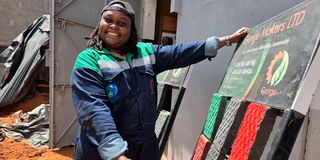
Nzambi Matee, founder of Gjenge Makers, at the company’s manufacturing plant in Nairobi on April 30, 2026.

What you need to know:
- Despite global recognition, Kenya’s circular economy innovators struggle to secure capital needed to scale and achieve profitability sustainably.
- Nzambi Matee’s journey highlights funding gaps, gender disparities and systemic barriers facing women entrepreneurs in manufacturing innovation sector.
When Nzambi Matee walked away from her job at Kenya’s National Oil Corporation in 2016, her family thought she had lost her mind. “Tell me, if people don’t quit their jobs in oil and gas to start dealing with plastic waste, that is the true blueprint of someone going mad,” she says, laughing at the memory.
Nzambi had been working in upstream oil data analysis, applying the physics she had studied at university. It was a secure, well‑paying job in one of the most lucrative industries in the world. But something was missing.
“My heart wasn’t in it. The passion, the desire; it was missing. I felt like something was lacking,” she says, punching her right hand into her left to emphasise just how deeply she longed to do what she truly wanted.


What she wanted was not merely to get by – doing an office job just to survive – but to leave a mark, a legacy characterised by strong conviction, much like the late Nobel laureateWangari Maathai.Using her background in physics, she ventured into innovation within the circular economy, tackling a pressing environmental and climate challenge: plastic pollution. Piles of plastic waste, when burned, release climate-warming greenhouse gases such as methane and ethylene.
In simple terms, a circular economy is about turning waste into value and keeping materials in use for as long as possible, instead of discarding them.She wanted to make construction materials from recycled plastic waste. And so she began collecting discarded plastics, storing them in her mother’s backyard in Nairobi, and experimenting with turning them into construction paver blocks.
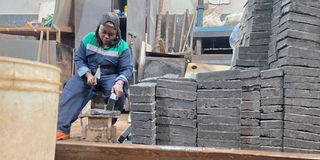
Nzambi at work - making paver blocks at the company’s manufacturing plant in Nairobi on April 30, 2026.
“My uncles and aunties told my mom, ‘Your child has gone loose.’ Even my mother asked me, ‘Are you sure you’re okay?’ But I told her, there is a method to the madness. You might not understand it now, but in time you will see.”
While some studies indicate that women make up roughly 60 per cent of Kenya’s informal waste workforce, many earning less than $2, concrete data on women engineers and innovators in the circular economy remains scarce.
Take Nzambi Matee. A materials engineer with a degree in Physics (Pure and Applied) from the Jomo Kenyatta University of Agriculture and Technology. Existing data largely captures women as informal recyclers, not as scientists, engineers, and entrepreneurs driving innovation in the sector.
The love for Physics
Born and raised in Nairobi, Nzambi represents the minds behind products made from recycled waste, solutions that transform materials that would otherwise harm communities.Her interest in science began early. Drawn to physics despite struggling with biology, she recalls: “My biology teacher used to tell me, ‘just do your physics homework,’ because biology was hopeless for me.”
When she joinedcampus in 2011, she was one of only 12 women in a class of 52, a reality she says has since begun to shift as more girls pursue engineering.The latest available data from the Global Gender Gap Report 2024 shows that in Kenya, women accounted for just 19.46 per cent of graduates in engineering, manufacturing, and construction.
For Nzambi, however, her love for physics made the path clear: She knew that was where she belonged.“I was so sure about physics,” she says. “It’s the mother of engineering. I wanted to understand the fundamentals.”
While her family thought she needed a psychiatric assessment at a mental facility such as Mathare Hospital, Nzambi was deep in geophysical calculations, pushing her mind to its limits.
Her mother’s backyard became her laboratory. There, she took her first steps, building machines from scrap metal, before progressing to producing one or two paver blocks each day. She then moved to the next phase: walking from one construction site to another, seeking feedback from contractors and site engineers on her early prototype(a mix of sand and recycled plastic).
Even when some dismissed her, treating her efforts as a joke, she did not give up. She understood rejection was part of the process and refused to let it stand in her way. For the next nine months, she kept returning to construction sites, asking engineers to test her paver blocks.
The nine months
The kinder ones had something to tell her.“They would say, ‘No, change this, do this, do that.’ Every day I would take plastic, process it, make one or two paver blocks, and go to construction sites,” she says.“After nine months, several contractors told me, ‘You’re onto something.’ It was like a pregnancy; nine months later, I had my eureka moment.”
But scaling up required machinery, which required money. She drafted a business plan, secured letters of interest from contractors, and approached banks. Every single one said no.
“Banks are not in the business of funding innovation,” she reflects. “They are in the business of selling money.”
At her lowest point in 2017, she applied to the Watson Institute, an incubation programme focused on social entrepreneurship. To her surprise, she was accepted and spent a year there, from January to December 2018. At Watson, in collaboration with the University of Colorado, she gained access to advanced labs and mentors.“I felt like I had landed in heaven,” she recalls.
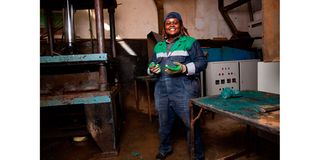
Nzambi at the moulding press in Gjenge makers company in Nairobi's industrial area.
She refined her paver block design, built prototypes of new machinery, and secured seed capital from the institute.Although she registered her company, Gjenge Makers, in November 2016, it was only in 2019 that it began to gain traction, courtesy of the seed capital.
She hired a team of four and built machines capable of producing hundreds a day. “I moved from producing 10 to producing 500 in a day. I was so happy. It was so nice,” she says.
Covid-19 and turning point
Then Covid-19 struck. She had just launched her product in March 2020 when Kenya went into lockdown.Ironically, the pandemic became a turning point. Competitors reliant on imported machinery collapsed when supply chains froze. Gjenge survived because its machines were locally built and easily serviced.
With people stuck at home, demand for renovations surged. Gjenge pivoted to online sales and began supplying paver blocks for home projects.
The struggle for capital
Despite progress, breaking even has been a long, grinding struggle. Expansion requires patient capital [long‑term, low‑interest financing], but Kenya’s financial system is not designed to support manufacturing innovation, she says.
“We need cheap patient capital,” she insists. “That’s what boosted China’s manufacturing industry. Here, if you get a loan, by the time you’ve set up the machine and tested it, they’re already asking for repayment.”
Government institutions have also failed to step in, she says. “If there’s anyone who has the muscle to take us from this level to being bankable, it’s the government. But if they’re not going in this space, then who is?” she asks.
Impact investors, meanwhile, shy away from capital expenditure, she says. “They say we don’t invest in machinery. But without machinery, I can’t scale. It’s a Catch‑22.”
Her testimony reflects the funding realities faced by women innovators. A 2024 Kenya Innovation Outlook by the Kenya National Innovation Agency, a state corporation, highlights this challenge, showing that women-led startups secured only 12 per cent of total funding between 2019 and 2023.
While the report advocates for more inclusive innovation systems, Nzambi’s experience suggests that government agencies are still falling short in supporting women innovators.
Building machines from scratch
Part of her company’s uniqueness lies in its machines, which Nzambi designed herself with the help of engineers and a mentor. “I see machines in my head,” she says. “I run simulations in my mind. I draw sketches, even though I’m not good at drawing. Then we build prototypes, test them, iterate, break them down, and rebuild.”
Her machines are designed to handle the abrasive mix of plastic and sand, a process similar to extrusion but modified for construction materials.
Undeterred determination
From 2020 to 2023, she focused on proof of concept, testing her product in the market, refining processes, and building customer trust. “In manufacturing, you don’t just wake up and start growing. There are stages: prototyping, proof of concept, and then commercialisation.”
The company is now ready for commercialisation: mass production at scale. But that, she says, requires hundreds of millions in investment. Without it, operations remain small-scale, limiting their ability to meet growing demand.
Currently, she employs 30 full-time workers and about 250 others on temporary contracts, especially during projects involving the installation of paver blocks. With the right machinery, capable of producing more than 500 units in a single shift, the company could meet demand more efficiently and create more jobs.
At present, production runs 24 hours a day in three shifts. “The demand is not the problem,” she says. “The problem is supply. If we had the capital to scale, we could create jobs, reduce waste, and build affordable housing materials. But without it, we crawl.”
After nearly a decade of persistence, Nzambi has distilled her frustrations into three demands. “We need cheap, patient capital,” she says. “Loans with long moratoriums and low interest rates, the kind that gives manufacturing room to breathe.”
Her second task is to make serious investment in research and development (R&D) grants. She says, “R&D is the seed that shifts us from being a consumer market to a productive one. But here, no one finances R&D. To financiers, it looks like a waste of money. They don’t understand that it’s the genesis of everything.”
Finally, she calls on government institutions to rethink how they invest in innovative ventures, noting that “the state needs to support local machinery and innovation that doesn’t fit neatly into existing categories”.
Despite the obstacles, she remains undeterred. Still, she continues at her own pace, expanding slowly with the resources she can muster. “I will expand at my own pace using my own resources,” she says. “It will take more time than if provided with credit, but we will get there.”