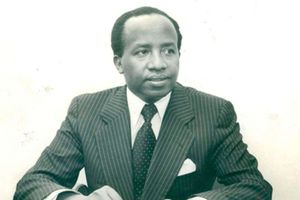
Retired journalist George Githii, who died on November 7, 2025 at the age of 89.

The death of George Githii in Canada on 7 November 2025 closed a vital chapter in Kenya’s journalistic history. To those who worked under him at the Nation newspaper, he was more than an editor-in-chief.
He was an institution—a force of nature who combined intellect, defiance, and discipline to define what political reporting meant in post-independence Kenya. He could be charming or ferocious, unpredictable or avuncular, but above all, he was the journalist’s editor: a leader who inspired, provoked, and protected his reporters while setting the profession’s moral compass.
His career spanned Kenya’s most turbulent years. He believed, with missionary conviction, that the press answered not to the State but to the public. When other editors trimmed their sails to the prevailing political wind, Githii stood firm. The image endures: the elegant man in a bow tie—urbane, witty, yet unafraid to cross swords with power. To his critics, he was “the mad man”; to his newsroom, he was simply “GG”.
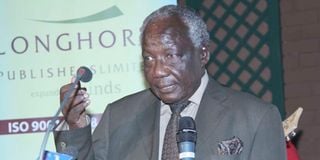
Philip Ochieng during the launch of his biography written by Liz Gitonga-Wanjohi at The Stanley on August 21, 2015.
He had an uncanny eye for talent. Githii could spot a promising journalist before the journalist spotted himself. Many of Kenya’s finest writers passed through his newsroom: Philip Ochieng, whom he lured from the late 1960s into a column that dissected the young republic’s foibles; Julius Njoroge, recruited from the Kenya News Agency and later promoted to group managing editor at the Standard. “GG was my mentor,” Njoroge recalled. “He recruited me, trained me, and gave me the confidence to lead. I use the communication skills he taught me to this day.”
Assistant editor
I, too, was a beneficiary. In the early 1970s, while lecturing at the University of Nairobi’s School of Journalism, I received an unexpected offer from Githii to join the Sunday Nation as assistant editor. I had no newsroom experience, but that did not deter him. He valued curiosity, not credentials.
He also prized balance. My first encounter with him came in 1967, during a student strike. He turned up on campus alone—no driver, no entourage—and spoke quietly with students before writing an editorial that captured their grievances and the government’s excesses with equal precision. Years later, when I joined the paper, he drilled that same discipline into me. During the Arab-Israeli war, he asked me for an editorial on the conflict. I wrote passionately for the Arab cause. He read it, smiled, and said: “With the same eloquence that you’ve used to put the case for the Arabs, put the case for the Israelis.” That lesson in fairness stayed with me for life.
He could be eccentric. One morning, I found him composing an editorial with two boiled eggs and a bottle of Pilsner beside his Olivetti typewriter. “It clears my head,” he explained—though I never saw that breakfast again. He was disarmingly humble. When I married, he came to the reception and insisted on washing glasses in the kitchen. Hierarchy meant little to him.
Yet behind the affability was a steely protector of his reporters. In 1974, after my investigation into corruption at the Central Government Medical Stores (now KEMSA) led to a senior official’s conviction, police arrested me for questioning. Three days later, I was released to find Githii’s driver waiting to take me home. I later learned that he had intervened personally with President Jomo Kenyatta to secure my freedom. He never bragged about it.
Courage defined him. He had once served as Kenyatta’s personal assistant and knew power’s psychology intimately. But that never blunted his independence. In 1967 he was caught drafting an obituary for the still-living president, who was recovering from a heart attack. When the Attorney-General, Charles Njonjo, alerted Kenyatta, Githii was “properly reprimanded and intimidated following orders from above.” But, sure in the knowledge he was doing what is standard practice in journalism, he remained undeterred.
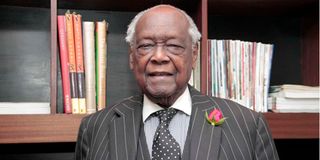
Former Attorney General Charles Njonjo during an interview at his Westlands office on May 15, 2015. He died on January 2, 2022.
After disagreement with the ‘Nation’ board, he crossed over to The Standard, where he continued to cause waves. In an editorial in July 1982, he severely criticised the government of President Daniel arap Moi and its increasing intimidation of the press and the detention of individuals without trial. He was dismissed from his position as editor shortly after the editorial was published due to the controversy it caused. “For governments that fear newspapers, there is one consolation. We have known many instances where governments have taken over newspapers, but we have not known a single incident in which a newspaper has taken over a government,” he said in the editorial. The line became his most famous declaration, a touchstone for Kenya’s press freedom.
Success
Politicians hated him, which was proof enough of his success. “George Githii may be one of the most disloyal Kenyan personalities we have in responsible positions today,” thundered MP Maina Wanjigi in 1973. But Githii was loyal only to truth. Despite being newly appointed to The Standard, the famous editorial denounced touched on the most sensitive issue at the time— detentions without trial and “fear and insecurity in the body politic”.
Vice-President Mwai Kibaki called the article destabilising; Njonjo branded it “diabolical”. And within months, following the August 1, 1982, coup attempt— a failed attempt to overthrow Moi's government— he left for exile—first to Vienna in Austria to take up a communication job with the International Atomic Energy Agency, later to Ottawa in Canada.
Legend has it he carried a pistol. His nephew, Ciugu Mwagiru, recalled: “He was a fighter. People remember him as a guy with a gun in his coat pocket.” The weapon was less machismo than insurance. As former Nation editor Gerry Loughran wrote, after Githii had been arrested for preparing Kenyatta’s premature obituary, he decided never again to be caught unprepared. Those who knew him well, like I did, saw not a gunman but a gentleman—articulate, dapper, and deeply courteous.
Exile changed him. In Canada, he became a street preacher, returning to the faith of his father, a Presbyterian minister. “He quit alcohol nearly four decades ago,” said his nephew. “He became a deeply religious man.” The combative editor had found a different pulpit.
To place him in context is to recall Hilary Ng’weno, his predecessor at the Nation and the paper’s first African editor. Ng’weno built the intellectual foundations of Kenyan journalism; Githii built its muscle. One supplied analysis, the other defiance. Together, they gave the post-colonial Press both a conscience and a spine.
When news of his death broke, Joseph Odindo, a later editorial director of Nation Media Group, rightly called him “one of the most consequential journalists to have led a Kenyan media stable”. Githii, he said, “resisted the abuse of power by Kenyatta’s courtiers, stood up against detention without trial by Moi, and defended media freedom even from proprietor interference.”
That judgment and then some stands. George Githii taught his reporters that journalism was not a job but a public trust, a vocation worth its risks. He proved that an editor could lose his post, his country, and his comfort, yet still keep his integrity. His voice is silent now, but the courage it embodied echoes in every Kenyan newsroom that still dares to speak truth to power. Rest in power, George Githii, in the enduring belief that a free press remains essential to a healthy democracy.
The author is a former Public Editor with the Daily Nation