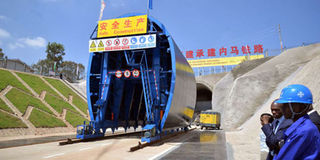
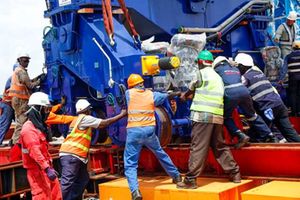
The government has suffered a setback after the High Court dismissed an application seeking to lift orders halting construction of the Sh12 billion Ngong–Riruta commuter railway over alleged diversion of Standard Gauge Railway levy funds to the metre-gauge project.
The court ruled that the State had failed to prove it would suffer substantial loss if the conservatory orders suspending the project remained in force pending appeal.
The judge said the orders issued on March 19 were preservatory in nature and included directives requiring disclosure of project documents within 30 days, a timeline that had already lapsed.
“Without the evidence of substantial loss, it would be of no reason to stay an order,” the court ruled, dismissing the application filed by Kenya Railways Corporation and the National Assembly.
The Milimani Law Courts in Nairobi.
Photo credit: File | Nation Media Group
The court found that allowing the case to expeditiously proceed to final determination without delay would better serve the interests of justice than suspending the conservatory orders.
“In my view the interest of justice will be served in conclusion of this matter without a delay,” the court said.
The ruling means construction of the 12.5-kilometre railway linking Riruta township in Nairobi and Ngong in Kajiado will remain suspended as the constitutional petition challenging its financing proceeds to full hearing.
The heart of the legal dispute is whether money collected from taxpayers in form of Railway Development Levy Fund can lawfully be used to finance a metre-gauge railway project despite the law restricting the fund to Standard Gauge Railway (SGR) projects.
Kenya Railways, the National Assembly and the Attorney-General had asked the court to suspend the March ruling, arguing that the stoppage had exposed the government to massive financial losses and disrupted contractual obligations.
The State told the court the project was about 40.5 per cent complete and that more than Sh4 billion had already been spent.
Lawyers representing Kenya Railways argued that continued suspension risked rendering the intended appeal useless because contractors had already demobilised and works had stalled.
They said the country risked losing billions of shillings already invested in the commuter railway if the stoppage persisted.
The corporation also warned that over 600 workers faced job losses and argued that disclosure of procurement records and financing agreements would breach confidentiality provisions and expose commercially sensitive information.
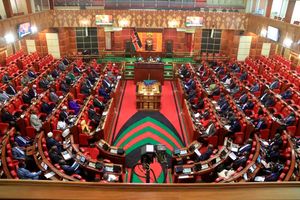
The National Assembly backed the application, saying recent amendments to the Railway Development Levy Fund law had overtaken the dispute.
It told the court the amended law now permits use of the levy for broader railway infrastructure projects, including metre-gauge lines such as the Ngong–Riruta railway.
The attorney-general also supported the application and argued that the court should consider the amended legal framework in deciding whether to suspend the orders.
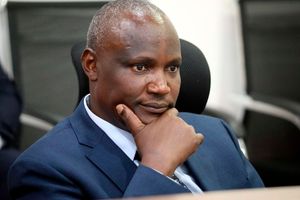
But the petitioners, Busia Senator Okiya Omtatah and rights advocate Bernard Muchere, opposed the application, saying the State was attempting to re-litigate issues already determined by the court.
Senator Okiya Omtatah at the Supreme Court on September 2, 2022.
Photo credit: File | Nation Media Group
Mr Omtatah argued that the dispute was rooted in constitutional safeguards governing public finance and could not be cured retrospectively through legislative amendments.
He maintained that the State had failed to meet the legal threshold required to justify a stay of conservatory orders.
The court agreed with the petitioners and rejected claims that continuation of the suspension would cause catastrophic harm.
“It had been argued that without stay the nature of the contract will be affected and workers will be prejudiced, but I am not persuaded that this is the case,” the judge ruled.
“The project has been on hold for two months and one more month to conclude this case is unlikely to be catastrophic.”
The court further noted that when issuing the conservatory orders in March, it had already cautioned that the findings were made on a prima facie basis and did not amount to a final determination of the dispute.
It also reminded parties that judgment in the constitutional petition is expected within 90 days from March 19, placing the anticipated decision around June 17.
The dispute centres on whether billions of shillings collected through the Railway Development Levy Fund can legally finance a metre-gauge commuter railway despite earlier law restricting the fund to Standard Gauge Railway projects.
The petitioners argue that using the levy for the Ngong–Riruta project amounts to unlawful diversion of public funds and breaches constitutional safeguards on public finance management.
In the March ruling, the court halted construction and ordered Kenya Railways to disclose feasibility studies, procurement documents and financing agreements linked to the project.
The court said the petition had raised serious constitutional and legal questions, including alleged procurement irregularities, lack of adequate public participation and possible misuse of public funds.
It had warned that continued spending on the project risked irreversible dissipation of public funds before the legality of the financing structure was determined.
The commuter railway project was commissioned by President William Ruto in December 2023, with construction beginning in early 2024.