Fresh questions have emerged following the murder of another patient at Kenyatta National Hospital (KNH), five months after the hospital management assured the public of heightened security at the giant referral facility.
Details have revealed how detectives from the Directorate of Criminal Investigations (DCI) were forced to manually piece together clues with no CCTV footage to review what transpired in Ward 7B on Thursday, putting the facility under further scrutiny.
This latest murder of Edward Maingi Ndegwa, in the same facility where Gilbert Kinyua was brutally murdered in February 2025, has raised more questions than answers about the stringent security measures that were promised, including to MPs who toured the facility.
After the February 7, 2025, murder of 39-year-old Gilbert Kinyua, whose throat was also slit at KNH Ward 7C, the hospital’s management announced that security at the hospital had been beefed up with more security personnel, increased surveillance around the wards, and a promise to enhance CCTV coverage at the hospital.
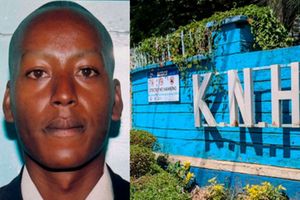
The late Gilbert Kinyua, who was tragically murdered in his hospital bed at Kenyatta National Hospital (right).
Photo credit: Bonface Bogita | Nation Media Group
Five months down the line, the hospital is yet to fully comply with some of the security measures it promised to implement.
Detectives also failed to conclude the investigations over the February murder, with no suspect arrested.
In the latest case of Ndegwa, a probe by the Crime Scene Investigations Unit revealed that slippers found under the bed of Mr Kennedy Kalombotole, also a patient, had bloodstains. He was subsequently arrested as a suspect.
A red pair of slippers with blood spots and forensic investigations of the footprints in Ward 7B at Kenyatta National Hospital led DCI investigators to the arrest of Mr Kalombotole, a patient who is now in police custody for murder at the referral hospital.
But the similarities of the crimes — a patient in Ward 7, a knife suspected to be in the hands of another patient, a slit neck, and a person of interest who has been in the hospital for a long time — have raised hard questions.
Another critical question is why Mr Kalombotole, if in fact he was a person of interest in Kinyua’s murder as police now say, was allowed to stay in the same hospital — and at the same crime scene — after the first killing.
KNH, in a statement by Dr William Sigilai, said Mr Kalombotole had been a long-term patient who had first been admitted in November 2022 into its Intensive Care Unit before being discharged to the general ward.
“Being a homeless person with no known relatives nor proven identity, he stayed on in the hospital even as the hospital made several attempts to identify him through fingerprint identification and also through our social media pages,” Dr Sigilai said in a statement.
In June 2024, the hospital said he secured a home where he was taken, before being returned to KNH in December last year after he fell sick. He stayed on after the home that had previously hosted him refused to take him back.
“Following the death of patient Gilbert Kinyua, the DCI flagged the suspect as a person of interest and they then advised the hospital to hold him pending the conclusion of their investigations. The hospital is awaiting the outcome of the previous incident,” Dr Sigilai said, blaming the DCI for not communicating its way forward.
The hospital added: “We emphasise that the suspect had been discharged, and the hospital did not intend or desire to host him indefinitely.
However, in the absence of alternative options and pending direction from investigative agencies, we had no choice but to continue with his stay in the hospital.”
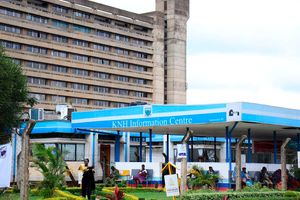
The Kenyatta National Hospital in Nairobi, where 15 teachers received treatment under SHA.
Photo credit: Bonface Bogita | Nation Media Group
Friday’s statement by DCI boss Mohamed Amin, for the first time, revealed that Mr Kalombotole had been identified as a suspect in Kinyua’s murder when it named him as one in that of Ndegwa.
The Office of the Director of Public Prosecutions (ODPP), however, ordered more investigations.
“Following the incident, a case file was compiled and submitted to the ODPP. However, after reviewing the file, the ODPP directed the Investigating Officer to undertake further inquiries to reinforce the prosecution’s case,” the DCI said, adding that Mr Kalombotole was still in custody, undergoing processing pending arraignment.
On Friday, DCI boss Mr Amin, in a post on social media, said Kalombotole, who was arrested by homicide detectives, is also suspected to have been involved in the murder of Mr Gilbert Kinyua, which happened in Ward 7C of KNH in February 2025, according to DCI investigations.
Mr Amin said his officers are putting together the evidence as they investigate the motive behind the killings and whether the suspect was acting alone.
In addition, directly on the ground below the seventh floor, where the window to the deceased's ward is located, detectives allegedly recovered a knife wrapped in gloves.
The recovered items were forwarded to the National Forensic Laboratory for detailed analysis to augment the case.
The KNH management said it was working closely with law enforcement authorities and has since launched an internal investigation to determine the facts surrounding the incident.
According to the DCI, Mr Kalombotole will remain in custody as they prepare to take him to court.
In the case of Gilbert Kinyua, who was brutally murdered inside Ward 7B on February 24 this year, his lifeless body was also found lying on his bed with a slit neck.
Kinyua had been admitted to KNH on December 11, 2024, due to a cerebral disorder. Just days short of a month later, his body lay in a pool of blood in a hospital ward—an unlikely murder scene.
In the ward where Kinyua was admitted, another patient was seeking treatment for the same condition. The patient was weak and could not explain anything about what transpired before and after the bizarre incident was reported.
On arrival at the scene, detectives recovered a bloodstained kitchen knife that had been thrown onto the ground floor through the window near where Kinyua had been killed. They are seeking answers as to who committed the murder.
The detectives were at the crime scene attempting a reconstruction as they retrieved CCTV footage from the areas surrounding the ward. There was little evidence recovered by the time of publishing this story.
Tragic death of a patient
Patients in the neighbouring wards, as well as the hospital's management and the family of the deceased, have been interrogated.
As part of the probe, KNH then detailed that the facility is cooperating with law enforcement authorities and has since launched an internal investigation to determine the facts surrounding the incident.
"We are deeply saddened to confirm an incident involving the tragic death of a patient at Kenyatta National Hospital. Our thoughts and prayers are with the patient’s family during this difficult time. The hospital is working closely with law enforcement authorities and has since launched an internal investigation to determine the facts surrounding the incident," read the statement.
In 2016, then KNH top management officials shocked Parliament when they revealed that KNH did not have CCTV cameras that would have helped unravel the murder of cancer patient Cosmas Mutunga, 42, who was murdered on his hospital bed in November 2015. He was found dead with stab wounds and one of his eyes gouged out.
When the top officials appeared before a parliamentary committee to shed light on the matter, the then CEO Lily Koros, defended the hospital from allegations of negligence following the murder of Mutunga.
Koros told the Health Committee that KNH had not received the final report of investigations that were conducted by the Directorate of Criminal Investigations (DCI), 10 months after the mysterious killing.
Ms Koros, who was accompanied by KNH’s Chief Security and Safety Services Officer Reverend Manasseh Mugwang’a, was hard-pressed to make public a report on the hospital’s own internal investigations into the killing of Mutunga.
Mutunga was admitted to the hospital’s Ward 8C on November 8, 2015 and was found dead in the night with stab wounds and one of his eyes gouged out. He was with an incapacitated and deaf cancer patient at the time he was killed.
Three nurses were on duty on the night of the brutal murder. Ms Koros said the hospital had only received a preliminary report from the DCI at Kilimani Police Station, indicating that the department was still waiting for directions from the Director of Public Prosecutions, who had been given the file for review.
The committee was hearing a public petition filed in Parliament by Mwingi North MP John Munuve on behalf of Mutunga’s family.
The family is seeking compensation from Kenyatta National Hospital, arguing that they are not interested in the criminal aspect of their kin’s murder. MPs hit out at the hospital management for failing to investigate the killing and bring the perpetrators to book.
Ms Koros refused to admit that the hospital was liable in the absence of a conclusive report from the DCI. MPs reacted sharply to Ms Koros’ revelation that no action had been taken against the nurses or the security officers on duty that night.
“We have no CCTV in KNH. An attempt was made to install them at the lifts area but the project is incomplete. There was no CCTV on the eighth floor,” she told MPs in the presence of the late Mutunga’s wife, children and other relatives.
The committee directed Ms Koros to provide the internal probe report for scrutiny. The team also resolved to summon the KNH board to appear before it to shed light on Mutunga’s death, the investigations, and possible compensation.